
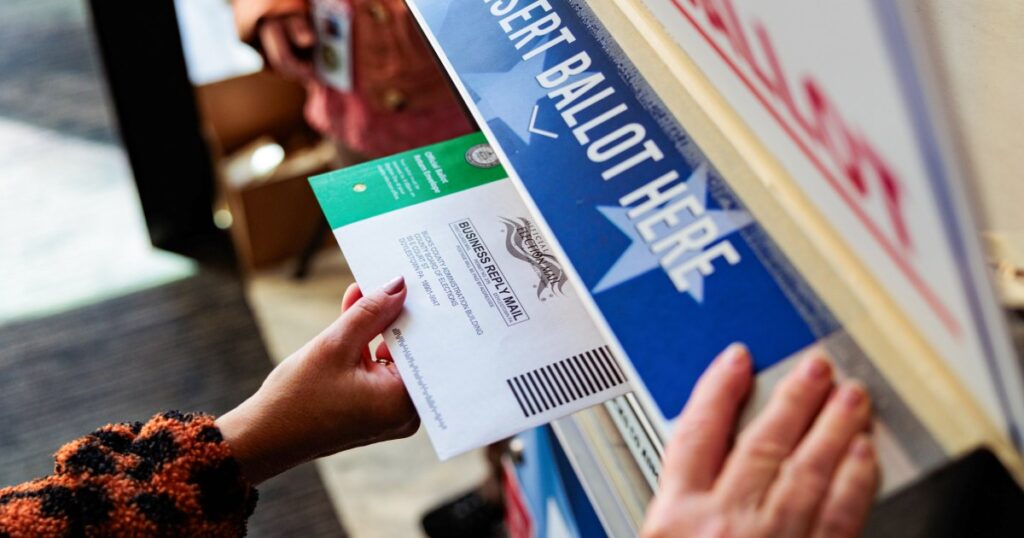
WASHINGTON — Conservative Supreme Court justices on Monday questioned whether states should be allowed to count ballots that are mailed on time but arrive after Election Day.
The nine justices heard more than two hours of arguments as President Donald Trump has ramped up his opposition to mail-in voting and urged Congress to ban it in most cases.
The court is considering a Mississippi law, similar to measures in 13 other states, that allow for mail-in ballots to be counted as long as they are postmarked by Election Day. The case could have implications for the midterm elections this November, when voters will decide which party controls the House and Senate.

FORSUBSCRIBERS
02:01
NBC News poll shows Democrats with slight lead as midterms begin
00:0000:00
Based on the oral arguments, the court is closely divided on whether a federal law that sets election dates prevents ballots from being received after that day. Some justices also questioned whether a ruling placing limits on late-arriving ballots would also raise questions about the legality of early voting.
California, New York and Texas are among the states with comparable laws to Mississippi’s. Eligibility for mail-in ballots differs among those states, with Mississippi limiting it to a list that includes elderly and disabled people.
If the court were to strike down the Mississippi statute, it would upend election rules in the affected states, as well as potentially for people who live overseas, including members of the military. In total, 29 states allow extended deadlines for voters abroad and the military, according to a brief filed by former national security officials.
While the Constitution gives states a major role in overseeing elections, the legal question revolves around the federal law that sets Election Day as the Tuesday after the first Monday in November.
Four Republican states have recently changed their laws to bar the counting of late-arriving ballots. Trump has complained, without evidence, that the mailing of ballots allows for elections to be “rigged.” The Trump administration filed a brief backing the challenge to Mississippi’s law.
Justice Samuel Alito, one of the six conservatives on the court, echoed some of Trump’s concerns that late-arriving ballots can give an appearance of fraud by radically changing the trajectory of an election as votes are counted.
He asked whether the court should take into account Congress’ decision to set an election date “for the purpose of combating fraud or the appearance of fraud” in weighing Mississippi’s law.
Another conservative, Justice Brett Kavanaugh, had a similar sentiment.
“Is that a real concern? Is that something we should be thinking about, confidence in the election process?” he asked Mississippi Solicitor General Scott Stewart, who is defending the law.
Of the other four conservatives, Justice Neil Gorsuch and Justice Clarence Thomas, were similarly skeptical of Mississippi’s law. Justice Amy Coney Barrett also had sharp questions for Stewart, although it was not clear where she or Chief Justice John Roberts might ultimately land.
Barrett, at a later point in the argument, said that while there are “really good policy reasons” to require ballots to arrive by Election Day, she still had questions about whether federal law bars it.
The case pits Mississippi against the Republican National Committee and Mississippi’s own Republican Party. The Libertarian Party of Mississippi has also challenged the measure.
The court’s three liberal justices pointed to the fact that states have broad leeway to conduct elections and that federal law merely sets the election date without setting any other requirements as reasons why Mississippi’s law should be upheld.
Justice Ketanji Brown Jackson, referencing House Republican legislation that would restrict mail-in ballots, suggested Republicans want the Supreme Court to decide a policy question.
“The worry is that you want this court to decide the case rather than have Congress do it,” she said to Paul Clement, the lawyer representing the RNC.
Justice Elena Kagan repeatedly questioned whether a ruling that restricts states’ authority to enact flexible voting rules would also imperil the wide availability of early voting.
“It just seems inconceivable that on the basis of this kind of evidence, we would reject these practices that are so entrenched in 30 states. But the problem still remains is that your theory would have us reject them,” she told Clement.
Both the RNC and the Trump administration say that the Election Day law prevents late-arriving ballots but does not bar early voting.
The Mississippi law allows mail-in ballots to be counted up to five days after Election Day as long as they were sent beforehand. The state argues that nothing in the federal law bars states from extending the deadline for ballots to be received as long as the votes were cast by Election Day.