
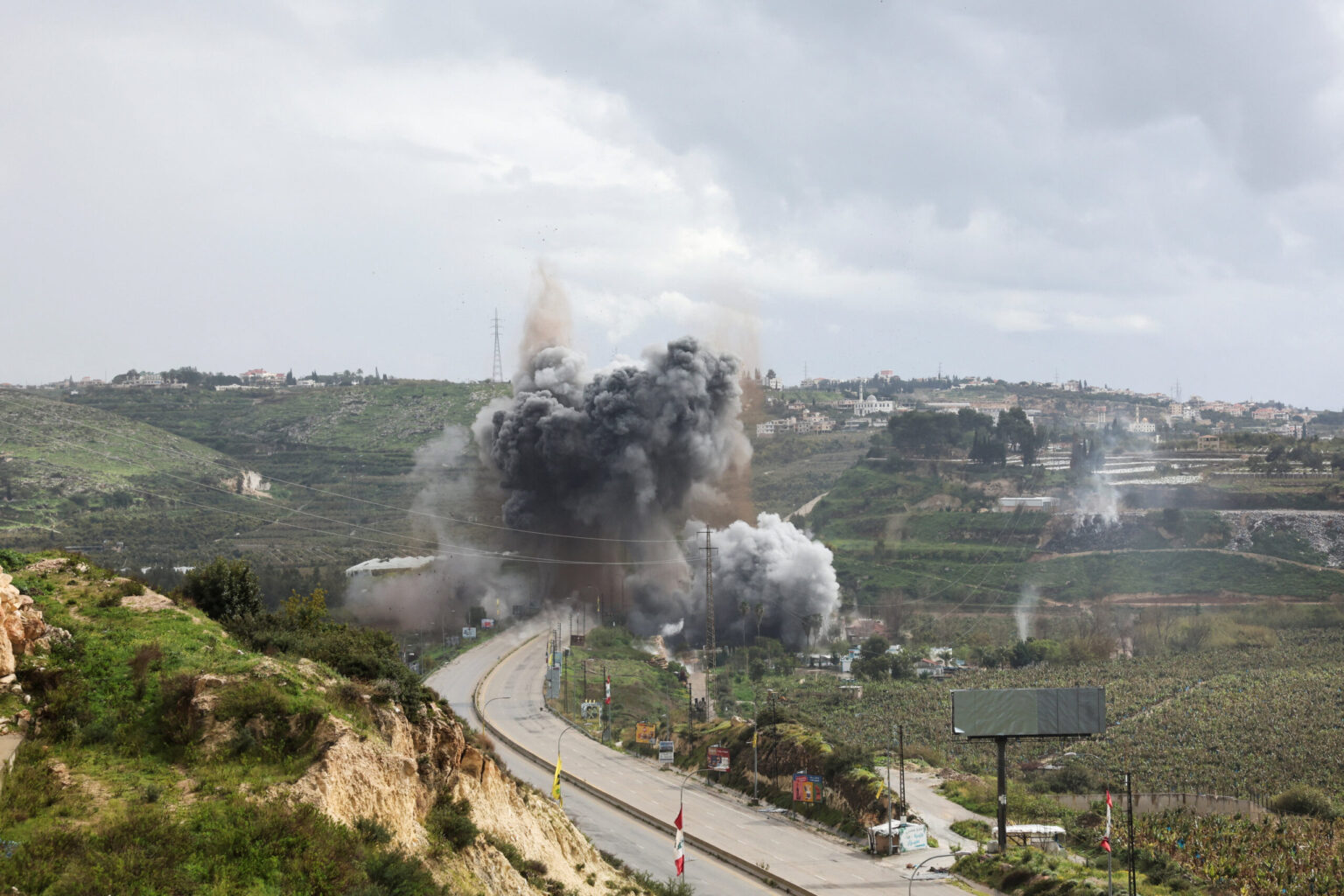
 Smoke rises after an Israeli strike on a bridge, following an escalation between Hezbollah and Israel, amid the U.S.-Israeli conflict with Iran, near Qasmiyeh, Lebanon, March 22, 2026. REUTERS/Amr Abdallah Dalsh
In less than a week, the Iran war will mark one month since it began on Feb 28th. StratNewsGlobal learns that Israel’s decision to decapitate the top Iranian leadership including Supreme Leader Khamenei on the opening day of the war, may have been dictated by crucial intelligence it had received.
The intelligence indicated a “ground invasion” of Israel using proxies Iran’s Hamas and Hezbollah, possibly even the Houthis. The invasion was planned for 2027 and the replenishment of Hezbollah and Hamas arms stockpiles was reportedly underway.
Iran has no land border with Israel, but did it plan to send troops to assist the invasion? It means Iran would have had to pre-position troops, equipment and logistics in Lebanon. Preparations of this kind would not have gone unnoticed by the Israelis.
It’s not clear when this intelligence was received. Is it something recent? Did it come before the Hamas attack on Israel in Oct 2023? These questions remain to be answered.
But a source said that “billions of dollars” are being spent on intelligence operations in Iran, indicating that the invasion idea had was based on facts.
Also, while Mossad did not have agents in every corner of that country, they were receiving information in real time from ordinary Iranians, including the movement of some top Iranian leaders.
The intelligence penetration of Iran has led to the gradual consensus in Israel that Iran poses an existential threat to the Jewish state, and more strikes to take out second and third tier leaders cannot be ruled out. How could Iran take that?
“Dealing with Iran is a challenge,” the source acknowledged, “and there is no clarity about its political repercussions. This could change the balance of power in the region. But Israel’s plan is to neutralise the threat from Iran and give confidence to the Gulf states that investors can return.”
Closely tied to this are US plans to occupy Kharg Island, which lies 25-km off the Iranian mainland and more than 600-km northwest of the Strait of Hormuz. Kharg island serves as a terminal for a lot of Iran’s oil exports, therefore the attraction for Trump.
But the source warned that “it would be a risky venture and with mid-term elections around the corner, is this a risk Donald Trump wants to take. Perhaps there could be an international coalition to open the Straits of Hormuz.”
In his view, Iran has suffered considerable damage. It’s navy, space and air defence assets have been degraded/destroyed. Some missiles remain hidden in the mountains. Does that mean the war can end and negotiations begin?
In his view, unlikely. Israel, he believes, is seeking to restore the balance of power and remove the threat from Iran. Has it hurt Iran enough for that threat to cease? Unlikely. The clerical regime or at least the outward trappings of it, remain in place with the Revolutionary Guard providing the muscle. And the Guard seems nowhere close to giving up.