
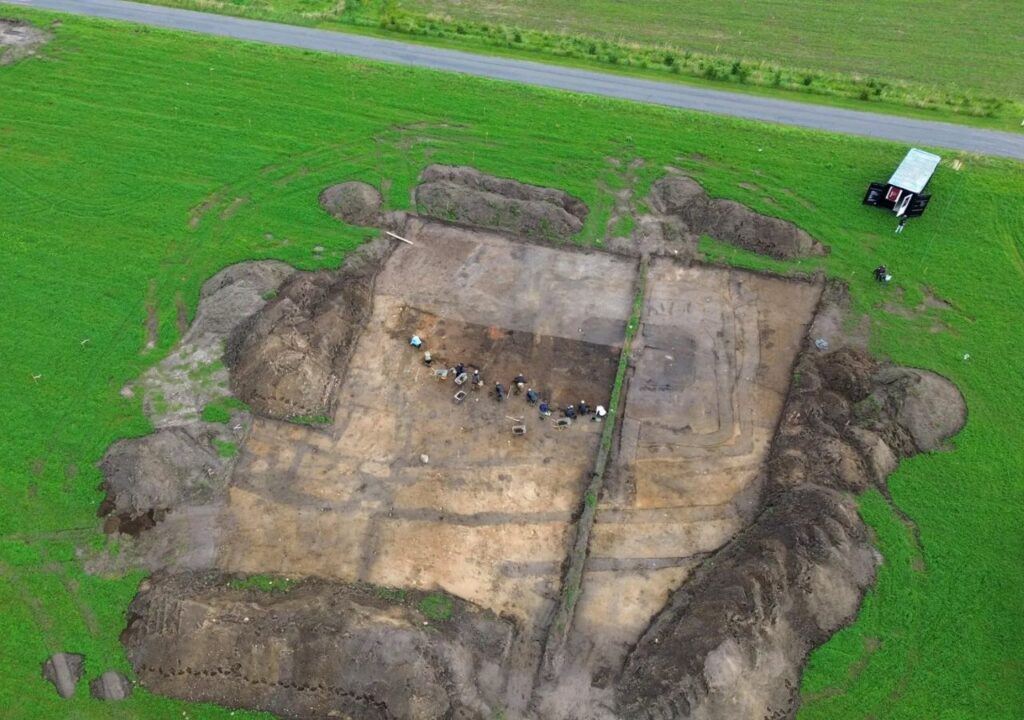
Archaeologists have uncovered the remains of an ancient temple in Denmark dating to the time of Christ, offering new insight into a powerful and previously overlooked elite society. The site, located at Hedegard southeast of Herning, is now considered one of the most significant Early Iron Age locations in the country due to its scale and complexity.
The temple was investigated in the summer of 2025, when researchers identified the charred outline of a large structure measuring about 15 by 16 meters. The building featured a surrounding row of sturdy posts that likely supported a covered walkway, enclosing a smaller inner chamber. This central structure measured roughly 9.5 meters in length and 5.7 meters in width, with an entrance facing south.
Inside, archaeologists documented deep-set support posts and walls constructed from wooden planks coated with clay. In its final phase, the building included a raised hearth at its center, decorated with simple patterns and markings. The careful design and layout suggest the site held ceremonial importance.
A cultural hub with continental links
Researchers say the temple reflects strong connections with Central European religious architecture, indicating that Hedegard was part of a wider cultural network. Evidence from the site shows a blend of Celtic and Roman influences, pointing to a community shaped by both local traditions and foreign contact.
Beyond the temple, Hedegard contains a wide range of archaeological features. The area includes one of Denmark’s richest burial grounds from around the birth of Christ. Graves at the site have yielded imported weapons, bronze vessels and jewelry linked to both Celtic and Roman regions.
The settlement itself was extensive and evolved. At its center stood a large fortified structure inspired by Roman design. Within this protected space, archaeologists found traces of a chieftain’s residence along with workshops used for crafting gold, bronze, amber and iron objects. These discoveries indicate the presence of a wealthy and influential group with access to skilled labor and long-distance trade.
Rare artifacts reveal far-reaching trade
Although only a small section of the temple’s inner chamber has been excavated, the findings have already provided valuable clues. Researchers believe the space had been cleared before it was destroyed by fire, yet two unusual objects remained.
One artifact is a slender turquoise glass bead, likely originating from Egypt. The second is a gold-foil bead believed to have been produced in the Levant region. These items suggest that Hedegard maintained trade connections stretching to the eastern Mediterranean.
The excavation where this ancient temple of elite society forms part of the “Under Pres” project, led by several Danish museums and supported by academic institutions and cultural agencies. In late 2024, authorities secured the site to protect it from agricultural damage, ensuring that further research can continue.