
FORWARD FOCUSED:
The DPP said that starting the approval process is a possible response to need, not a hard plan to bring the two reactors back online
-
By Lin Che-yuan
and Esme Yeh /
Staff reporter, with staff writer
It is a misinterpretation to say that the Democratic Progressive Party (DPP) government has a definite intention to restart nuclear plants, DPP caucus chief executive Chuang Jui-hsiung (莊瑞雄) said yesterday.
President William Lai (賴清德) on Saturday said the government has begun the approval process for restarting the decommissioned Guosheng Nuclear Power Plant in New Taipei City’s Wanli District (萬里) and the Ma-anshan Nuclear Power Plant in Pingtung County’s Hengchun Township (恆春).
The remarks drew criticism from opposition parties, who said Lai “busted the myth of a nuclear-free homeland and took a U-turn in his policy.”
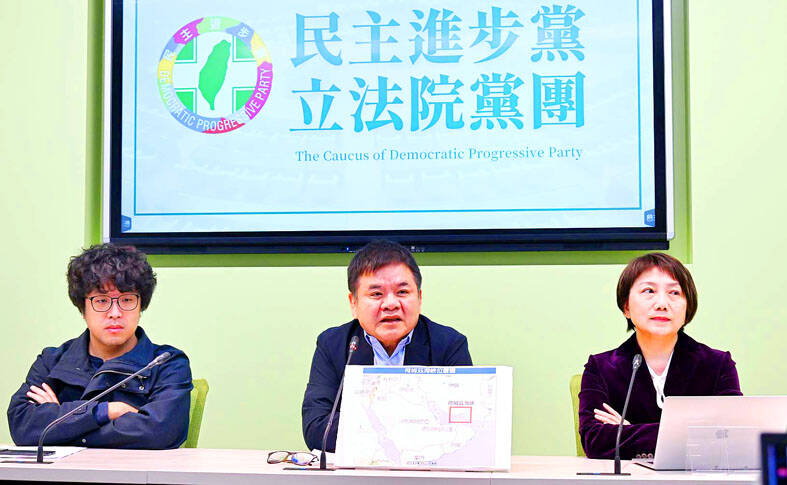
Photo: Fang Pin-chao, Taipei Times
Chuang yesterday said that what Lai is doing is taking precautions, given the gravity of restarting nuclear plants.
Taiwan reached nuclear-free status after the No. 2 reactor of the Ma-anshan nuclear power plant was decommissioned on May 17 last year, he said.
The DPP is known for its vision of a “nuclear-free homeland” while the Chinese Nationalist Party (KMT) embraces nuclear power, he said.
The DPP’s position on nuclear power has been clear and consistent from former president Tsai Ing-wen’s (蔡英文) two terms to Lai’s administration, he said.
Nuclear plants would not be operated without nuclear safety and nuclear energy would not exist without public consensus, Chuang said.
“Lai’s remarks are meant as a contingency response,” Chuang said.
“It’s understandable that the administrative branch, in response to amendments to the Nuclear Reactor Facilities Regulation Act (核子反應器設施管制法), has initiated procedures and is conducting evaluations in accordance with the law,” he said, referring to the Legislative Yuan’s amendments to the Nuclear Reactor Facilities Regulation Act (核子反應器設施管制法) last year that provide a legislative basis for the continuation of nuclear power plant operations even after entering the decommissioning stage.
“However, rashly claiming that ‘the DPP government will restart nuclear power plants’ is a misinterpretation,” he added.
Chuang said industry requires a stable power supply, in response to opposition criticism, particularly as Taiwan is seeing rapid economic development and demands from artificial intelligence and semiconductor industries are spiking.
While Taiwan’s electrical capacity should be sufficient until 2032, the government must plan ahead to ensure a stable power supply thereafter, he said.
DPP caucus secretary-general Fan Yun (范雲) cited Premier Cho Jung-tai (卓榮泰) as saying that the government would neither change its energy transition roadmap nor change its requirement for nuclear safety.
It would stick to the “three principles” — that safety is assured, nuclear waste is manageable and there is social consensus — Fan quoted Cho as saying.
That is the DPP caucus’ position on nuclear energy, she said, adding it would strictly supervise the Nuclear Safety Commission and the Ministry of Economic Affairs, which is responsible for handling nuclear waste.