
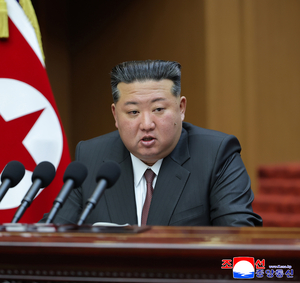
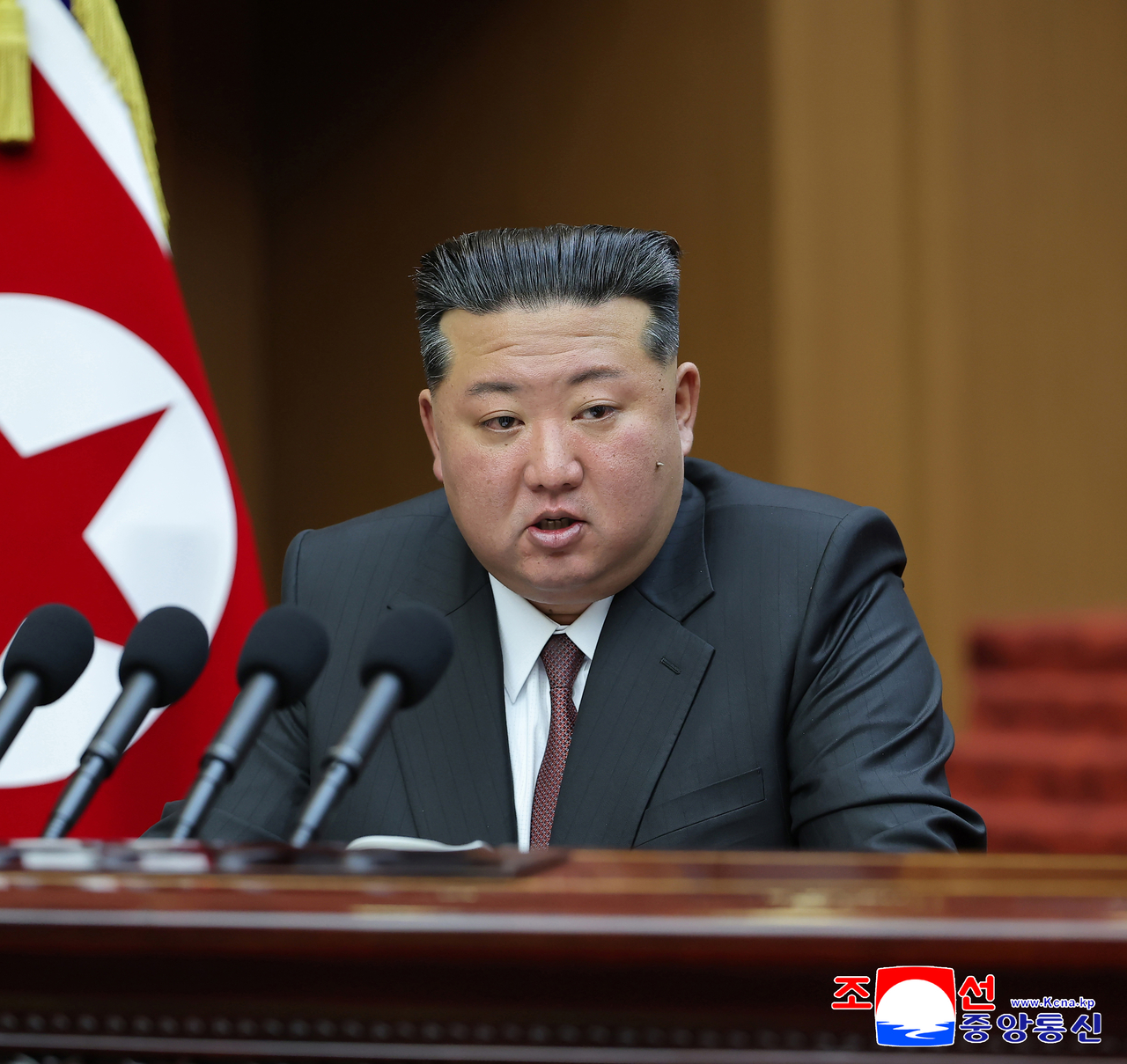
 North Korean leader Kim Jong-un delivers a speech at the second and final day of the first session of the 15th Supreme People’s Assembly at the Mansudae Assembly Hall in Pyongyang on Monday according to the Korean Central News Agency on Tuesday. (KCNA-Yonhap)
 North Korean leader Kim Jong-un’s labeling of South Korea as the “most hostile state” hints at a fundamental legal redefinition of inter-Korean relations, experts say.
Delivering a speech Monday at the second and final day of the first session of the newly elected 15th Supreme People’s Assembly, Kim said Pyongyang would “officially recognize” Seoul as its primary adversary. It will “thoroughly ignore and disregard it through the clearest remarks and actions,” the state-run Korean Central News Agency reported Tuesday.
He warned that any actions deemed provocative would lead to “merciless” consequences for South Korea.
Kim also said his country would continue to strengthen its nuclear capabilities on a permanent basis, stressing that Pyongyang’s status as a nuclear-armed state is irreversible. Expanding a “self-defensive nuclear deterrent” is vital for national security, regional stability and economic growth, he added.
“North Korea will continue to solidify its status as a nuclear weapons state … while aggressively staging campaigns to crush any provocations by hostile forces,” Kim was quoted as saying.
The remarks come amid indications that Pyongyang is revising its constitution, though state media did not confirm whether the changes would formally codify South Korea as a hostile state. The North’s constitution still includes provisions calling for peaceful reunification, but Kim had ordered legal revisions in 2024 to redefine Seoul as the “No. 1 hostile country.”
Analysts say the lack of detail may reflect an effort to maintain flexibility.
“By referring to South Korea as the ‘most hostile state,’ Kim’s statement may indicate that the designation has been formalized within North Korea’s legal framework, redefining inter-Korean relations as those between two separate states in confrontation,” said Lim Eul-chul of the Institute for Far Eastern Studies.
He added that the shift signals a move toward “hostile coexistence,” effectively abandoning long-standing notions of ethnic unity and reunification.
Other experts pointed to broader institutional changes accompanying the speech. Yang Moo-jin, a professor emeritus at the University of North Korean Studies, said the developments suggest “institutional consolidation of a party-state integrated system” and a “strategic shift to ‘hostile coexistence’ and a two-state framework,” alongside a likely constitutional codification of South Korea as a primary adversary.
Pyongyang has maintained that its nuclear status is irreversible since enacting a 2022 law authorizing preemptive nuclear strikes.
In his speech, Kim also accused the United States of engaging in terrorism and military interventions worldwide, while reiterating that Pyongyang is prepared for either confrontation or coexistence, depending on Washington’s approach.
South Korea’s presidential office pushed back against the North’s rhetoric, emphasizing dialogue over confrontation.
“The government maintains that the continued use of hostile rhetoric does not contribute to peaceful coexistence,” a Cheong Wa Dae official said, requesting anonymity.
“The path that guarantees the safety and prosperity of both Koreas on the peninsula lies not in hostility and confrontation, but in peaceful coexistence through dialogue and cooperation,” the official added, stressing that Seoul will pursue its policy consistently from a long-term perspective.
Since taking office last year, the Lee Jae Myung administration has sought to ease tensions and revive inter-Korean ties through confidence-building measures, including halting loudspeaker broadcasts along the border and signaling openness to dialogue.
An official at Seoul’s Unification Ministry, also declining to be named, echoed Cheong Wa Dae’s tone, saying Kim’s speech “reaffirmed the existing stance of two hostile states while adding that “the government will continue consistent efforts to develop inter-Korean relations into one of peaceful coexistence oriented toward eventual reunification.”
The official also noted that while Kim’s remarks toward Washington continued, their intensity appeared relatively restrained, suggesting room for potential diplomatic maneuvering.
Beyond foreign policy, Kim used the parliamentary session to outline domestic priorities, including governance reforms and economic management. The assembly approved a 5.8 percent increase in this year’s state budget — the largest rise in recent years — as the regime seeks to “financially guarantee” state operations and policy implementation.
Experts say the speech also highlighted a push for more institutionalized governance, including legal reforms and potential restructuring of internal security systems, as part of a broader effort to strengthen state control while pursuing economic development under a nuclear framework.
Despite the sweeping rhetoric, Pyongyang’s decision to withhold specific details of its constitutional revisions may point to a calculated strategy.
“Pyongyang may be maximizing ‘strategic ambiguity’ to maintain flexibility in response to changing security conditions,” Lim said.
mkjung@heraldcorp.com