
There are mishaps, there are close calls, and then there are calls that could have been close. This is the story of what I would consider one of the latter and how such a thing can occur even to a pilot with lots of experience who tries to fly conservatively and with good risk management skills. In the end, nothing happened due to safeguards in the system, but a safety “escape” is still an escape — something that got closer to an incident than we like. It pays to look at just how such a thing can happen, because only once we understand the error chain can we find a way to make sure that we sever it in the future.
It was a lousy day to fly — the air was clear, but the winds were coming up. A storm was brewing, and while still a day away, the winds in front of it were bubbling out of the southwest, bringing moisture to meet the approaching low that would loft it into a late spring snow/rain event. Coming across the mountains, the wind picked up waves and turbulence. The wind was registering on the hangar anemometer at about 10, gusting to 15, and was predicted to stay below gusts of 20 until 10 a.m. After that, the gust numbers in the forecast were flirting in the low 30s. Fortunately, the direction was measured and predicted to be within 10 to 20 degrees of runway heading — crosswind was not much of a consideration. Our valley acts as a straightening vane to funnel strong winds down our runway — one of the reasons that the runway was built in the direction where it sits.
I had a mission — to fly a TV journalist who had traveled across the country to do a story. I am an experienced commercial pilot with thousands of hours in the type of aircraft we were flying, and I have a very solid understanding of where the edges of the envelope were for me and the aircraft. We weren’t close to falling over an edge by any means, but it wasn’t going to be terribly comfortable — or fun. But the mission wasn’t about fun; it was about getting the flight in so long as it wasn’t dangerous. The bad parts could be easily edited out of the finished product, and the eventual audience wouldn’t know the difference.
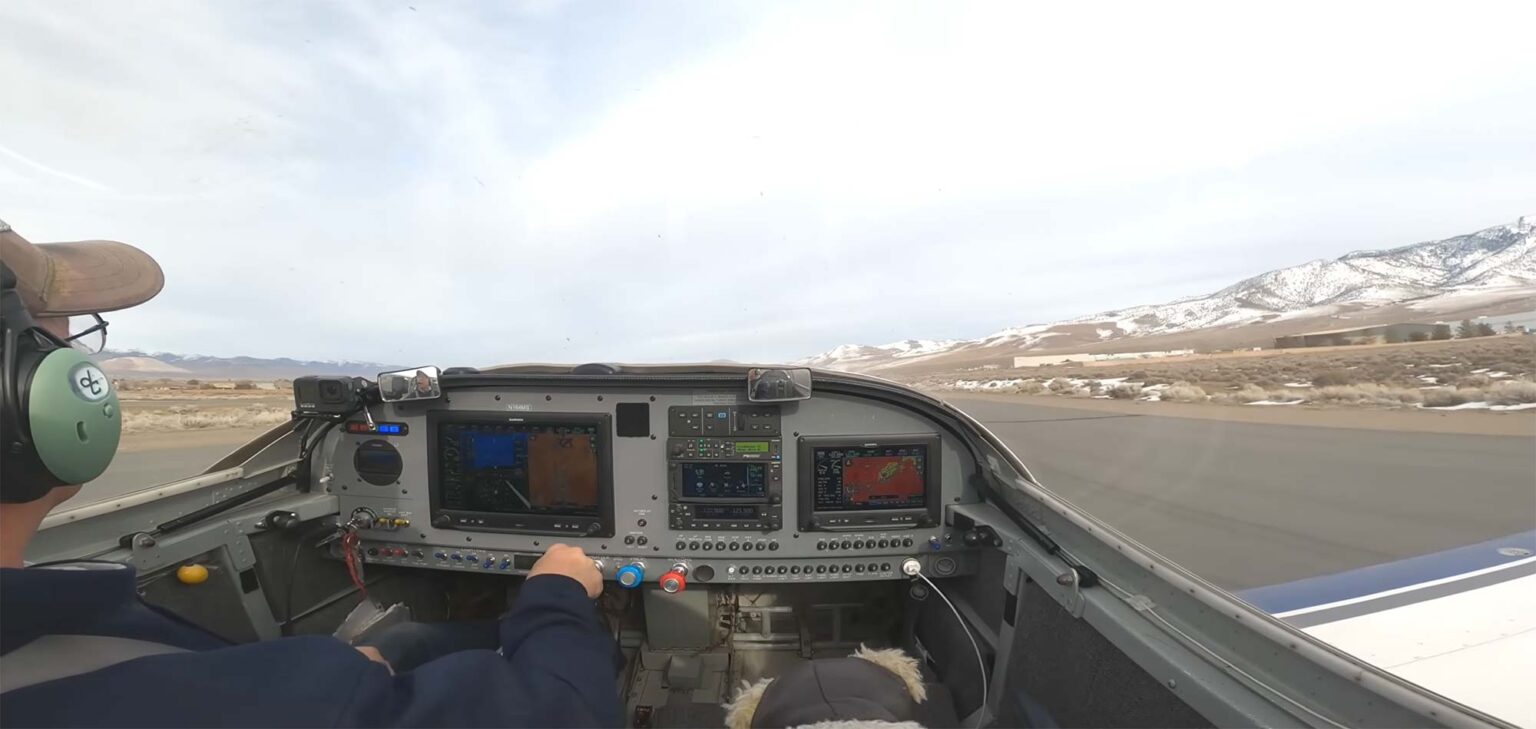
So the aircraft, weather, and passenger were all go, and we set up cameras on the aircraft and the ground to record the event for the show. The goal was to simply get the journalist aloft and give him a little experience in an experimental aircraft. He had flown in the back seat of an F/A-18 for a story a few years ago and had been in helicopters and light aircraft throughout his career, so it wasn’t a new thing to experience some bumps and maybe a bumpy landing. We strapped in, briefed, and back-taxied the runway for departure, the strong tailwind trying to get the taildragger to swap ends on the way down to the other end. At least it was easy to get the tail to swing around for takeoff!
With a camera crew at the other end of the runway, we were asked to hold it on the deck to build speed, then do a pull as we passed them — not a tough maneuver if you have experience, a good AoA, a good sense of how to keep the G’s low, and lots of energy. Although this is a killer maneuver for many, it can be done safely if you manage all of the factors. And that’s what we did — I got off the ground and flew higher than I would have if it had been calm, because I wanted more margin for gusts. The pull-up was mild because our ground speed was slow (due to the headwind, which was probably now gusting in the low 20s), so it looked more spectacular than it was from the cockpit. We were about 3 miles from the field when a voice came on the radio and informed us (via handheld) that the camera crew had forgotten to activate the GoPros on the aircraft, and we needed to return so they could do that! Well, the point of the flight was the video, so there was not much choice other than to head back — even though I was hoping to only land in that wind once.
The landing wasn’t terrible, probably a 4 on a scale of difficulty from 1 to 10. The cameraman leaned into the cockpit and started the cameras — but it took him a minute to go through a bunch of button presses to get them running right, proof that we probably wouldn’t have gotten it right if we tried to do it while airborne. We once again taxied back and spun around for takeoff, repeating our pull-up at the end of the runway. The talent in the back seat asked if I could bank towards the ground cameras as I went by — not so that they could see his face, but so that they could see his extended middle finger as we passed.
The rest of the flight actually went quite well — the bumps smoothed out at 1,000 feet AGL, and while we couldn’t make much progress against the strong west winds aloft, we got high enough to actually see the waters of Lake Tahoe — then did some mild chandelles and not-so-lazy 8s to give the impression of the aircraft being fairly sporty. We finished off with a tour of an old abandoned gold mining town and headed home. And this is where the day got the potential to be interesting.
The talent asked if we could make a low pass down the runway — he wanted a buzz the tower moment for the video. I don’t normally do low passes because of the risk of bird strikes and the simple fact that they are more dangerous than not doing them — but I also know that if you keep enough energy, don’t pull too hard, and make sure you inform folks of what you’re doing, they can be done while staying inside the acceptable risk envelope. Since we were approaching from downwind of the airport, and the winds were still building, I called our intentions at 6, 3, and 1 mile, each time saying we were doing a low pass down the runway, then pulling up into the downwind. I checked to make sure we were on the right frequency and knew the radio was good. No one else was on the frequency except for our ground crew on the handheld.
Now the last piece of the risk management puzzle that went through my head was: OK, I don’t really like doing low passes, but there won’t be any birds because of the wind, and also, no one else is going to be stupid enough to be flying today — it’s just not that much fun! No one else was on the radio, so I was fairly confident that we were fine. The low pass went as planned, although it looked slow from the ground because the winds were now gusting to about 25 mph. It also turned out that our ground crew had somehow changed the frequency on the handheld, so they hadn’t heard us coming and didn’t get the shot! But I didn’t know that as I pulled up into a crosswind to downwind turn, concentrating on making sure I was as far from the edges of a stall as I could be — I had plenty of energy and didn’t exceed 2 G’s in the pull to downwind. The rest of the pattern was fine, and the landing was … sporty. I mentioned to my back-seater that today was a great example of the saying, You don’t stop flying a taildragger until it’s tied down and chocked! As we were rolling out, I heard the ground crew come on the radio (they had realized their frequency error) to tell us, “Expedite your exit because of the aircraft on your tail!”
Aircraft on my tail? Who else was up here? And why weren’t they on the radio?! I certainly didn’t want to add any speed because I was close to flying again, even at a walking ground speed because of the wind. But as I exited and turned 90 degrees to the runway, I saw a high-wing taildragger touching down on the numbers — there was no danger of them running us over. But still — how had I missed him? I heard nothing on the radio and didn’t see him following me in the pattern — but based on his high wing, I am guessing I probably had 50 knots on him in the pattern.
It turns out that when I was making the U-turn crosswind, he was just entering the downwind, and based on what we reconstructed afterwards, he did see me and turned out a little to the right. I pulled ahead of him on downwind and had flown a short base/final. And the reason I never heard him on the radio was that he was on the wrong frequency, having selected the frequency for the nearby large airport. So he was transmitting — but we couldn’t hear him, and I was transmitting, but he couldn’t hear me. As I always tell people, you just have to assume there are NORDO aircraft out there because anyone who has flown long enough to earn their private ticket has probably mistuned their radio at some point — and being on the wrong frequency is the same as not having a radio!
So no — we didn’t come close enough to have a true close call, but we could have — if he hadn’t seen me while I was concentrating on making a perfect climbing arc and not getting the AoA too high. A collection of mistakes — links in an error chain — got us close to being in trouble, but the Big Sky Theory and his scanning of the pattern where he expected aircraft to be kept us apart. He figured I wasn’t transmitting, compounding my showy low pass — but in fact, he wasn’t listening — but he thought he was. I assumed that I was going to be alone in the sky because it was just a really bad morning to be in the air.
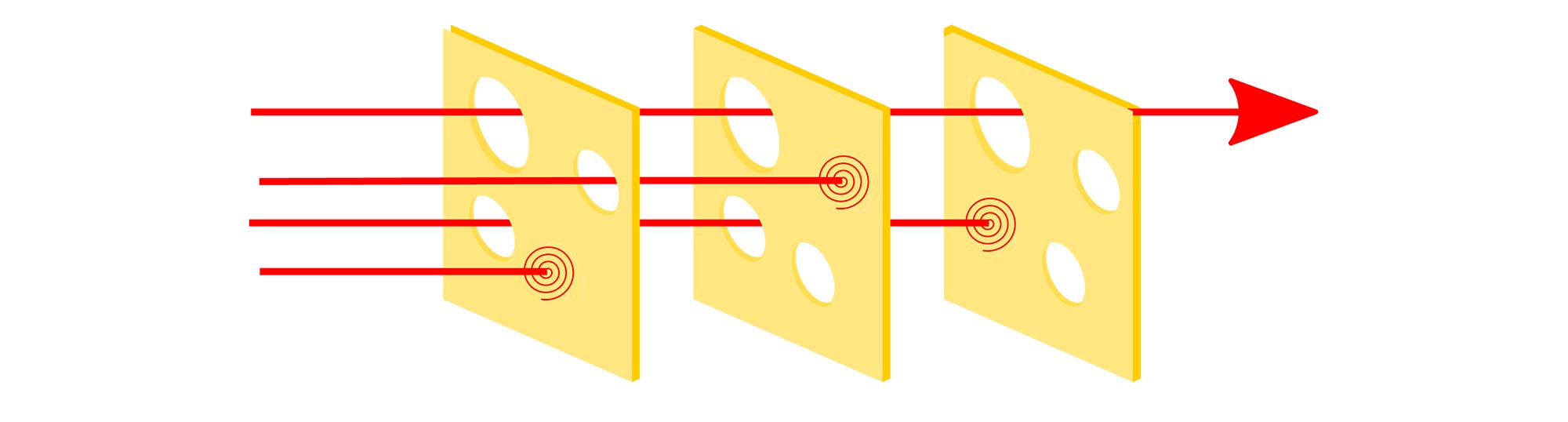 BenAveling – Swiss cheese model, CC BY-SA 4.0
Near misses (and near-near-misses) are like that. You can describe them using the error chain model — break one link and the error doesn’t occur — or using the Swiss cheese model — a mishap occurs only when all the holes in the various slices of cheese line up — but in the end, it is not a good idea to rely on the chain breaking or the holes to be closed. At the same time, we all know that the easiest way to assure that nothing bad happens in the air is to never venture into the air … but that is sort of a self-defeating philosophy for aviators.
So our goal is always to keep analyzing and managing the risk the best we can and calculate the possible problems that can arise from a course of action. That’s how we minimize — not eliminate — the risk. We can cover for one another and break potential error chains if everyone is thinking about how things could go wrong — and understanding that once in a while, everyone is going to make a mistake in their own calculations.