
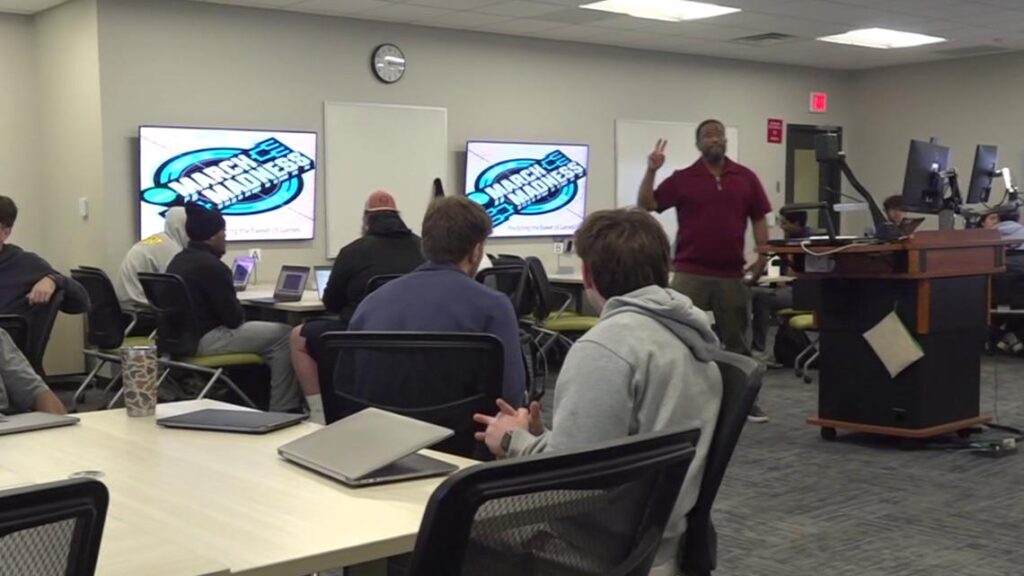
CHARLOTTE, N.C. — With March Madness in full swing and Sweet Sixteen games tipping off, millions of Americans are filling out brackets and placing bets.
At UNC Charlotte, one class is channeling that excitement into the classroom not for profit, but for education.
Inside a sports analytics course led by program director John Tobias, students are taking on the role of bettors using a mock sportsbook designed to simulate real-world decision-making during the NCAA Tournament.
“This is something that does not encourage students to bet, but at the same time, it’s all about educating them,” Tobias said.
The project divides students into three groups: those with strong basketball knowledge, those with little to no experience and those relying strictly on advanced data and predictive models.
The goal is to see which approach proves most effective and how much luck plays a role.
With March Madness known for its unpredictability, the results have already been eye-opening for some students.
“The ‘aha’ moment was listening to what other people thought as well, and then mixing in the betting odds with it,” student Carter Thomas said.
“I think how biased I can be and how biased other people can be,” student Evan Wiseman said. “If you have any allegiance to a team at all, you just want to pick them.”
Instead of using a real betting platform, interns created a custom application for the class allowing students to apply their data science and modeling skills in a controlled environment.
“We just wanted the students to take an algorithmic approach when it came to sports betting and use the skills they’ve accumulated,” intern Abhi Veerthineni said.
He helped develop the app.
“Really use their modeling skills to see what gave them a better edge over other groups, and then just compare at the end of the day,” Veerthineni said.
Students say the experience is helping them better understand how sports betting works and the risks that come with it.
“It helps you be thorough before you make financial decisions, even if they’re minor financial decisions,” Wiseman said.
While no real money is involved, instructors say the goal is to give students a realistic look at sports betting and the decision-making behind it especially as betting becomes more accessible.