
Silvio Berlusconi died in June 2023 at the age of 86. He left behind five children, a media empire worth billions, a political party, a complicated legacy, and a question that Italy is still trying to answer: what does the Berlusconi family mean now that the man himself is gone?
The answer, it is becoming clear, is: quite a lot. Possibly more than anyone expected.
Who Is the Berlusconi Family?
Berlusconi had five children from two marriages. His eldest children, Marina Berlusconi and Pier Silvio Berlusconi, were born from his first marriage. His three younger children, Barbara, Eleonora and Luigi, were born from his marriage to Veronica Lario.
The family’s wealth is channelled through Fininvest, the holding company Berlusconi founded in 1975 and built into one of Italy’s largest private corporate groups. Following Berlusconi’s death, his eldest two children received additional stakes in Fininvest, taking their combined holding to 53%. The three younger children also received stakes, with Barbara and Luigi continuing as directors of the family holding company.
In practice, the family divides into two distinct operational tiers. Marina and Pier Silvio run the business. The three younger siblings hold stakes but play no active management role. The real power within the family sits with the eldest two, and between them, a further distinction has emerged: Pier Silvio runs the media, and Marina runs everything else, including the increasingly consequential political dimension.
The Business Empire: What Fininvest Controls
To understand the Berlusconi family’s influence on Italy, you first need to understand the scale of what they own.
Marina Berlusconi chairs Fininvest, which oversees significant stakes in MediaForEurope, the publishing giant Mondadori, and the publicly traded Italian bank Banca Mediolanum.
MediaForEurope, formerly known as Mediaset, is the commercial television empire Berlusconi built and Pier Silvio has since transformed into a genuinely European operation. The Berlusconi family owns 50.002% of the voting rights in MediaForEurope via Fininvest. MFE holds 100% of the shares in Italian Mediaset and the Spanish Grupo Audiovisual Mediaset España, as well as a significant stake in the German broadcaster ProSiebenSat.1.
The numbers are substantial. Fininvest’s three key assets produce revenues of around 4 billion euros, with operating profits of 280 million and net profits of 263 million, according to the most recent consolidated accounts. The family’s combined financial wealth, based on their stakes in quoted companies, is estimated at around 2.5 billion euros for Marina and Pier Silvio alone, before counting annual dividends.
This is not merely a rich Italian family sitting on inherited assets. It is an actively managed, expanding business operation with reach across three major European markets in television, a dominant position in Italian publishing, and a significant stake in one of Italy’s most successful banks.
Marina Berlusconi: The Power Behind the Influence
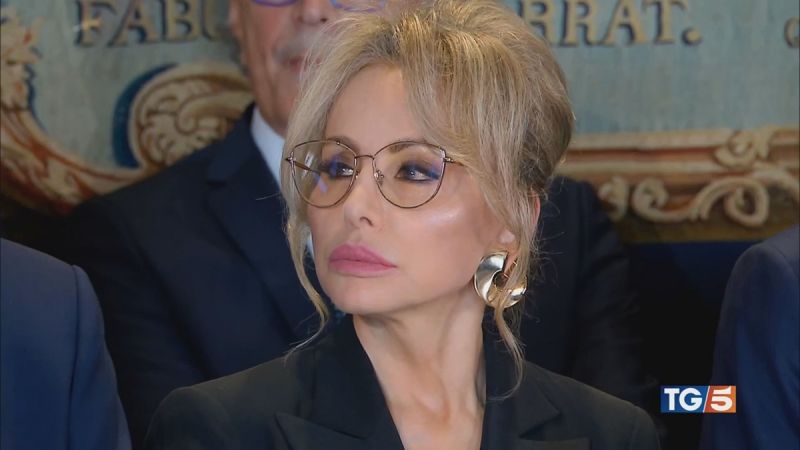
Marina Berlusconi is 59, born in Milan in 1966. She joined Fininvest young, became deputy chair in 1996, and has been chair since 2005. She is considered one of the most influential women in the Italian business world and plays a decisive role in the management and strategic direction of the family businesses.
She is not a public figure in the conventional sense. She gives relatively few interviews, makes no speeches at political rallies, holds no elected office. And yet her interventions in the affairs of Forza Italia, the party her father founded, have in the past year become the most closely watched signals of where Italian centre-right politics is heading.
Each of Marina’s public outings has not only outlined the axes of what observers describe as a “liberal manifesto” but has added to the pressure on the current Forza Italia leader Antonio Tajani to open what she calls “a new phase.” Her messages are carefully calibrated. She praises Tajani for what he has done, and in almost the same breath suggests that what he has done is essentially complete. She talks about the future in terms that do not obviously include him as its leading figure.
This week, following the failure of the judicial reform referendum that Forza Italia had championed partly in her father’s name, it was Marina who was widely reported to have inspired the internal party move that ousted Maurizio Gasparri as Senate group leader, with 14 of the party’s 20 senators signing a letter calling for his replacement. She did not sign any letters. She did not need to.
Pier Silvio Berlusconi: Building a European Media Empire
If Marina is the political force in the family, Pier Silvio is its corporate engine. The second child of Berlusconi’s first marriage, born in 1969, he has spent his entire career inside Mediaset and has transformed what was a predominantly Italian commercial broadcaster into something more ambitious.
According to Forbes, in 2026 Pier Silvio Berlusconi is the 32nd richest Italian in the world, with a managed wealth of 3 billion dollars. He is executive vice president and CEO of MFE-MediaForEurope, and president of RTI, the Italian company that operates all of the Mediaset television activities.
The ProSiebenSat.1 acquisition was his project and his vision: the understanding that Italian commercial television, in the long run, cannot survive the competition with global streaming platforms unless it operates at European scale. Analysts expect the combined group to reach revenues of 6.8 billion euros in 2026, with 760 million in operating profits. This would make MFE one of the largest commercial television groups in Europe.
Pier Silvio’s relationship with politics is more cautious than his sister’s. In summer 2023, immediately after his father’s death, polls showed significant support for him as a potential political figure. He declined to enter the arena. His public statements since have consistently prioritized the business over any political ambition, though he has not ruled anything out permanently.
The Three Younger Siblings
Barbara, Eleonora and Luigi Berlusconi are shareholders in Fininvest but play no active management role in the group’s core operations. Barbara, the eldest of the three, has been involved in football ventures and has a public profile, but has not emerged as a significant force in the family’s strategic direction. The inheritance has consolidated real operational control firmly in the hands of the two eldest children.
The Political Inheritance: Forza Italia Without Berlusconi
The most delicate and consequential dimension of the Berlusconi family’s current role in Italy is not the business. It is the political party their father created and what they choose to do with it.
Forza Italia was, in a very direct sense, Silvio Berlusconi. It was his vehicle, his project, his answer to the political vacuum of the 1990s. Without him, it faces a structural question that no amount of loyalty to his memory can fully resolve: what is it for, and who does it represent?
Observers have noted that the family clearly intends to exercise a decisive influence on the party, not just a moral suasion from outside. But most believe that for the moment the focus remains on the business. Their attention is concentrated on the three main pillars: television with Mediaset, publishing with Mondadori, and banking through the participation in Mediolanum.
The political involvement, when it comes, is likely to be gradual. Marina’s interventions have been designed to shift the party’s direction and refresh its leadership without triggering a crisis that could damage the coalition government in which Forza Italia participates, and in which Tajani serves as Foreign Minister and Deputy Prime Minister.
The family’s position is one of patient pressure. They do not need to move quickly. They own the media that covers Italian politics, the publishing house that produces political books, and the bank that finances a significant slice of the Italian professional class. They are not in a hurry.
What the Berlusconi Legacy Means for Italy
The question of what the Berlusconi family means for Italy is, in the end, a question about power and how it transmits across generations in a country where the two things are often the same.
Silvio Berlusconi’s singular achievement was to fuse business, media, and politics into a single personal enterprise in a way that Italy had never seen before. The question now is whether that fusion can survive its creator, and in whose hands it will evolve.
Marina and Pier Silvio have, in the two and a half years since their father’s death, managed the transition with more skill and fewer missteps than many observers expected. The business is growing. The political party is intact. The family name retains its gravitational pull in Italian public life.
What comes next, whether that means a formal political role for one of the children, a repositioning of Forza Italia around a genuinely liberal rather than personality-driven identity, or something nobody has yet predicted, remains open. But the Berlusconi family is not receding into private life. It is reorganizing, quietly and methodically, for whatever comes after the man who built everything.
In Italy, that is called the second act. The Berlusconis appear to be preparing for it carefully.