
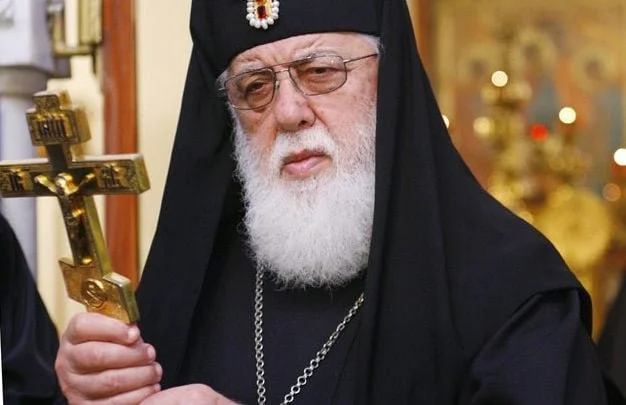
Georgia’s spiritual shepherd died on March 17, after nearly a half century as the leader of the ancient Georgian Orthodox Church. Much of this week’s “Crossroads” podcast focused on a complex New York Times obituary that attempted — with a great deal of success — to describe his legacy. The feature, however, failed to examine why the term “godfather” was at the heart of one of the patriarch’s most remarkable achievements. Hold that thought.
First, here is the obit’s sweeping double-decker headline:
Patriarch Ilia II, a Spiritual Symbol of Stability in Georgia, Dies at 93
The longest-serving leader in the history of the Georgian Orthodox Church, he helped guide his country in its transition from Soviet repression to modern statehood.
In the podcast, I argued that the key to Patriarch Ilia’s life was his skill in avoiding long conflicts with the Soviet Union and then Russia, while also stating his fierce rejection, as an Orthodox leader, of Russia’s invasion of neighboring Ukraine. He maintained ties — using the term “fraternal” — to the Russian Orthodox Church while, backed by Orthodox leaders around the world, regaining “autocephalous,” independent status for his church.
Consider the, literally, byzantine nature of this summary of Georgean Orthodox history at the Orthodox Wiki website:
The Church of Georgia is one of the oldest Christian churches, tracing its origins in tradition to the missionary efforts of the Apostle Andrew in the first century. Historically, adoption of Christianity by the kingdom of Georgia (Iberia) is traced to the missionary efforts of St. Nino of Cappadocia beginning in early fourth century. Initially, the Georgian church was part of the territory of the Patriarchate of Antioch. The church was granted autocephaly by the Patriarch of Antioch in 466. While seriously disrupted by the invasions of the various Tartar tribes in the 13th and 15th centuries, the autocephalous church survived until it was placed under the administration of the synodal Church of Russia in 1811. After the abdication of Czar Nicholas II following the February Revolution of 1917, the Georgian hierarchs restored the church’s autocephaly, which was eventually recognized by the Church of Constantinople and the Church of Russia.
That last sentence is crucial and stands in stark contrast to the tense, tragic state of the competing Orthodox bodies in modern Ukraine (click here for my “On Religion” column from Kiev, in 2009).
The Times obituary offered two crucial passages of background material, one short and one long and, fittingly, quite complex.
Thousands of Georgians accompanied the coffin on … as it was transferred from the patriarchate in Tbilisi’s Old Town to the Holy Trinity Cathedral, the country’s largest church, where he was to lie in state. …
As Georgia navigated the transition from Soviet repression and civil strife to modern statehood, Ilia II provided a sense of continuity and spiritual stability during tense periods — from the economic collapse of the 1990s to the 2008 war with Russia over two secessionist territories and Georgia’s current drift away from the West.
“Thousands” may be an understatement, based on the stunning visuals of these open-air rites mourning rites
The Times feature included a long passage that captured several elements of the Patriarch Ilia era. First, there is the status of the Georgian church itself:
Georgia prides itself on having been one of the first nations to adopt Christianity as a state religion, and its population remains deeply devout. When Ilia II became leader in 1977, however, the church consisted of only a few dozen open parishes and a handful of monasteries. He oversaw an extensive expansion and worked to secure the recognition of the church’s independence. Today, the Georgian Orthodox Church has more than a thousand parishes.
It is an understatement to say that the transition from the Soviet era to the present day was fraught with peril, both in terms of bullets, bombs, politics and church life. Let’s keep reading this crucial Times material.
Following the end of Soviet anti-religious suppression, new challenges emerged in Georgia. The country was plunged into civil war, with street battles in central Tbilisi and breakaway regions claiming independence. …
In the 1980s, Ilia II supported and often sheltered leaders of the Georgian national anti-communist movement. In 1989, anticipating the arrival of Soviet tanks to crush dissent, he called for protesters to move from the central square in front of the Parliament building to a nearby church. The protesters remained, and 21 people were killed in the subsequent crackdown.
Throughout the 1990s, at the height of civil strife, Ilia II sought to mediate between opposing factions. In the 2000s, as Georgia underwent rapid liberal reforms and drifted toward the West, he tried to maintain ties with Russia and its Orthodox Church. …
Finally, Russian invaded Georgia in 2008, but quickly withdrew — in part because Orthodox leaders around the world openly rejected one Orthodox nation attacking another. Of course, Georgian political leaders also promised to remain neutral, avoiding provocative ties to the West.
Today, Georgia is a “partner” in many NATO efforts, but has never joined that military alliance. Also, Patriarch Ilia II stressed the differences between Georgia and the highly secular cultures in Western Europe.
Thus, the crucial question, from the viewpoint of the European Union and the U.S. State Department: Is a tense peace between Georgia and Russia a good thing?
Let’s keep reading:
In 2013, five years after the 2008 war, Ilia II met with President Vladimir V. Putin in the Kremlin, telling him, “I believe that the problems existing between us will be eliminated, and we will continue to be brothers.”
After the Russian invasion of Ukraine in 2022, Ilia II called for an end to the hostilities but also did not recognize the independence of the Orthodox Church of Ukraine, saying that “the government of Ukraine, being at war, has its own position towards it, and does not consider religious depth.” In his traditional Easter epistle in 2023, he called for peace and reconciliation.
It’s important to note that the creation of a new “independent” Orthodox Church of Ukraine — backed by the EU, the USA and the Orthodox Ecumenical Patriarch in Turkey — has been rejected by the rest of global Orthodoxy.
Thus, Patriarch Ilia II, in effect, argued that Orthodox unity issues should be settled by global Orthodox leaders, as was the case in Georgia. Ilia openly supported the ancient Ukrainian Orthodox Church, which has done everything it can — under Orthodox canon laws — to cut centuries of ties to Moscow.
Thus, the Times piece quoted Georgian lawmaker Armaz Akhvlediani, who “called Ilia II ‘a great diplomat.’ But he also said that the patriarch had ‘simply made no compromises when it concerned the integrity of Georgia and its independence.’” Meanwhile, the Georgian patriarch made it clear that Georgian Orthodox leaders rejected moral, cultural and religious trends in Western Europe.