

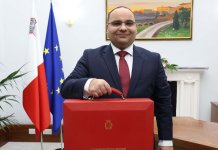
 Finance minister Clyde Caruana (left) with prime minister Robert Abela (Photo taken from Facebook footage)
Malta’s national debt has hit €11.4 billion, with the Nationalist Party pointing out on Friday that prime minister Robert Abela has become “synonymous with debt” after figures published by the National Statistics Office confirmed a record €893 million in new borrowing over the course of 2025 alone.
The NSO data, covering government finances for the full year January to December 2025, show that debt rose from €10.47 billion at the end of 2024 to €11.36 billion by the close of last year. The PN translated that into a figure it said should alarm every Maltese taxpayer: nearly €2.5 million in new debt accumulated every single day under Abela’s watch.
Shadow finance minister Adrian Delia and shadow economy minister Jerome Caruana Cilia said the scale of the borrowing under the current prime minister was without precedent. When Abela succeeded his disgraced predecessor Joseph Muscat, they noted, national debt stood at just over €5 billion. It has now more than doubled.
“Robert Abela is responsible for half of this entire debt,” the PN said. “He has borrowed more than all previous prime ministers – Labour and Nationalist – combined.”
The interest burden is equally striking. According to the same NSO statistics, Malta paid €297 million in interest on its public debt during 2025, an increase of €35 million on the previous year, and equivalent to approximately €814,000 per day drawn from taxpayers’ money. The government’s own projections in the 2026 budget suggest that figure will rise still further this year, to between €340 million and €350 million, crossing the threshold of €1 million per day in interest payments alone.
The deficit picture compounds the concern. In 2025, government expenditure reached €8.896 billion against revenue of €8.072 billion, producing a deficit of €824 million. That is nearly double the €433 million deficit recorded in 2024. While revenue grew by €212 million year on year, expenditure surged by €604 million, almost three times as fast. The PN said the figures demonstrated that spending was rising at a rate the economy could not sustain.
Malta remains under the European Union’s Excessive Deficit Procedure, a formal mechanism triggered in July 2024 after the country breached EU fiscal limits. The opposition noted pointedly that finance minister Clyde Caruana had claimed last April that Malta would exit the procedure early. Thursday’s NSO data confirmed it has not. Structural weaknesses in the public finances, the PN said, are going unaddressed while debt continues to compound.
Looking ahead, the trajectory is unambiguous. Government projections published in the 2026 budget forecast debt rising to over €14 billion by 2028. The PN said that would mean Abela had not merely doubled the debt inherited from his predecessors, he would have tripled it within a single parliamentary term.
“It is now confirmed in black and white,” Delia and Caruana Cilia said in their statement. “The high level of deficit and debt imposed on the people by Robert Abela means that since becoming prime minister, he has borrowed more than all previous prime ministers – Labour and Nationalist – combined.”
The comes at a moment of heightened sensitivity over Malta’s fiscal trajectory. While international institutions have broadly affirmed the sustainability of Malta’s debt – which remains below the EU average at around 47% of GDP – concerns over spending discipline have been mounting.
The European Commission warned in November that Malta’s budgetary plan was “at risk of material non-compliance” with EU fiscal rules, citing cumulative expenditure growth far exceeding recommended ceilings. The government’s own Fiscal Advisory Council has reportedly cautioned against “unproductive expenditure,” while the Malta Chamber of Commerce has echoed warnings from rating agencies that “fiscal discipline and governance reform” are essential for long-term resilience.
Credit rating agencies have maintained Malta’s ‘A’ grade with stable outlooks, but DBRS Morningstar recently cautioned that the “slow pace of fiscal consolidation – driven by sustained public expenditure, energy subsidies and income tax cuts – risks undermining the country’s fiscal trajectory.”
The Abela adminisration has consistently defended its record, pointing to reaffirmed credit ratings and Malta’s robust economic growth as evidence that its approach of avoiding austerity during global turbulence has been vindicated.
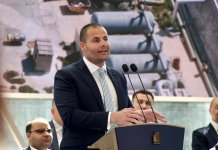
Speaking at a campaign-style news conference this week, Abela doubled down on that strategy, vowing to “keep incentivising more, not tightening belts” and arguing that a strong economy would generate greater revenue to pass further benefits to the public. But with debt and interest payments climbing sharply, the opposition’s latest salvo suggests fiscal credibility will remain a central battleground in the run-up to the next election.

