
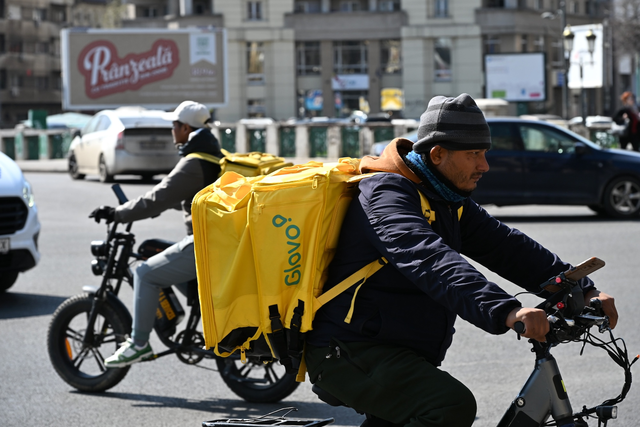
A growing labor shortage has forced Romanian employers to recruit some 100,000 mainly Asian workers annually. Many are struggling to get by.
Nimal, a 29-year-old from a village near Kurunegala, Sri Lanka, waited two years and paid over 4,000 euros to an agency back home to come work in Romania. He thought he would be driving a truck, but when he arrived in October 2025, he ended up riding a bicycle. He is one of thousands of foreign workers recruited to the country to deliver food orders made through online platforms such as Glovo, Bolt Food, and Wolt.
Nimal earns far less than he expected, often relying on tips to buy food while picking up orders. He has barely begun to pay off the loan he took out to cover his recruitment fee. His best bit of luck may be that he only has to share his room with two people. Others sleep in warehouse-style dormitories, sometimes more than a dozen to a room, with their bikes parked beside their beds.
“Abusive” Working Conditions
These workers zipping through traffic with large, brightly colored backpacks are the most visible sign of how migrants from outside the European Union, largely from Asia, have permeated the Romanian labor force. More than 10,000 work permits were issued for courier jobs in 2025 alone, according to the General Inspectorate for Immigration (IGI). Their visibility has made delivery workers targets of far-right politicians and, in some cases, physical attacks. But most migrants remain largely out of sight, working in restaurant kitchens, up and down hotel corridors, and on construction sites and factory floors.
At the end of 2025, more than 148,000 non-EU citizens held residence permits for employment, according to IGI, roughly half from Nepal and Sri Lanka, followed by Turkey, Moldova, India, and Bangladesh. Advocates say many more remain in the country without the proper paperwork thanks to a system that makes them dependent on their employer, vulnerable to abuse, and pushes them into irregular status. A draft emergency ordinance seeks to address these shortcomings, but has faced criticism from rights groups, recruitment agencies, and employers.
Employers have also criticized a decision to cap the number of non-EU workers newly admitted to the labor market at 90,000 in 2026, a 10% reduction from previous years, even as the country faces a labor shortage driven partly by Romanians themselves becoming migrant workers elsewhere in the EU since the country’s accession to the bloc in 2007. Today roughly one-fifth of Romanians live abroad, while employers report tens of thousands of vacancies in construction, hospitality, and manufacturing.
Romania has limited the number of non-EU workers entering the country each year through an annual quota since 2014. The cap remained in the low thousands for several years, but a 2018 law allowed foreign workers to be paid the minimum wage (currently 4,050 lei or around 800 euros) rather than the average pre-tax wage, which as of January 2026 stood at 9,220 lei. The quota reached 30,000 the year following the change. In 2022, it surged to 100,000, although the government barred migrant workers from leaving their jobs during their first year without written permission from their employers.
“It’s one of the most abusive legal documents I have ever read,” said Georgiana Badescu of the Center for Legal Resources, a Bucharest-based human rights organization, referring to the 2022 ordinance. “It is not only disturbing, it’s destroying migrants.”
She likened the rule to the kafala system in the Gulf countries, the main destination for many South Asian migrant workers, where immigration and residency status are tied to a specific employer.
Anatolie Cosciug, deputy director of the Center for Comparative Migration Studies think tank, echoed Badescu’s assessment. “This dependency creates what you see already in the Gulf countries: terrible working conditions, terrible housing conditions,” Cosciug said.
Promises vs. Hard Reality
In its latest report on Romania, the Council of Europe’s anti-trafficking body GRETA warned that migrant workers, especially those from South Asia, face heightened exploitation risks linked to deceptive recruitment practices. In countries of origin, jobs are often arranged through brokers and recruitment agencies known as “manpower” offices, with migrants paying several thousand euros in fees, paperwork, and travel, frequently financed by loans. Some migrants arrive to find the job bears little resemblance to the ones they were promised, and agencies sometimes quote gross salaries without explaining taxes or employer deductions for housing and food.
Delivery workers like Nimal, employed by local companies acting as intermediaries between platforms and couriers, also have money taken from their pay for bike or scooter rentals and other equipment. Nimal said he must earn 1,450 lei (about 280 euros) per week for the company before taking home anything himself – something he says was nearly impossible during the harsh winter in Bucharest.
“They didn’t give me anything. They said they would give me free medicine. They said they would give me a basic salary, but it’s nothing,” he said.
The law allows workers to change employers if their rights are violated, Badescu said, but that rarely happens because migrants may be unaware of their rights and fear reporting will lead to deportation. She said she knows only two who managed to obtain release letters from their employers. Some instead escape by working without papers or moving illegally to another European country, something made easier by Romania’s entry into the Schengen area in 2025.
In November last year, Labor Ministry State Secretary Ciprian Vacaru said the government would “radically” update the legislation to simplify the process for bringing in foreign workers and “make the work of the respective companies easier.” Stricter rules for recruitment agencies, he said, would aim to curb onward migration.
Later that month, about 30 rights organizations sent a joint letter saying civil society had been excluded from consultations and calling for greater transparency in how the amendments were being drafted.
“We have serious doubts that the new provisions will genuinely reflect the needs and urgent issues of migrant workers in our country,” the groups wrote, warning that previous legislation had largely prioritized employers’ interests over workers’ rights.
When the draft ordinance was published on 23 December (it can take effect without a vote in parliament, although lawmakers must later approve it), the groups had just 10 calendar days over the holidays to submit written feedback, though public consultations were later held in mid-January, followed by a revised draft later that month.
We Are Just Middlemen, Job Agencies Say
Under the proposed law, recruitment would be moved onto a centralized online platform, and agencies and employers would have to meet strict criteria to register. It remains unclear whether workers would have access to the platform. Currently, only employers can request work permits, leaving workers with no access to their files, no way to track the application, and no notification if it is rejected.
The law would also reduce from one year to six months the period migrant workers must remain with the same employer. Badescu said the change may offer limited relief, noting cases where employers terminate and then rehire workers, effectively resetting the clock. She argues the broader system still pushes migrants into irregular status through no fault of their own. Although the draft ordinance would also allow migrants already in Romania to apply for legal status, the window would be limited, and only those not already ordered to leave the country would be eligible.
“If you are not caught, you will be made legal again. If you were caught, you will not,” Badescu said. “This is so arbitrary.”
Industry groups have also supported a path to legalization. The current situation is like “having a car without plates in your garage” and having to buy a new one instead of registering the first, said Romulus Badea, president of PIFM, an association representing companies that recruit foreign workers.
He does take issue with the law’s effect on agencies, such as a provision to suspend agencies if more than 20% of the workers they recruit fail to take up or maintain employment in Romania – including cases Badea says are outside agencies’ control. Agencies would also be required to post a financial guarantee to cover repatriation costs or possible penalties, starting at 75,000 euros for up to 250 workers and increasing by 50,000 euros for each additional 250 workers.
“The sanctions are not only for [agencies’] deeds but also for everyone else,” Badea said. “You can’t put everything on the shoulders of the recruitment agent because in the end they just facilitate the interaction between the candidates and the employer.”
Managing partner Melania Pop of International Work Finder said she is “very happy” with the draft law. The company says it has placed more than 25,000 non-EU workers in Romania and is already preparing for the new requirements. Pop said the new law would reduce “unfair competition” from smaller Romanian agencies that circumvent existing rules by working with manpower agencies in migrants’ countries of origin that charge workers rather than employers, enabling them to offer lower-cost labor to Romanian firms than agencies that follow the rules. In addition to potential legal risks, she said her firm warns employers that lower-cost labor often brings more problems in practice.
“They will be cheaper, but they will create more problems for you,” she said.
Even though her company specializes in recruiting Asian workers, Pop said she welcomed the law for being more “restrictive,” not only because it may help level the playing field, but also as an opportunity for Romania to learn from what she described as Western Europe’s “mistakes.”
Migrants who fall out of the legal system, she said, often end up working informally. “Instead of paying taxes, they just survive here.”
Migrant Workers Face Insults and Attacks
Far-right politicians have also portrayed Western Europe as a cautionary tale on immigration, while ramping up the rhetoric against foreign workers. In August 2025, Dan Tanasa, a parliamentary deputy and spokesperson for the anti-immigrant AUR party, urged Romanians to refuse deliveries from foreign workers. A few days later, a Bangladeshi delivery rider was assaulted in Bucharest by a man shouting, “go back to your country” and “you are an invader.”
Economic concerns, corruption, and distrust of mainstream parties still rank higher among voters’ priorities than migration. Yet anti-immigration rhetoric is increasing online and advocates say attacks are becoming more common. In October, posters appeared in central Bucharest with photos of a Nigerian man arrested for rape, urging people to “defend your city.” A month later, a Sri Lankan delivery rider was insulted, spat on, and hit in a town just outside the city.
“There is almost no week in which I don’t get a video with some delivery guys being attacked on the street,” Cosciug said.
 Migrant workers are often seen on the streets and construction sites of Bucharest and other Romanian cities. Photo by Artur Widak / NurPhoto.
In the meantime, demand for foreign labor continues to grow. The 2022 quota for 100,000 foreign work permits remained in place through 2025, when employers had already submitted more than 230,000 applications by October. Employer groups requested a quota of 150,000 for 2026, but the government instead cut the cap to 90,000.
Labor Minister Petre Florin Manole said the quota reduction was meant to keep jobs open for Romanians expected to be laid off in the public sector. But “people from the public sector will not do that kind of work, washing dishes in restaurants or working [on a] construction site,” Badea said.
A willingness to accept what Romanian workers will not is exactly what many recruitment agencies promise clients, with scores of websites extolling the advantages of hiring Asian workers, applauding their discipline, work ethic, and willingness to work more for less.
“The Asian workers recruited by our agency are motivated to work both because they have a special respect for work, as part of the culture of their country of origin, and because they want to support their families back home and are open to overtime,” reads the website for International Work Finder.
Siddiki, 24, from Pratappur, Nepal, borrowed over 5,000 euros to come work in Romania. He earns just over 500 euros per month, paid in cash, mixing chemicals and cleaning in Constanta.
“I am poor in my country. I have to do something in my life. I have to build my home,” he said. After almost two years of working 12-hour shifts for 14-day stretches with no overtime, he has yet to pay back the loan.
Jared Paolino is a freelance journalist based in Romania. He has a master’s degree in international affairs and journalism from Sciences Po Paris.
The names of workers have been changed to protect their identities.