
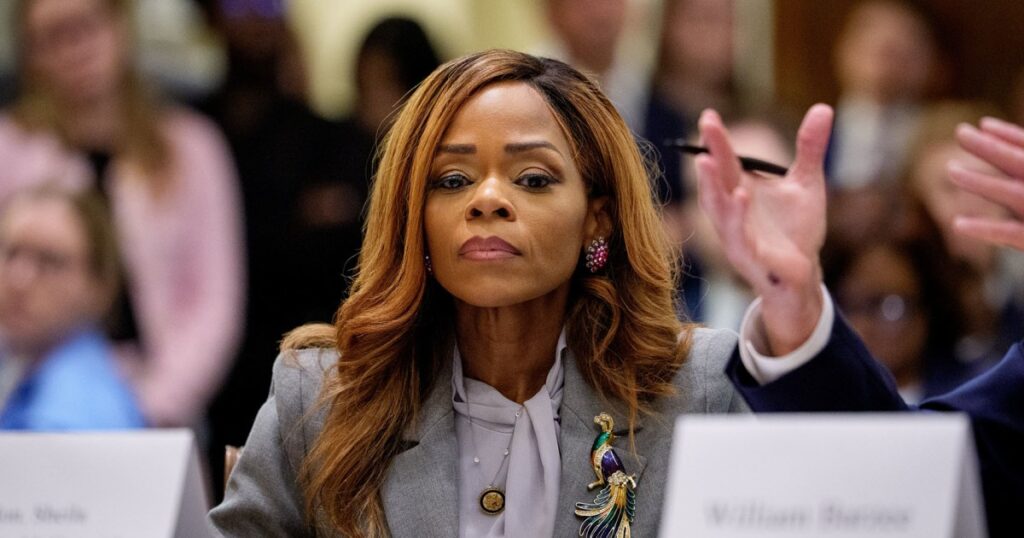
WASHINGTON — After a rare and dramatic public hearing, a special House Ethics subcommittee on Friday found Rep. Sheila Cherfilus-McCormick, D-Fla., guilty of 25 ethics charges, capping a three-year investigation into allegations she stole millions in federal relief funds and funneled some of that to her congressional campaign.
The secret vote came after Cherfilus-McCormick and her attorney sat for a nearly seven-hour televised House trial, after which lawmakers on the panel deliberated overnight for hours before reaching their decision.
Cherfilus-McCormick has denied wrongdoing and pleaded not guilty in a separate but related federal criminal case.
“I look forward to proving my innocence,” the congresswoman said in a statement. “Until then, my focus remains where it belongs: showing up for the great people of Florida’s 20th District who sent me to Washington to fight for them.”
The decision likely sets the stage for Cherfilus-McCormick’s ouster from Congress. Even before the trial, GOP Rep. Greg Steube, a fellow Floridian, had threatened to force a vote on expelling the congresswoman from the House.
After Friday’s development, several Democrats publicly called on Cherfilus-McCormick to either resign or be expelled.
“You can’t crime your way into legitimate power,” Rep. Marie Gluesenkamp Perez, D-Wash., posted on X. “Since she was found guilty, she should resign or be removed.”
Minority Leader Hakeem Jeffries, D-N.Y., did not answer when asked Friday if Cherilus-McCormick should remain in the House.
The Ethics Committee said it will hold a hearing after the House’s two-week spring recess to determine any possible sanctions, which could include censure, removal from committees or expulsion.
There is recent precedent for expelling a member of Congress before the conclusion of their federal criminal case. In 2023, the House expelled then-Rep. George Santos, R-N.Y., in a bipartisan 311-114 vote, making him the first House member in modern history to be expelled before a federal conviction.
The Justice Department indicted Cherfilus-McCormick in November on charges that she stole and laundered $5 million in Federal Emergency Management Agency funding. Her family’s health care company, Trinity Healthcare Services, had been working with FEMA through a Covid-19 vaccination contract, but then received a $5 million overpayment. The Justice Department alleged she and her brother never paid it back, routed it through multiple accounts and then used it to fund her successful 2022 special election campaign.
She could face more than 50 years in prison if convicted.
The House Ethics panel — which is made up of an equal number of Republicans and Democrats — began conducting its own investigation of the congresswoman in 2023, after the nonpartisan Office of Congressional Ethics said the committee should probe the matter.
In December, the Ethics subcommittee tasked with investigating Cherfilus-McCormick adopted a statement of alleged violations against the Florida Democrat. It detailed 27 counts in which the subcommittee determined there was “substantial reason to believe” that she violated House rules, regulations or the law.
The investigative subcommittee “reviewed over 33,000 documents totaling hundreds of thousands of pages of materials and conducted 28 witness interviews” before making its determination. In January, the Ethics panel, led by Chairman Michael Guest, R-Miss., and ranking member, Rep. Mark DeSalnier, D-Calif., formed a separate, special adjudicatory subcommittee to evaluate the other subcommittee’s findings.
The Ethics panel typically conducts its business behind closed doors. But the committee decided to bring this issue out into the open — the House’s version of a court trial — because Cherfilus-McCormick has decided to fight the allegations rather than resign, and the ethics case is moving faster than the judicial system.
Throughout Thursday’s lengthy public hearing, Cherfilus-McCormick was seated beside her attorney, William Barzee. She did not speak publicly but occasionally privately conferred with Barzee, who said he had only begun representing the congresswoman three weeks ago.
Barzee told the committee that it should not move forward with a public hearing or verdict, arguing that such a decision would influence her criminal case, which is set to go to trial in April but could be delayed.
Her lawyer also said the House process was being rushed and that he should be able to call his own witnesses and cross-examine the committee’s witnesses.
“I need to be able to to see witnesses; she has a right to confront those witnesses,” Barzee told the committee members. “I have to be able to cross-examine people. We do not accept the facts as they are alleged by staff.”
The Ethics Committee’s lawyer pushed back, saying the Department of Justice had not made any request for the House panel to halt its action, and that Cherfilus-McCormick had been given ample opportunity to cooperate with their probe but chose not to. Barzee replied that the congresswoman had not fully cooperated because that was the advice of her previous legal teams.
Sydney Bellwoar, the senior counsel for the Ethics panel, told lawmakers that Cherfilus-McCormick and her siblings “funneled more than $500,000 originating from Trinity into various outside organizations that made expenditures on behalf of the campaign.”
Bellwoar said “the most egregious example” of the scheme occurred on June 23, 2021, when Trinity transferred $2 million directly to Cherfilus-McCormick, who then moved the money to her campaign the next day to make her campaign appear strong.
After the end of the filing period, on July 2, counsel said, Cherfilus-McCormick “returned the money to herself nearly in full.”