
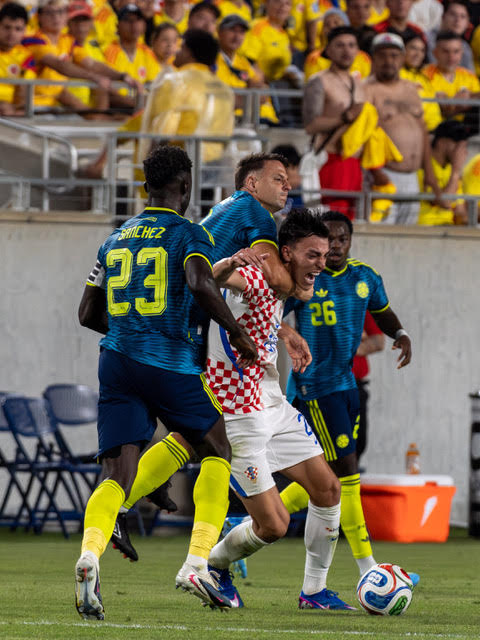
Croatia overcame an early deficit to defeat Colombia 2-1 Thursday at Camping World Stadium, with Igor Matanovic’s 42nd-minute header delivering the decisive blow in a frantic first half that produced all three goals. But the score line only tells part of the story of a night that belonged as much to the crowd, the stars on the field, and the region that hosted them as it did to the final result.
The atmosphere inside Camping World Stadium crackled from the opening whistle. The crowd, composed overwhelmingly of Colombian supporters, came to see their stars — and their stars delivered moments worthy of the occasion. When Luis Díaz received the ball on the left flank, the Bayern Munich forward drew the kind of reaction reserved for players of his caliber. The fans went wild. When Richard Ríos, the Benfica midfielder, touched the ball in the center of the park, the noise level rose again. And when captain James Rodríguez — now with Minnesota United but still unmistakably the heartbeat of this Colombian side — picked up the ball and drove precise, weighted passes into the runs of Díaz and others, the stadium responded as if it were a World Cup knockout round rather than a March friendly.
Colombia struck first and fast. Jhon Arias buried a left-footed shot from the center of the box in the second minute to the center of the goal, catching Croatia’s defense flat and giving the hosts an immediate advantage. It was no gift — just before Arias connected, Díaz had already tested Croatia with a blocked shot from outside the box, a sign of Colombia’s early aggression. Perhaps they came out a touch overconfident — they had the stars, they had the crowd, and they had the energy of a team that had not lost in over a year. But this was exactly the kind of test coach Néstor Lorenzo sought: a chance to measure his side against a European heavyweight and find out what still needs work before the World Cup arrives in the summer.
What the Colombians learned is that they can compete at this level. What Croatia showed is that they are no small player on the international stage.
Four minutes after going down, Luka Vušković leveled things with a left-footed strike from outside the box that found the bottom left corner — a composed finish assisted by Mario Pasalic. Croatia did not flinch after conceding inside two minutes. They absorbed the early shock, organized themselves, and began to impose their rhythm in a way that spoke to the experience and confidence running through their squad. Then, with the match still wide open, Croatia grabbed the lead for good. In the 42nd minute, Marco Pasalic whipped in a cross following a corner, and Matanovic met it at the left side of the six-yard box, powering a header into the center of the goal to flip the scoreline before halftime.
The first half was a genuine spectacle. Díaz was a constant menace — he had a header from the center of the box that missed left, a right-footed shot from the left side that Livakovic tipped to the top left corner, and he drew foul after foul from a Croatian defense that could not contain him cleanly. James Rodríguez tested Livakovic with a right-footed shot from the center of the box, saved in the bottom left corner. Luis Suárez missed from the right side of the box. Croatia answered with their own chances — Mario Pasalic had a header high and wide from the six-yard box and a blocked left-footed shot, while Nikola Vlasic missed from the right side after a Marco Pasalic corner. It was end-to-end soccer that left neither goalkeeper comfortable.
The second half opened with Croatia making two changes at halftime, bringing on Petar Musa for Matanovic and Josip Stanišić for Ivan Perišić. Musa made his presence felt immediately, hitting the crossbar with a right-footed shot from the right side of the box in the 61st minute, then striking the left post from the center of the box in the 66th — two moments that would have put the match out of reach. Livakovic, meanwhile, made a strong save on a James Rodríguez left-footed effort from outside the box in the 58th minute, pushing it to the top center of the goal.
Then came the moment that briefly united both sets of supporters. When Luka Modrić — Ballon d’Or winner, living legend, and the defining midfielder of his generation — entered the match in the 79th minute replacing Mario Pasalic, Camping World Stadium responded with a roar that cut across national allegiances. The Croatian captain took control of the game immediately. His presence changed the tempo and texture of everything around him — calming and authoritative in equal measure, a reminder of why Croatia has punched above its weight on the world stage for the better part of a decade. Where Colombia had started their stars from the opening whistle, Croatia’s coaching staff made the deliberate choice to protect Modrić and deploy him only when the game needed steadying. Two different philosophies, one shared objective: find answers before July.
Colombia threw numbers forward in the final twenty minutes. Five substitutions at the 71st minute brought on Juan Fernando Quintero, Jhon Córdoba, Andrés Gómez, Gustavo Puerta, and Santiago Arias simultaneously. Córdoba had the best late chance — a header from the center of the box in the 76th minute that Livakovic saved in the center of the goal. Gómez fired twice without finding the target. Quintero’s corner in stoppage time led to a Gómez attempt that sailed high and wide. The equalizer never came.
There was one more notable moment in the second half: starter Camilo Vargas was forced off with an injury in the 62nd minute, bringing in his backup. The replacement was not seriously tested the rest of the way — Croatia sat deep and Colombia’s final-third execution never reached the level needed to break through.
Livakovic finished with four saves. Colombia held 58.1 percent possession, earned six corner kicks to Croatia’s four, and generated 13 shot attempts to Croatia’s 12 — but managed just five on target. Colombia collected zero yellow cards; Croatia picked up three. The stats paint a picture of a Colombian side that controlled large portions of the match without ever truly threatening to take it.
Among the individual performances, one carried particular local significance. Marco Pasalic, who plays for Orlando City SC in MLS, delivered the corner cross that led to Matanovic’s winning header and was one of the most assured players on the field for stretches of the first half. In a difficult MLS season for Orlando City, Thursday gave the club and its supporters something to hold onto — one of their own, competing at the highest level on a World Cup audition stage. That is a storyline the club can carry through the summer.
The broader context of the evening extended well beyond ninety minutes. Colombia trained at Osceola Heritage Park in Kissimmee throughout the week, while Croatia set up camp at UCF. Brazil, who play their own nearby friendly, trained at ESPN Wide World of Sports at Disney. The logistical footprint of this Road to 26 series across Central Florida was a statement in itself — proof that this region has the facilities, the infrastructure, and the soccer culture to support elite international competition at the highest level. It is also worth noting that this marked the first time the Colombian national team played in Orlando and trained in Osceola County — a milestone for a county that has quietly become one of the premier soccer preparation destinations in the world.
Orlando was not selected as a 2026 World Cup host city. But nights like Thursday make the argument that the region is world-class in every meaningful sense. The stadiums, the training grounds, the passionate and diverse fan base — in an emergency, Orlando could step in without missing a beat.
Neither coach will lose sleep over the result. This is what a preparation game is — ninety minutes to evaluate personnel, test combinations, and identify what needs fixing before July. Both Lorenzo and Croatia’s Zlatko Dalić got exactly what they came for. The real stakes arrive later. Thursday night in Orlando was simply a preview — and if the crowd’s reaction to Díaz, Ríos, James, and yes, Modrić, is any indication, Central Florida will be ready when the real thing begins.