
Willow Kennedy
Sand is not a material that typically features in energy infrastructure conversations. But a project now underway in Finland is making a case for it as a practical, high-capacity medium for storing heat at industrial scale, and the results so far are worth understanding.
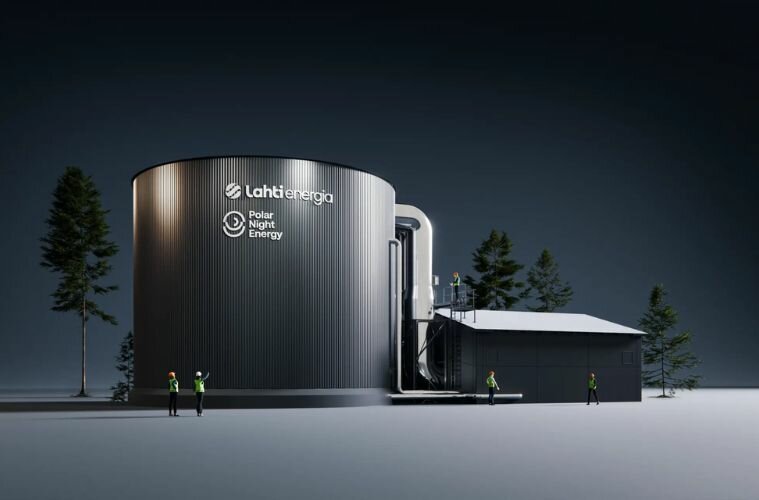
Polar Night Energy and Lahti Energia have agreed to build what will be the world’s largest sand-based thermal energy storage system, located in Vääksy, Finland. The installation will carry a heating capacity of 2 MW and a storage capacity of 250 MWh, connecting directly to Lahti Energia’s district heating network. On-site construction begins in early 2026, with completion scheduled for summer 2027.
How the System Works
A Sand Battery is a high-temperature thermal energy storage system. Renewable electricity is used to heat approximately 2,400 tons of locally sourced natural sand to temperatures above 500 degrees Celsius. That heat is then held and discharged into the district heating network on demand.
The completed unit will stand roughly 14 meters tall and 15 meters wide. A separate technical building will be constructed alongside it. The energy storage medium, natural sand, is widely available, inexpensive, and well-suited to the extreme temperatures required for this type of high-density storage.
The project is receiving energy aid from Business Finland, Finland’s government funding agency for research, development, and innovation.
What the Numbers Show
Lahti Energia projects that the Sand Battery will reduce fossil-based emissions in the Vääksy district heating network by approximately 60% annually. That reduction is driven by an estimated 80% decrease in natural gas use, alongside a meaningful reduction in wood chip consumption. For a network serving around 5,000 residents, that is a material shift in how local heat is produced and sourced.
There is also a grid services dimension. Lahti Energia’s CEO Jouni Haikarainen noted that the scale of the system enables participation in Fingrid’s reserve and grid balancing markets, the Finnish transmission system operator’s mechanisms for managing supply and demand fluctuations. As weather-dependent renewables make up a larger share of the grid, storage assets capable of providing that kind of flexibility carry operational value beyond their primary heating function.
Proven in the Field
This is not Polar Night Energy’s first commercial deployment. The company’s previous Sand Battery, built for Loviisan Lampo in Pornainen, Finland, has been operating for six months and has delivered reliable performance in real-world conditions. That operating track record matters when evaluating a technology that is still relatively early in its commercial life.
The company is currently in negotiations for several additional projects covering both district heating and industrial applications. The technology has recently received recognition from TIME magazine’s Best Inventions of 2025 list, the Capgemini Nordic Sustainability Tech Award, and a special award at the COP30 climate conference through the Mission Innovation Net-Zero Industries Mission.