
— The good news is that the overall workforce in Becker County is expected to grow at twice the rate of greater Minnesota as a whole — 6.7% for Becker County compared to 3.3% for greater Minnesota overall. That forecast covers the years 2025 to 2035.
The bad news is that Becker County needs to see people continue to move in — a trend called positive net migration — or that growth won’t happen and the labor force will stagnate.
Need proof? Just look at the numbers from April 1, 2020 to July 1, 2024: The net migration into Becker County was 471 people — 406 domestic and 65 international.
Without those new people, Becker County would have actually lost 212 residents, because more people died than were born in the county during that time period.
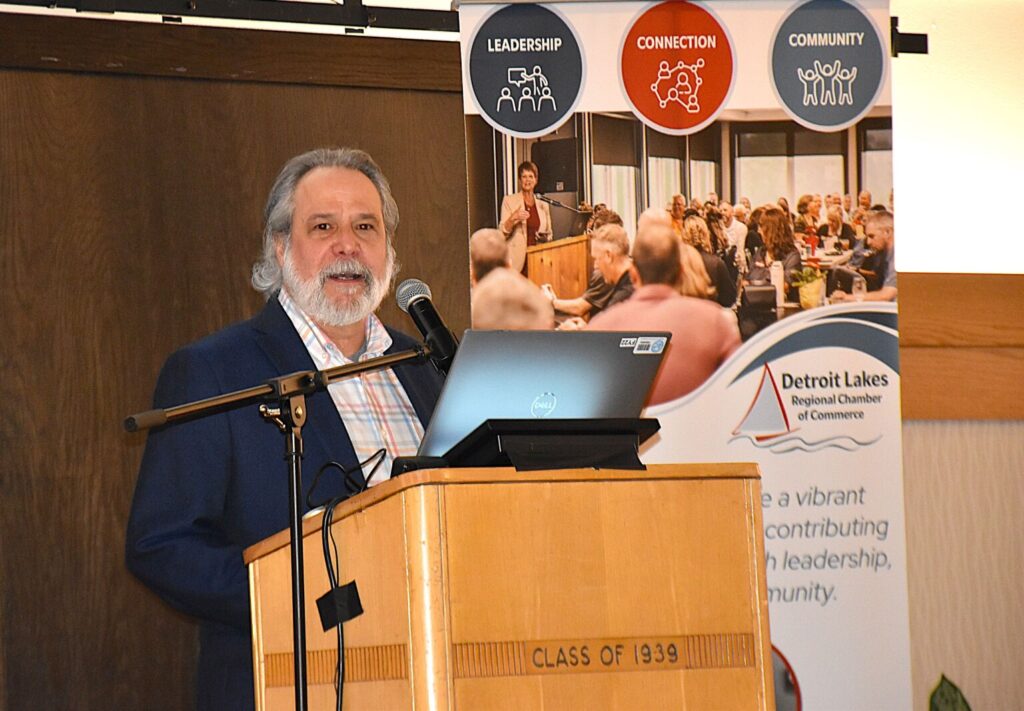
That’s why “communities need to be attractive to workers, not only to retirees,” said Anthony Schaffhauser, the Minnesota Department of Employment and Economic Development’s regional analyst for Northwest Minnesota.
He gave an analysis before a full house Friday at the Economic Summit held in the Holmes Ballroom by the Detroit Lakes Regional Chamber of Commerce.

Nathan Bowe / Detroit Lakes Tribune
One of Becker County’s saving graces over the last 10 years has been its population of young people — its up and coming workers. But that advantage is forecast to slip away through the year 2035, as the number of retiring workers grows higher than the number of youngsters entering the working world.
That’s why it’s so important that new people move to Becker County to grow the labor force, he said.
It doesn’t help that female employment has gone from growing to shrinking over the past dozen years, he added.
The number of women working in Becker County grew by 4% in the six years before covid hit in 2019, But dropped by 3.3% in the six years after the pandemic struck Becker County — a decline that’s part of a larger trend, he said.
The biggest workforce loss in Becker County over the last six years involved women ages 22 to 34 — a 25% drop — and also women ages 55 to 64, a 14% drop. There was not a similar drop in the number of male workers of the same ages.
The number of women leaving the workplace is likely because of childcare needs and to help aging parents and others. “There’s really no other plausible cause for it,” Schaffhauser said.
In general, most of the job openings through the year 2032 in northwestern Minnesota will come through vacancies due to retirements, as the huge Baby Boomer generation finishes its time in the workforce, a trend that is seen in almost all types of jobs.

Nathan Bowe / Detroit Lakes Tribune
The most jobs now in Becker County are in health care and social assistance (3,551 jobs), followed by manufacturing (2,420 jobs), retail (1,890 jobs), accommodation and food services (1,633 jobs) and educational services (1,033 jobs), according to Schaffhauser. There are about 15,400 jobs total in the county.
So how easy is it to get a job these days? About the same or a little more difficult than it was a year ago, according to Concentrated Employment Service employees, who were asked to rate their clients’ job-hunting experiences.
The unemployment rate in Becker went from 4.3% in October to 6.1% in December, and initial unemployment claims were up by 11% in January, compared to a year earlier, Schaffhauser said. That’s much higher than statewide initial unemployment claims, which were up just under 1% during that same time period.
On the other hand, continuing unemployment claims were down 9% in January, compared to a year earlier. That compares to down 3.3% statewide. So those alarming initial rates could just be due to more people in the workforce, he said.
At any rate, the jury is still out on whether the job market is really loosening, as it appears to be, and if so, by how much, he said. Time will tell what direction the local economy is going.
Jackie Buboltz, president of the Detroit Lakes Regional Chamber of Commerce, hosted the Economic Summit. Others who spoke there were Erick Garcia Luna, regional outreach director at the Federal Reserve Bank in Minneapolis; Katie Vasey and Deon Strapp on behalf of the Compass Young Professionals Network; photographer Jaime Kopveiler, who owns Overflow Creative; and Rachel Lawlor, the new vice president-administrator at Essentia Health St. Mary’s.
Giving updates at the summit were Detroit Lakes City Administrator Kelcey Klemm; Detroit Lakes Economic Development Director Hope Williams; Becker County Administrator Carrie Smith; Frazee Economic Development Coordinator Joe Tonihka; and Sarah Hofman, Dylan Ramstad Skoyles and Jim Granger, who all appeared on behalf of the Becker County Trails Collaborative.
Those presentations were followed by table discussion as those at the Economic Summit talked about what should be done with all that information.

Bowe covers the Becker County Board and the court system for the Tribune, and handles the opinion pages for the Tribune and Focus. As news editor of both papers, he is the go-to contact person for readers and the general public: breaking or hard news tips, story ideas, questions and general feedback should be directed to him.