
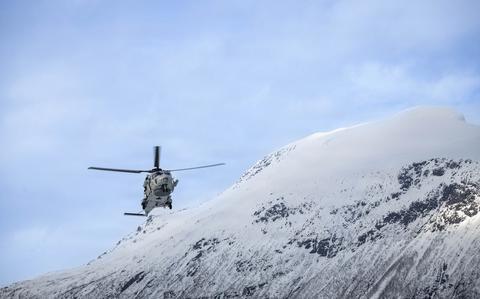
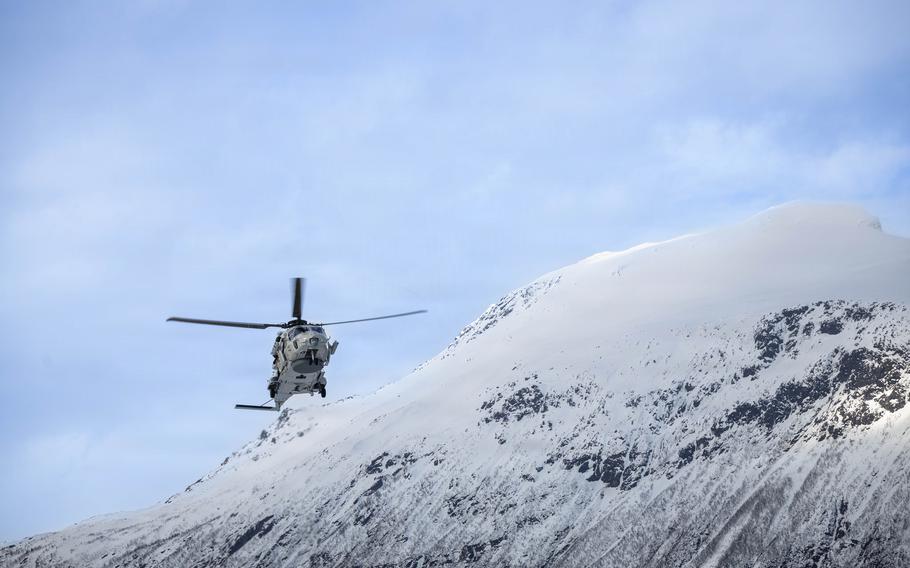
An NH90 NATO helicopter prepares to land in an airfield in Setermoen, Norway, March 18, 2026. NATO Secretary General Mark Rutte visited U.S. Marines and NATO Allies to highlight the strength of NATO’s joint force while observing their operational capabilities in an Arctic environment during Cold Response 26. (Alexis French/U.S. Marine Corps)
Russia and China are challenging the American and allied presence in the Arctic by expanding military and commercial activity around the North Pole at a time when American military focus is on other parts of the world, a congressional panel was told.
“If we do not maintain a sustained focus on strengthening America’s Arctic security, we will have failed in our duty to protect the United States,” Heather Conley, a senior fellow at the American Enterprise Institute, testified Thursday.
Conley and two other experts on Arctic security spoke Thursday at a joint hearing by two House Homeland Security Committee panels — the Subcommittee on Transportation and Maritime Security and the Subcommittee on Counterterrorism and Intelligence.
The hearing was called “Arctic Security in an Era of Global Competition: Safeguarding U.S. Interests in Frigid Waters.”
Rep. Carlos Gimenez, R-Fla., chairman of the House Subcommittee on Transportation and Maritime Security, described the ongoing competition between countries for a dominant role in the “High North.”
“In recent years, Putin’s Russia has significantly expanded its military footprint in the region, while Communist China has sought to project its influence through increased deployments of icebreakers and other polar-capable vessels,” he said.
The discussion of Arctic policy returned to the overall political approach of President Donald Trump.
Republicans and Democrats on the subcommittees, as well as Conley and other witnesses, agreed that the $25 billion increase in funding for the Coast Guard — a key line of military defense in the Arctic — was an important policy step.
But more was needed, they said.
Russia has the largest fleet of icebreakers in the world, including some nuclear-powered models and a new design incorporating a deck gun and space for ship-to-ship missile launchers.
“Despite its ongoing war with Ukraine, Russia has quietly expanded its military footprint in the High North and reactivated its Cold War-era bases to deploy more advanced air and missile defense systems and increase complex naval operations across the region,” Gimenez said.
China has backed up its declaration as an emerging Arctic power with the construction of its own icebreakers as well as the expansion of commercial and scientific missions to the region.
Russia and China have conducted joint naval and air exercises near the territory of the U.S., Canada and NATO allies.
The funding “gives the U.S. an unprecedented opportunity to deploy the Coast Guard’s Arctic assets and exert greater dominance,” Gimenez said.
Rep. LaMonica McIver, D-N.J., the ranking member, said Trump’s pronouncement about Canada becoming the 51st state and taking over Greenland, a territory of Denmark, has done damage to the NATO alliance.
“Trump has threatened to invade Greenland, an insane proposition that has angered and made our NATO allies very wary,” McIver said. “When we undermine trust with our closest partners, we do not strengthen our position. We weaken it. The United States cannot lead in the Arctic alone, and we cannot afford to create conditions that prompt our allies to question our trustworthiness.”
Gimenez countered that Trump was trying to get allies to pay more for the cost of common defense, not to erase NATO.
“It is the greatest alliance, and it’s the one that keeps the world safe,” Gimenez said. “But they needed to step up.”
Conley said Canada and Denmark have pledged major increases in spending to defend the Arctic. The United States needs to follow through on its own efforts as well, she said.
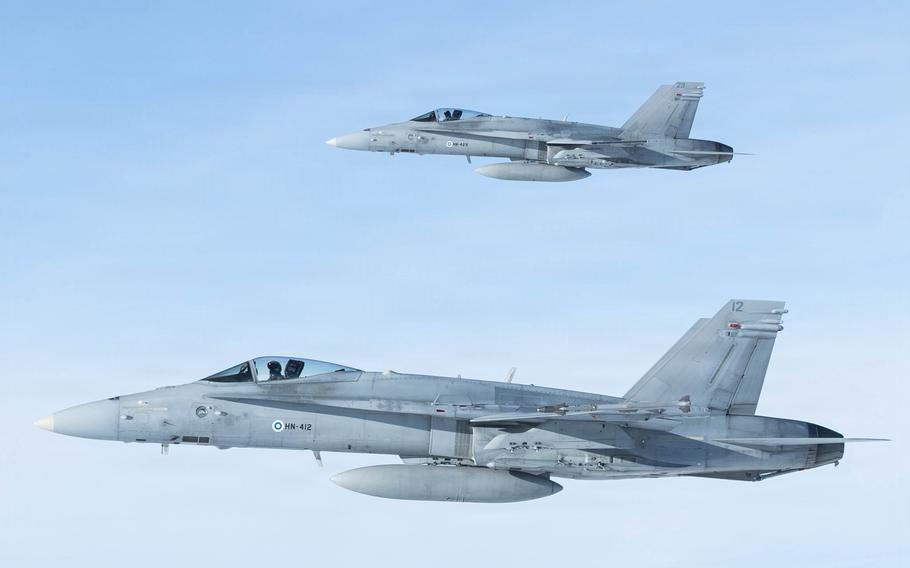
Finnish air force F/A-18 Hornets near Evenes Air Station, Norway, March 16, 2026. (Mya Seymour/U.S. Marine Corps)
“The Arctic region is within Homeland Defense,” Conley said. “It’s part of our integrated defense of the Western Hemisphere. The ongoing modernization of our Arctic-based missile defense architecture, as well as developing a persistent presence in the maritime Arctic, with overdue investments in our icebreaker fleet, are critical components of this shift.”
Bryan Clark, senior fellow and director of the Center for Defense Concepts and Technology at the Hudson Institute, said that modernizing American defenses in the Arctic was a crucial step. Until recently, Clark said, the region was a strategic “flyover” for defense.
But with warmer temperatures opening up new naval routes and exposing NATO sensors and undersea communications lines, defense across multiple domains was paramount.
“We need to start translating our aspirations into something real on the ground and in the air,” he said.
Clark pointed to the rapid growth of drones and remote or autonomous vessels, which could require the U.S. to “plug a hole” in Trump’s proposed “Golden Dome” anti-ballistic missile plan.
“Look what’s happening right now in Iran, what’s happening in Ukraine — drones are now the newest air threat that we’re going to face, and drones can be deployed from uncrewed vessels of their own, or they can be deployed from civilian vessels that merge into background commercial traffic,” Clark said. “We could find ourselves facing significant threats, via the Arctic, that have nothing to do with ballistic missiles, and on a scale that our existing defenses would not be able to handle. We could easily find ourselves overwhelmed and surprised.”
Marisol Maddox, Senior Fellow at the Institute of Arctic Studies at Dartmouth College, told the lawmakers that Russia’s ability to restock its supplies of weapons despite the war in Ukraine shouldn’t be underestimated. She also underlined that China sees the region as a key component to its future power projection.
Maddox said that environmental changes in the Arctic had important military and political implications. The widening of sea lanes and the exposure of more land require the maintenance of growing infrastructure.
Major fires in the Canadian wilderness create smoke and particulate matter that degrade U.S. military and allied sensor data quality, Maddox said. She pointed to other climate change effects on the Arctic that she said have an impact on seafood harvesting, Indian subcontinent monsoon patterns, prolonged droughts, and other conditions around the world that will draw even more nations to express an active national interest in the Arctic region.
“And for this reason, I recommend referencing the planetary boundaries framework to appreciate the complexity of changes underway,” Maddox said. “The Arctic remains a region strongly characterized by transboundary challenges and opportunities. The growing risk of wildfire in the Arctic puts our assets, personnel and readiness at risk.”