
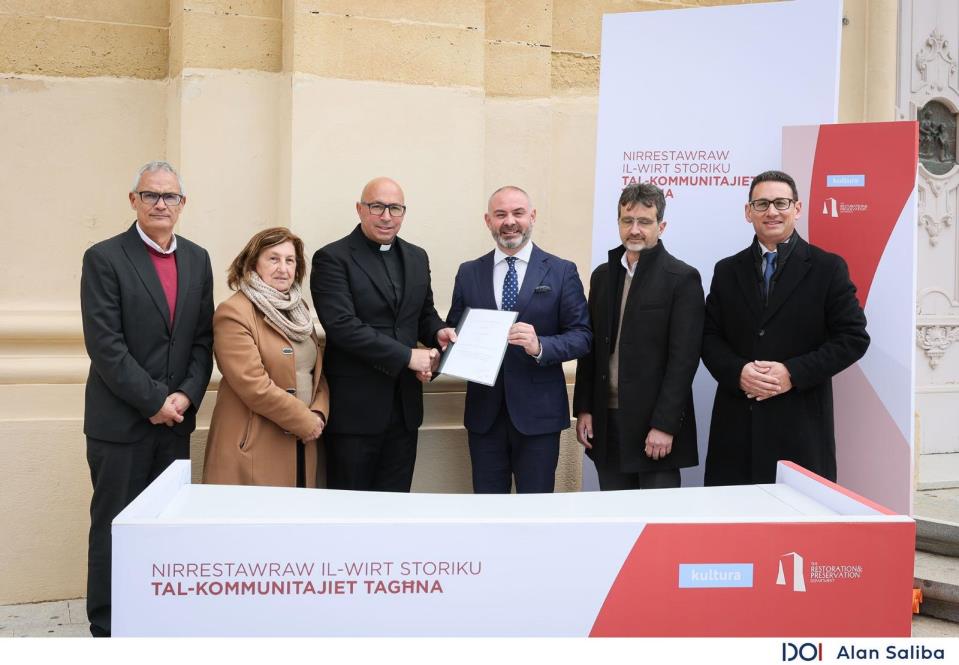

A major restoration project has been announced for the Parish Church of St Catherine of Alexandria in Żurrieq, following the signing of an agreement between the parish and the Restoration and Preservation Department, the government said.
Culture, Lands and Local Government Minister Owen Bonnici presided over the agreement, which paves the way for an extensive restoration programme aimed at restoring the parish church to its former glory.
Bonnici described the project as an important investment in Malta’s cultural and religious heritage, saying it strengthens the identity of the Żurrieq community while safeguarding the church’s historic beauty for future generations. He praised the preparation and dedication of those involved and said initiatives of this kind breathe new life into the heart of Maltese villages.
He noted that the project joins other church restoration works already carried out in Malta, including those at the Jesuits’ Church in Valletta and the Trinity Church in Marsa.
The works will include restoration of the main façade and bell towers, as well as waterproofing of the roofs across the entire church complex. Other interventions will involve the replacement or restoration of dome openings in the side chapels, the design and installation of external lighting, and improvements to the lightning protection system for the bell towers.
The agreement is intended to ensure the conservation and protection of the church’s historical and architectural value.
The Żurrieq parish church, dedicated to St Catherine, is one of the oldest and most significant churches in Malta. Its origins date back to medieval times, although the current structure was built in the 17th century to a design by renowned architect Lorenzo Gafà.
The church is known for its artistic interior, which includes works by notable painters, and it has remained an important spiritual and cultural centre for the Żurrieq community over the years. Żurrieq itself is one of the 10 parishes that were already in existence by 1436. The present Baroque church was built between 1634 and 1659 and was consecrated in 1731.
The agreement was signed by Restoration and Preservation Department Director General Architect Norbert Gatt, Archpriest Fr Daniel Cardona, and Malta Archdiocese Administrative Secretary Michael Pace Ross.