
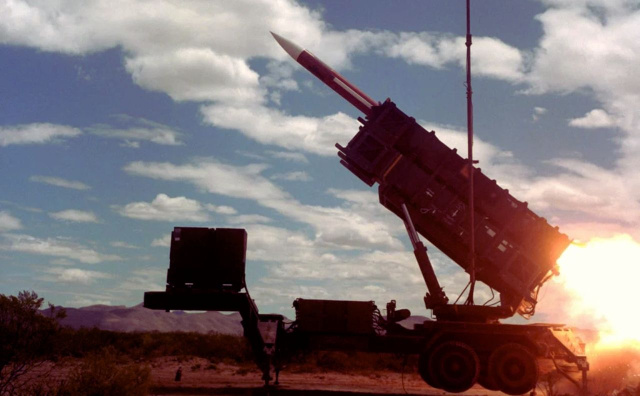
Greece has reportedly expanded its regional air defense involvement, including measures linked to the protection of Bulgarian airspace, amid heightened tensions in the wider Middle East following strikes involving the US, Israel and Iran. Athens deployed a Patriot missile system and two F-16 aircraft in northern Greece at Bulgaria’s request, as concerns over potential spillover threats into the Balkans increased.
The security environment is described as increasingly volatile, with references to intercepted ballistic missiles heading toward Turkey and a drone strike on the British Akrotiri base in Cyprus. These developments have been interpreted as part of a broader pattern of regional risk, prompting NATO members to reassess air defense coordination and readiness.
Beyond Bulgaria, Greece is also said to be involved in wider defense commitments. Its airspace responsibility for North Macedonia continues under NATO arrangements, while a Greek Patriot battery has been positioned in Saudi Arabia since 2021. Reports indicate that this system has recently been engaged in intercepting Iranian ballistic missiles during attacks in the Gulf region.
Greek defense capabilities have also been deployed in maritime operations, including EU missions in the Red Sea aimed at countering drone threats from Houthi forces. The domestically developed Centaur anti-drone system has been used on naval platforms, including frigates operating in the region and deployments connected to Cyprus following security requests linked to escalating conflict risks.
At the center of Greece’s evolving defense posture is a large-scale modernization program approved by the Government Council for Foreign Policy and defense, valued at around five billion euros. A key component is the proposed “Achilles Shield” multi-layered defense network, designed to integrate air, missile and anti-drone protection, with estimates placing its cost at approximately three billion euros.
The Centauros system, already tested in operational conditions, uses electronic warfare methods to disrupt drone navigation and communications, forcing hostile UAVs to land, return or crash. It has been integrated with systems such as Israel’s BARAK-MX, allowing combined electronic and kinetic interception capabilities under unified command structures.
A significant part of Greece’s defense transformation is based on cooperation with Israel. A bilateral agreement expected in the coming months is set to cover joint production and procurement, with Greek industry participation planned at around a quarter of the work share. Deliveries of new systems are expected within 12 to 18 months after finalization.
Among the systems under discussion are SPYDER short- and medium-range air defense missiles intended to replace older Soviet-era Osa and Tor systems, David’s Sling for interception of ballistic and long-range missiles, and Barak MX as a multi-layer backbone system intended to replace older Hawk batteries. Advanced EL/M-2084 radars capable of tracking large numbers of aerial targets are also included, alongside a C4I command and control network to be developed with Greek industry participation.
Current Greek air defense still relies on a mix of American Patriot systems, Soviet-era S-300 batteries acquired via Cyprus arrangements, Hawk systems, as well as Tor, Osa and Stinger platforms, supplemented by domestic ASRAD Hellas variants and anti-aircraft artillery. Maintaining Soviet-origin systems has become increasingly difficult due to sanctions-related supply constraints.
Alongside ground-based systems, Greece maintains one of the stronger air forces within NATO and the EU, with around 200 combat aircraft. The fleet is undergoing modernization through the acquisition of Rafale jets, upgrades of F-16 aircraft, and planned procurement of F-35 fifth-generation fighters.
During recent discussions in Sofia, Greek defense Minister Nikos Dendias emphasized the importance of cooperation between Greece and Bulgaria in defense innovation, arguing that closer coordination between their industrial and technological ecosystems would benefit both countries and the broader European security framework. Bulgarian defense Minister Atanas Zapryanov similarly noted that there is significant potential for expanding joint work in military innovation.