Does foreign direct investment make countries cleaner or dirtier? It is one of the oldest questions in environmental economics, and decades of research have produced no consensus. Proponents of the “pollution halo” hypothesis argue that multinational firms export superior technologies and higher environmental standards to host countries. Skeptics counter that foreign capital chases weaker regulation, concentrating dirty industries wherever oversight is lax. The reality, as a growing body of evidence now suggests, is more complicated than either camp acknowledges.
One study that offers fresh clarity on this question examines the case most often assumed to be settled: the United States. “Testing the Pollution Halo Hypothesis for the US: Is There a Link Between FDI and Environmental Quality” uses ecological footprint as a broad-based measure of environmental pressure—rather than relying solely on carbon emissions, which capture only one dimension of impact—to trace how foreign investment has shaped environmental outcomes across different phases of American globalization, industrial restructuring, and regulatory change.
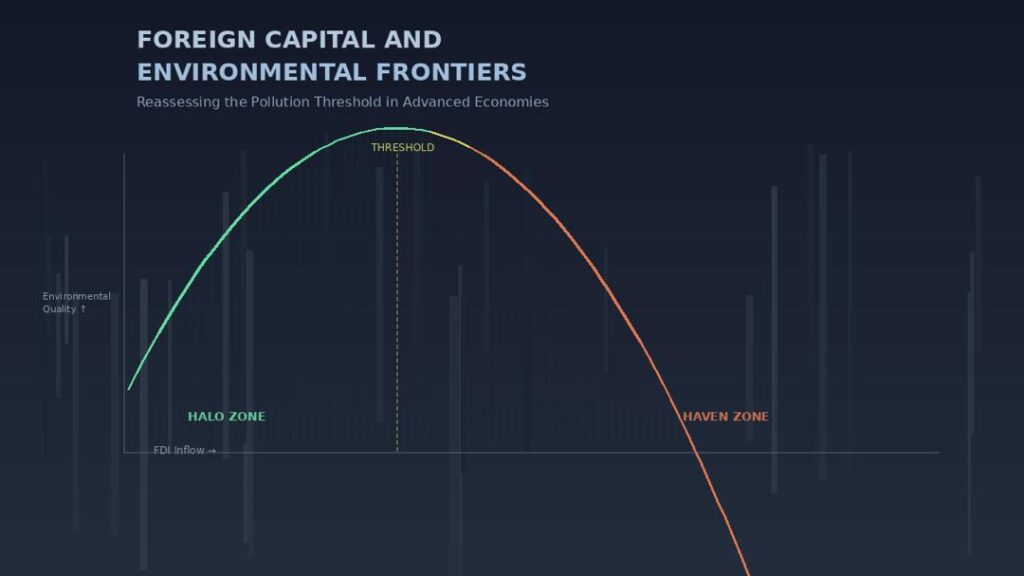
The central finding is a nonlinear, inverted U-shaped relationship between FDI and environmental degradation. At lower levels, foreign investment is associated with improvements in environmental quality. The mechanism is consistent with halo theory: multinational firms introduce cleaner production methods, more efficient resource use, and operational standards that often exceed domestic benchmarks. But the relationship reverses beyond a threshold. As foreign investment scales up, the sheer volume of additional economic activity begins to overwhelm efficiency gains, driving up ecological footprints and intensifying environmental stress.
The research, conducted by Glory David Adebayo, an economist based at Florida International University whose work has focused on the intersection of trade, capital flows, and environmental sustainability, identifies a threshold effect with important implications. The environmental impact of foreign investment is not a fixed property of FDI itself but depends on the conditions under which capital is deployed. Investments directed toward high-emission sectors or regions with weaker regulatory enforcement tend to accelerate degradation, while those channeled into innovation-driven, low-carbon industries produce the opposite effect. Domestic absorptive capacity—the host country’s technological readiness, human capital depth, and institutional coordination—plays a decisive role in determining which outcome prevails.
The study also demonstrates that the pollution halo and pollution haven hypotheses are not mutually exclusive. Both dynamics can coexist within the same economy at different levels of investment intensity. This nuance matters for policy. Rather than debating whether FDI is inherently good or bad for the environment, the relevant question is how to manage its scale, sectoral composition, and regulatory context to maximize the halo effect while containing the haven risk.
For the United States, where debates over industrial policy, environmental regulation, and foreign investment screening have intensified in recent years, these findings offer a data-driven framework for thinking about the environmental trade-offs embedded in globalization. For developing economies seeking to attract investment without sacrificing environmental goals, the message is equally direct: the regulatory and institutional environment surrounding foreign capital matters at least as much as the capital itself.