
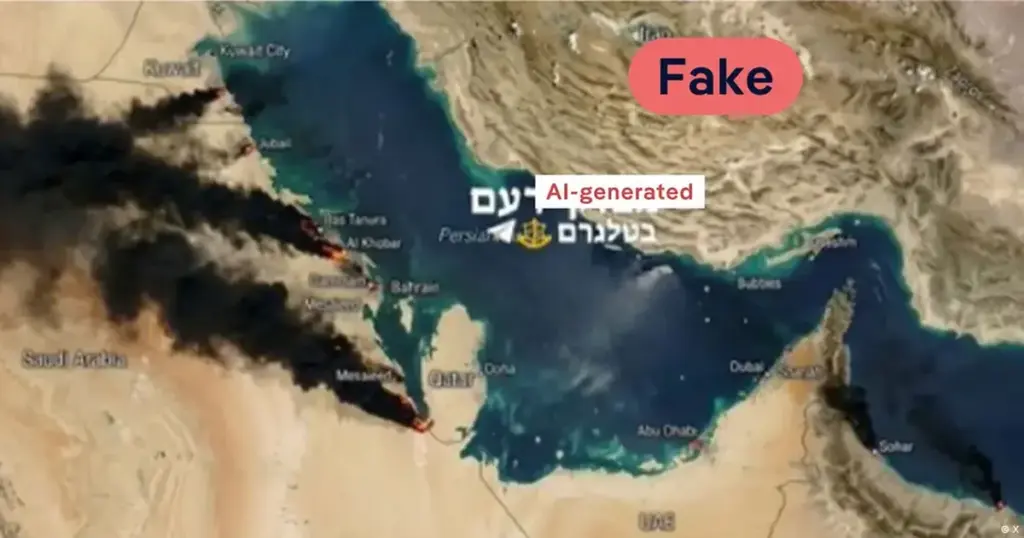
While the military conflict between the US-Israeli coalition and Iran continues to escalate on the ground, another battle is taking place in the information space. Satellite images, once considered irrefutable visual evidence of war damage, have become the latest propaganda tool, thanks to manipulations generated by Artificial Intelligence (AI).
According to media fact-checking experts, the general public has limited knowledge of how satellite imagery works, which makes them particularly vulnerable to fraud.
“If you change a small detail in a satellite image, it is very likely that no one will notice,” explains Symeon Papadopoulos, an AI researcher at the Greek institute CERTH.
Why is this happening now?
The rise of this phenomenon is linked to two main factors. First, new AI tools make it incredibly easy to take a real map from Google Earth and add artificial destruction effects. Second, commercial satellite providers often restrict the release of high-resolution images during conflicts for security reasons. This information gap is quickly filled by fakers on social media .
Three flagrant cases discovered by experts:
1. Fake fires in Qatar and the “Gemini” watermark
A viral image on Platform X claimed to show oil fields burning in Qatar after an Iranian missile attack. Although the image closely mimicked the colors of a satellite, one detail gave it away: the watermark of the AI ??tool Gemini was clearly visible in the lower right corner. According to detection tools, the image was a real map with unnatural smoke plumes artificially added to it.
2. The “Before and After” case published by Iranian state media
The Iranian newspaper Tehran Times released satellite images purporting to show the destruction of a US radar site in Qatar. Analysis revealed two hoaxes: First, the real location was a base in Bahrain (which had indeed been attacked, but not on that visual scale). Second, while the “before” photo was a real Google Earth view from 2025, the “after” photo was entirely AI-generated, with illogically warped building structures and cloned debris.
3. The fake account “MizarVision”
Another disinformation campaign used a fake account that mimicked the legitimate Chinese geospatial intelligence company, MizarVision. The ghost account posted black-and-white satellite images of the Ras Laffan refinery in Qatar with nearly identical smoke plumes. Investigations revealed that the explosions had been artificially cloned onto real-life renderings of oil tanks. The real Chinese company issued an official statement distancing itself from these fraudulent posts.
Appeal for vigilance
Open source intelligence (OSINT) analyst Brady Africk emphasizes that the public needs to change its approach.
“People think that because capturing a satellite image is difficult, it can’t be faked. That’s not true. They’re just photographs and can be manipulated like any other image.”
In this era where conflicts are broadcast in real time, raising digital literacy and a healthy skepticism towards dramatic “satellite” revelations are essential to avoid falling prey to war propaganda.