
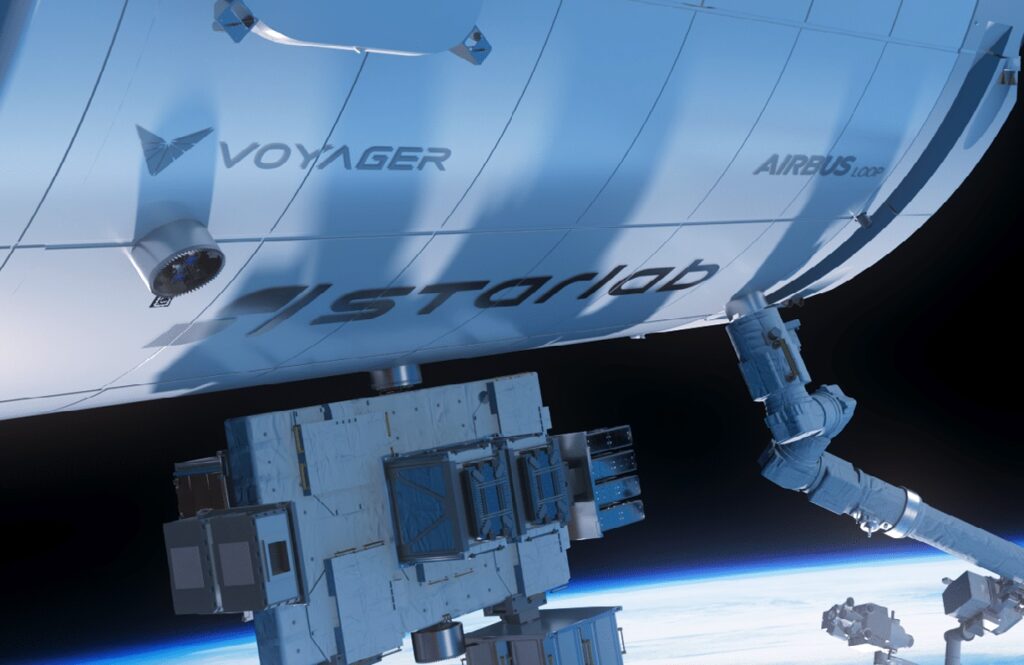
As the International Space Station (ISS) approaches retirement around 2030, a new generation of orbital platforms is preparing to take its place. Among them, one concept stands out for its ambition: launching an entire “science park in space” in a single mission.
That project is Starlab. Developed by Starlab Space LLC, the station is designed to enter orbit largely complete and begin operations almost immediately. If all goes according to plan, it could become a continuously crewed commercial outpost as early as 2029, offering a very different vision of life and work in low Earth orbit.
From ISS to Starlab: A Different Kind of Successor
For more than two decades, the ISS has been the backbone of human activity in low Earth orbit. Ageing hardware, rising maintenance costs, and an agreed end-of-life mean the station is headed for controlled deorbit by the end of this decade. NASA’s answer is not to build another ISS, but to support a portfolio of privately developed stations under its Commercial LEO Destinations (CLD) programme and become a customer rather than an owner. Within this new landscape, Starlab positions itself as one of the most ambitious successors.
Who Is Building Starlab?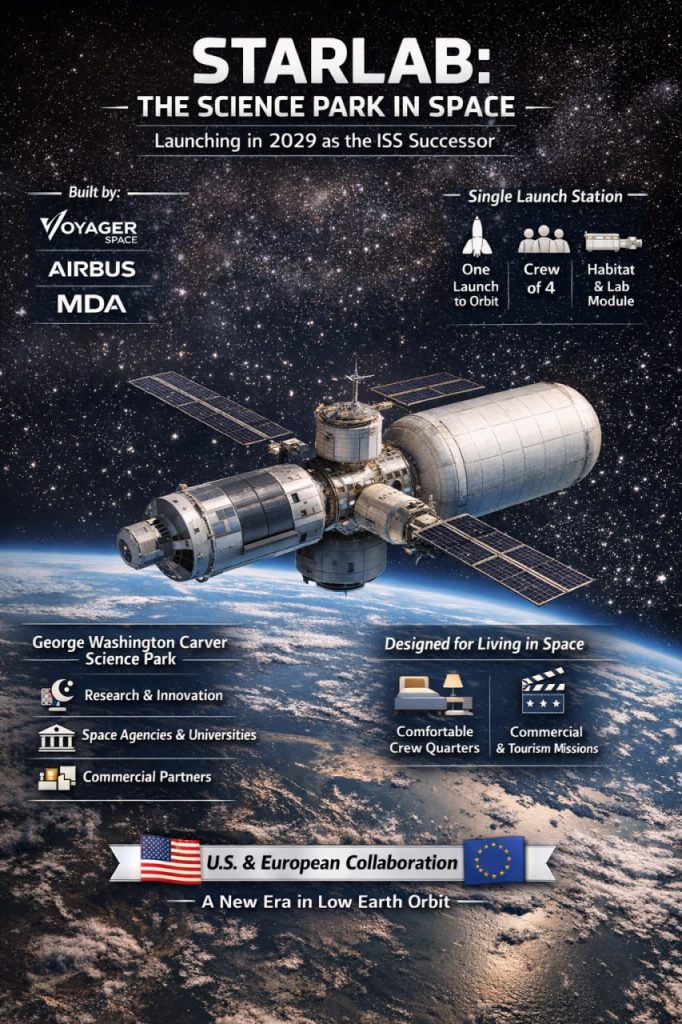 Credit: Orbital Today
Starlab Space LLC brings together several major players from across the space industry. The project is led by Voyager Space, the parent company of Nanoracks, alongside Airbus, which has extensive experience building ISS components and parts of NASA’s Orion spacecraft. Other partners, including Mitsubishi and MDA Space, contribute expertise in robotics, structures, and systems.
Originally, Nanoracks secured one of NASA’s largest CLD awards to develop Starlab. The goal was to build on its experience hosting experiments and commercial payloads aboard the ISS. The creation of Starlab Space LLC formalised the effort and strengthened it with a transatlantic industrial base, making the project more attractive to both U.S. and European customers.
A Station in One Launch
One of Starlab’s defining features is its architecture. Unlike modular concepts that grow piece by piece over many launches, Starlab is designed to reach orbit largely complete. Its architecture combines a large, semi-inflatable habitat and laboratory section with a rigid docking node and an attached service module that supplies power and propulsion. The whole complex is intended to ride to low Earth orbit on a single heavy-lift rocket.
Once deployed and inflated, Starlab is planned to offer a pressurised volume, electrical power, and payload capacity in the same class as the ISS, but arranged in a more compact, integrated layout. The station is designed to support continuous crews of up to four people. It also has the flexibility to host visiting vehicles and additional users through its docking hub.
An Orbital Science Park
At the core of Starlab’s identity is the George Washington Carver Science Park, billed as the first science park in space. Instead of being just a government lab with some commercial users, Starlab is positioned as an orbital campus. It is designed for space agencies, universities, startups, and established companies to run long-term programmes in microgravity.
The Science Park concept is meant to make Starlab feel familiar to terrestrial innovators: think of university campuses or technology parks, but with access to conditions impossible on Earth. Research in pharmaceuticals, advanced materials, agriculture, and in-orbit manufacturing is all on the table, alongside traditional space-science experiments. The goal is to turn low Earth orbit into a place where research and development happen as a matter of routine, not as an occasional experiment.
Designing How People Will Live There
Starlab is not only focused on science, but it is also rethinking how people live in space. One of the more human-facing aspects of Starlab is its partnership with Hilton. The hotel brand is working with Voyager and Starlab to help design crew quarters and shared spaces on the station. It is applying its experience in long-stay comfort to a very unconventional environment.
Crews on Starlab are expected to spend extended periods in orbit, where privacy, sleep quality, lighting, and well-designed common areas can have direct impacts on well-being and performance. By involving hospitality specialists early, Starlab aims to make its interiors more liveable than earlier generations of stations, where ergonomics and comfort often took second place to pure engineering.
What Will Happen Onboard
Starlab is designed to support a wide range of activities. Government space agencies will continue to use it for human spaceflight research and long-term scientific studies. At the same time, universities and research institutes will gain more consistent access to microgravity.
Private companies are expected to play a central role. This includes biotech firms, materials developers, and emerging in-space manufacturers. Together, they will form the core community of the science park.
In addition, Starlab could host commercial astronaut missions, technology demonstrations, and even media or tourism projects, depending on how the market evolves.
What Makes Starlab Stand Out
Several features distinguish Starlab from other proposed stations. First, there is the single-launch approach, which allows it to arrive in orbit ready for operations. Second, its “science park” model positions it as more than just a laboratory; it is intended as a hub for ongoing activity.
The project’s transatlantic partnership also stands out. By combining U.S. and European expertise, Starlab presents itself as a truly international platform.
Finally, its focus on habitability and user experience signals a shift in priorities. The station is designed not just to function, but to support long-term human presence more sustainably.
Challenges on the Way to Orbit
Despite its promise, Starlab faces significant challenges. Technically, the project must finalise and certify a complex design that combines inflatable and rigid elements. It also needs to integrate with launch systems and visiting spacecraft. And it’s all on a tight timeline aligned with the ISS retirement.
Commercially, success will depend on demand. Starlab must secure long-term customers beyond NASA and compete with other CLD projects. Its science park model will need to prove that it can attract a steady flow of users and projects.
Overall, as the race to replace the ISS accelerates, Starlab offers a distinct vision. Not a replica of the past, but a new kind of destination: one built from the start for a wider community in space.