
Mexico and Canada formalize a bilateral framework to scale collaboration in AI, energy transition, and health technologies, addressing gaps in Mexico’s R&D ecosystem. The agreement impacts academia, industrial sectors, and public institutions, reinforcing North American integration, supporting innovation-led growth, and aligning with Mexico’s policy priorities.
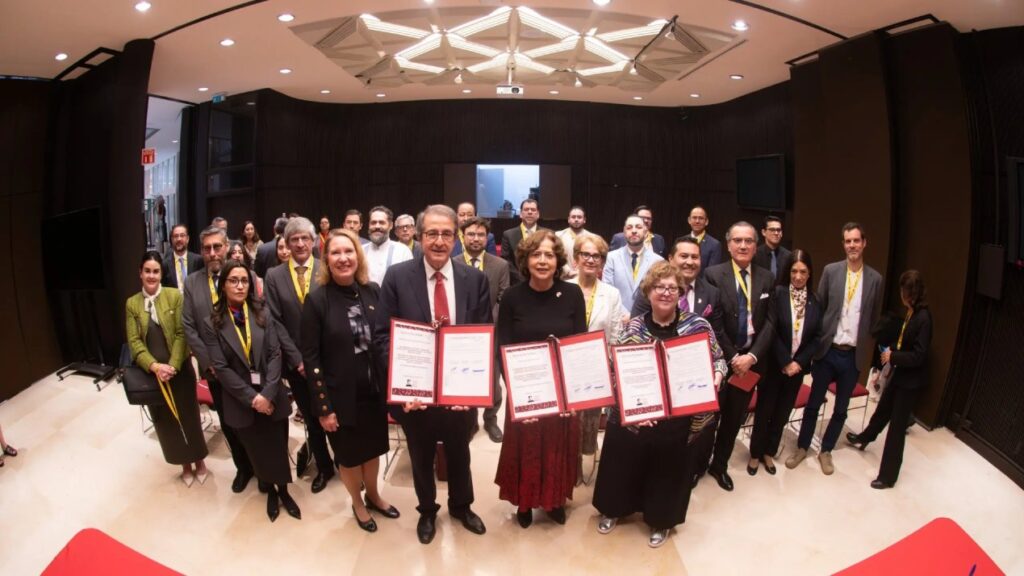
The Ministry of Science, Humanities, Technology, and Innovation (SECIHTI) and Canadian research councils signed a Memorandum of Understanding (MoU) to institutionalize bilateral cooperation in AI, energy transition, and health technologies. This agreement establishes a formal framework to coordinate research efforts and accelerate innovation within the North American region.
This institutional alignment addresses critical gaps in technological development and basic science through shared resources and expertise. Rosaura Ruiz, Minister of Science, says that the agreement reflects a shared conviction that international cooperation in science, humanities, and technology is essential to address contemporary challenges and develop knowledge that contributes to societal well-being.
“One of the fundamental functions of the ministry is to attend to those areas that have remained lagging, especially those related to technological development, where there were a series of works and not others that had to do with the development of knowledge; we want to overcome that,” says Ruiz. She adds that scientific work must maintain an ethical sense and social responsibility, adding that there is a necessity to establish ethical limits to ensure that science remains at the service of humanity.
A Historical Partnership
The MoU occurs within a deep bilateral relationship spanning 82 years of diplomatic ties and over 30 years of free trade. In September 2025, Canadian Prime Minister Mark Carney and Mexican President Claudia Sheinbaum elevated the existing relationship to the Mexico-Canada Action Plan 2025–2028.
This plan serves as a roadmap to guide strategic actions in the bilateral relationship. Coordination is managed by the vice minister of foreign affairs of Global Affairs Canada and the Deputy Minister for North America of Mexico’s Ministry of Foreign Relations. The framework includes nine specialized working groups that target: agribusiness; forests; human capital; trade, investment, and innovation; maritime connectivity; culture and creativity; energy; environment; and mining.
Both countries are deeply integrated economically. Canada is Mexico’s third-largest trading partner and the second-largest destination for Mexican exports. Bilateral trade grew from US$4 billion in 1993 to more than US$36.1 billion in recent years. Furthermore, Canada is the fourth-largest source of foreign direct investment for Mexico, trailing only the United States, the Netherlands, and Spain. Mexican corporations also maintain a significant presence in Canada. For example, Grupo Bimbo acquired Canada Bread Co. Ltd in 2014 for US$1.3 billion and Saputo Bakery in 2015 for US$86.2 million.
Bilateral Research Verticals and Strategic Implementation Frameworks
The agreement involves the Natural Sciences and Engineering Research Council of Canada (NSERC) and the Social Sciences and Humanities Research Council of Canada (SSHRC), and identifies specific strategic areas for immediate intervention. These sectors represent high-value opportunities for B2B collaboration, industrial modernization, and social development.
The partnership prioritizes the development of AI to optimize industrial processes and health diagnostics. Collaboration between researchers from the Universidad Nacional Autónoma de México (UNAM), the National Association of Universities and Higher Education Institutions, and Canadian counterparts aims to create scalable technological solutions.
Alejandro Adem, President, NSERC, says that the council is proud to join the SSHRC and the Mexican ministry in a framework that supports researchers, students, and communities in both countries to drive the advancement of knowledge.
Mexico and Canada are also aligning strategies to manage climate change, biodiversity loss, and pollution. The working group on energy focuses on technical-scientific cooperation for renewable projects. This aligns with previous efforts, such as the memorandum between the Mexican ministry of energy and Manitoba Hydro International Ltd, to promote technical development. The new agreement strengthens these ties by focusing on the transition to sustainable energy sources and the accounting of forest carbon.
A unique component of this scientific alliance is the inclusion of Indigenous knowledge systems from both nations. The MoU highlights the importance of respecting the leadership and expertise of Indigenous peoples. Sylvie Lamoureux, Interim President, SSHRC, says that Mexico and Canada are natural partners in research, and working together allows them to generate solutions that benefit both countries and the world.
The proposal to integrate Indigenous groups into a binational meeting in 2026 aligns with the goals of the Human Capital Working Group, which recently reestablished the Binational Roundtable on Indigenous and Intercultural Higher Education.
Future Projections and Institutional Oversight
The implementation of the memorandum will be monitored by high-level officials and the directors of various Mexican research centers, including the Instituto Mora, the National Institute of Astrophysics, Optics and Electronics (INAOE), InnovaBienestar, and Centro GEO. These institutions will work to ensure that the scientific policy addresses social problems while advancing technology and basic sciences.
By leveraging the strengths of the North American trade block and integrating data-driven innovation, Mexico and Canada aim to secure their positions as leaders in the global knowledge economy.