
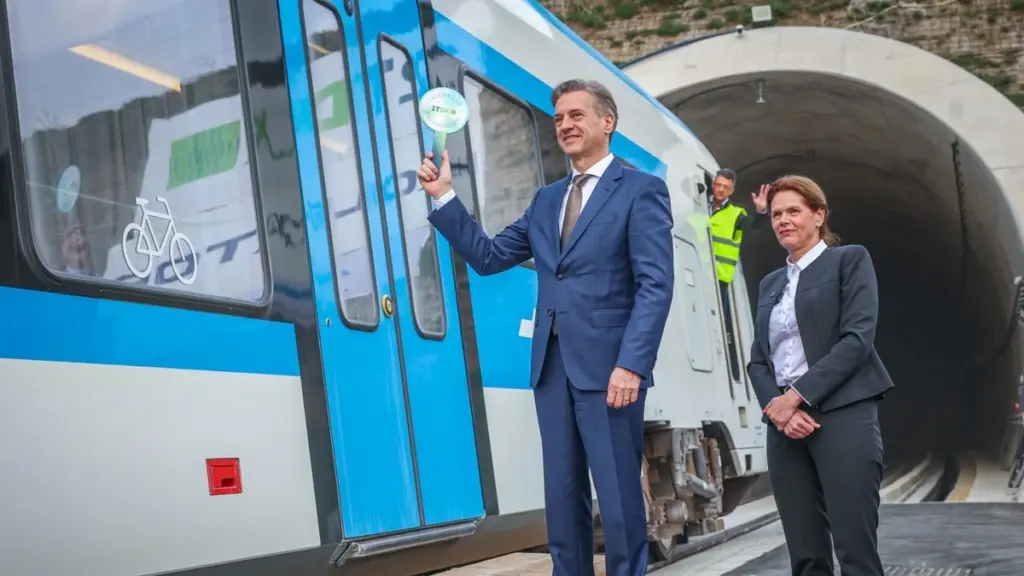
The Divača–Koper double-track line reached a historic moment for Slovenia’s national rail network as a Flirt train successfully completed its first test run.
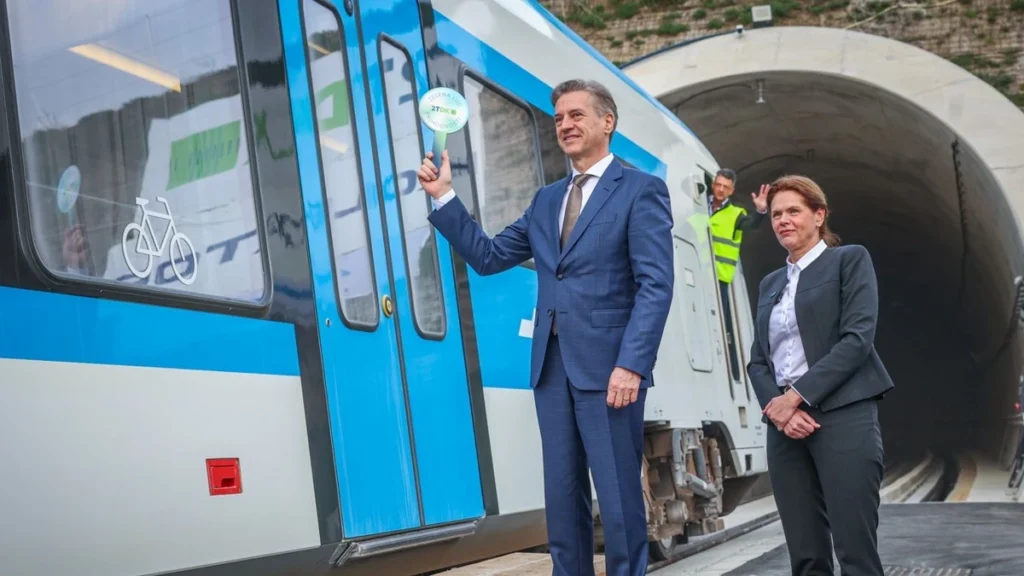 Slovenian Prime Minister Robert Golob and Minister of Infrastructure Alenka Bratušek. Photo: Government of Slovenia
This transit confirms the operational viability of a route designed to modernize the country’s logistical backbone. According to the project company 2TDK, the March 11, 2026, trial represents a major milestone for Slovenian railway infrastructure.
Don’t miss…SWR Legoland Arterio train marks 30 years of Legoland
Prime Minister Robert Golob and Infrastructure Minister Alenka Bratušek attended the event. They were joined by 2TDK CEO Marko Brezigar, 2TDK General Director Marko Brezigar, and Jerneja Jug Jerše. During the ceremony, Prime Minister Golob remarked: “The completion of the double track is a testament to Slovenia’s technical capacity and expertise, which made the design of this complex railway line possible. Our specialists took on the responsibility so that today we can travel on this route.” Additionally, he noted that the project is the concrete beginning of linking the Koroška region to central Slovenia.
Technical scale of the Divača–Koper double-track line
Stretching 27 kilometers, this line was built on a completely new route. It represents the first connection of this type completed in Slovenia in recent decades. The construction involved Slovenian companies Kolektor CPG and Železniško gradbeno podjetje Ljubljana. Also, they worked with numerous local and international partners. As noted in industry reports by Railway Pro, Minister Bratušek emphasized that the project goes beyond simple infrastructure.
Engineering and tunnel construction
Meanwhile, the engineering involved remains significant. Approximately 75% of the 27.7-km track is located in tunnels to navigate difficult terrain. This includes 20.5 km of tunnels consisting of a mix of viaducts, bridges, and seven tunnels. Specifically, the T1 tunnel stands as the longest in Slovenia, reaching over 6.7 km. Separately, CEO Marko Brezigar noted that such projects are rare both nationally and across Europe. Still, he positioned the work as a best practice example for the transparent implementation of complex investments.
Project costs and expanded rail capacity
Construction began in May 2021 as the existing single-track line acted as a bottleneck. The project was carried out in two sections. For example, a EUR 403.6 million segment runs between Divača and Črni Kal. Another section from Črni Kal to Koper cost EUR 224.75 million. Both contracts were awarded to the CPG consortium. Also, the total project value was over EUR 1.1 billion. Funding was secured through EUR 390 million in European co-financing and a 2023 European Investment Bank loan of EUR 250 million.
Additionally, the upgrade delivers immediate performance gains. Passenger trains can now travel at speeds of 160 km/h, up from 75 km/h. Freight trains reach 120 km/h. By reducing the distance by 17.5 km, travel time has been cut by 80 minutes. This journey now takes just 30 minutes. At the same time, capacity will increase from 98 trains to 212 trains on the modernized line. With the full commissioning of the Divača–Koper double-track line, the number of trains will reach 252 per day.
News on railway transport, industry, and railway technologies from Railway Supply that you might have missed:
Find the latest news of the railway industry in Eastern Europe, the former Soviet Union and the rest of the world on our page on Facebook, Twitter, LinkedIn, read Railway Supply magazine online.
Place your ads on webportal and in Railway Supply magazine. Detailed information is in Railway Supply media kit