
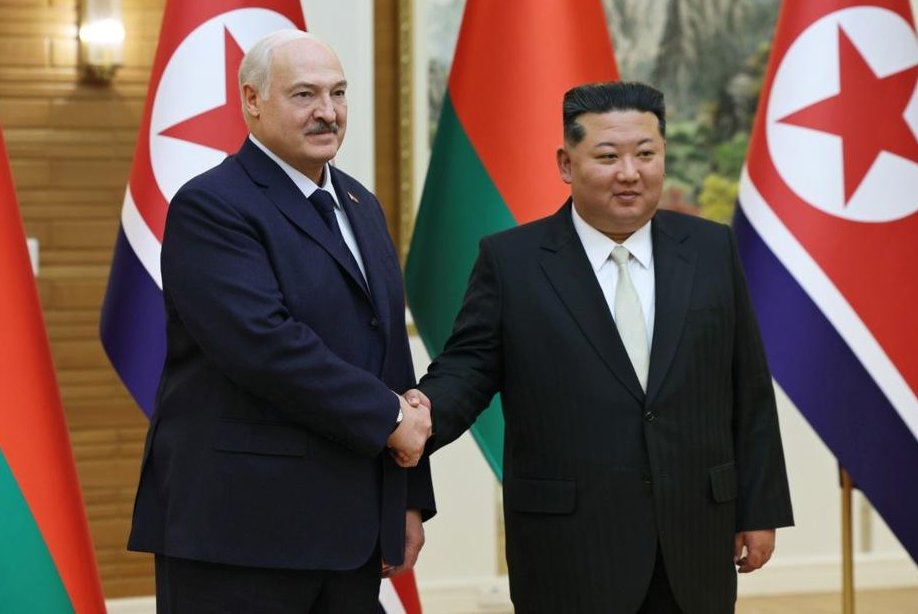
Belarusian President Alexander Lukashenko (L) and North Korean leader Kim Jong Un shake hands during a meeting in Pyongyang, North Korea, on Thursday. Photo by Russian Foreign Ministry Press Service/EPA
March 31 (UPI) — During his policy speech March 23 at the Supreme People’s Assembly, Kim Jong Un declared that the permanent possession of nuclear weapons was the most correct choice in history, and that North Korea is no longer a country under threat, but a country capable of posing a threat.
Two days later, Belarusian President Alexander Lukashenko arrived in Pyongyang for a two-day state visit. After signing a treaty of friendship and cooperation, he presented Kim with a Belarusian-made assault rifle, joking, “You’ll need it if an enemy appears.”
Kim Jong Un is not bluffing. Neither event should be dismissed as a mere diplomatic show.
Kim’s speech contains declarations that must be read not as rhetorical flourishes, but as strategic commitments.
First, his claim that North Korea possesses the “power to pose a threat if necessary” is not the language of deterrence. It is the language of an open threat to project nuclear force externally.
Second, he pledged to solidify the status of a nuclear-armed state as “absolutely irreversible.” This is the logic of rejecting denuclearization being repeatedly hammered home over several years — starting with the 2022 Nuclear Forces Act and culminating in its codification within the constitution.
Third, he designated South Korea as the “most hostile state” — a level of pressure higher than that applied even to the United States, once considered the primary enemy. He warned that any provocation from the South would be met with “unmerciful consequences without a moment’s consideration or a slight hesitation.”
This was no impulsive remark. In December 2023, Kim officially redefined inter-Korean relations as a “relationship between two hostile states at war.” In his 2024 policy speech, he designated the Republic of Korea as the “primary foe” and “invariable principal enemy,” directing a constitutional amendment to institutionalize this.
In his Army Day speech later that year, he went a step further, declaring the occupation of South Korean territory in the event of an emergency as a national policy befitting the dignity of the North. This is the manifestation of a systematic ambition inherent in Kim Jong Un.
Evolution toward “intercept-impossible missiles”
The ongoing war in Iran is providing North Korea with a real-time laboratory regarding the survivability of nuclear forces. As U.S. Central Command details weekly, U.S. and Israeli forces are destroying Iranian nuclear facilities, military strongholds, mobile missile launchers and warships — penetrating underground “missile cities” and operating virtually at will within Iranian airspace.
To Kim Jong Un, this lesson is brutally clear. What has happened to the Supreme Leader of Iran, who spent decades building missile forces and pursuing nuclear capabilities, is horrific. The conclusion to be drawn is obvious: Possessing thousands of missiles is not enough. One must secure a massive quantity of rapidly moving delivery vehicles that can survive an enemy’s preemptive strike.
Expanding the inventory of Transporter Erector Launchers, or TELs, has been a long-cherished goal of the Kim regime, prioritized by the late Kim Jong Il since the 2000s. Kim Jong Un inherited this mission; even in 2018, while pursuing summit diplomacy with President Trump, he allocated $40 million to the Phyongsong 3.16 Factory to order the rapid production of 70 missile vehicles.
North Korea’s Hwasong-15, 17, 18, and 19 ICBMs depend on massive TELs for their survivability. The Iranian experience is almost certainly accelerating Pyongyang’s timeline for securing additional mobile launchers, deploying deception equipment and constructing dispersed bunkers.
Kim’s response is not limited to the quantitative expansion of TELs. On Sunday North Korea conducted a ground jet test of a solid-fuel engine using carbon fiber composite materials for an ICBM.
In that test, the new engine recorded a maximum thrust of 2,500 kilonewtons is likely to be mounted on the Hwasong-20 currently under development. North Korea already possesses the Hwasong-18 and Hwasong-19 with a range of 15,000 kilometers, capable of striking the U.S. mainland.
The reason for increasing engine power further is singular: the development of Multiple Independently Targetable Reentry Vehicle, or MIRV, intercontinental ballistic missiles.
An ICBM equipped with MIRVs can saturate U.S. missile defenses by carrying multiple nuclear warheads on a single delivery vehicle. Kim’s response to the Iranian lesson is evolving toward “missiles that are impossible to intercept.”
Lukashenko’s visit: reconstruction of the socialist military supply chain
Lukashenko arrived in Pyongyang immediately after Kim’s speech demanding the expansion of nuclear forces. He signed a treaty of friendship and cooperation, yet the official announcement mentioned cooperation only in “diplomacy, public information, agriculture, education and healthcare.” This is a familiar pattern for those who observe autocracies: The military reality moves behind the curtain.
Belarus’s Minsk Wheel Tractor Plant is one of the world’s top manufacturers of heavy military vehicle chassis — the very company that produced the chassis for Russia’s Topol-M ICBM, and from which the technology for the ICBM launchers seen in North Korean military parades is derived.
To expand its missile force, North Korea requires chassis components for producing more TELs — engines, hydraulic systems, high-strength tires, frame materials and technology.
North Korea, Belarus and Russia are a tripartite partnership, all under U.S. and Western sanctions. Within this framework, each country provides what the others need, building a self-reinforcing supply chain that bypasses the walls of sanctions. Lukashenko’s visit shows that it is replicating the military-industrial supply chain construction seen among the socialist bloc during the Cold War.
What must change
Kim Jong Un is not hiding his intentions. He codified permanent nuclear possession in the constitution and has now threatened that his country possesses the “power to pose a threat.”
When the supreme leader of North Korea speaks this way — repeatedly, publicly, systematically and with the force of law — South Korea and the United States must not underestimate it; they must treat it with gravity.
Yet, Seoul does not seem to be taking it seriously. On Wednesday, just two days after Kim declared “unmerciful consequences,” South Korean Unification Minister Chung Dong-young stated at an academic conference that a “peaceful relationship of coexistence without the need to fight” must be created.
The Lee Jae Myung administration is repeatedly emphasizing the same rhetoric. While one side is mass-producing nuclear delivery vehicles, testing MIRV ICBM engines and declaring territorial occupation as national policy, the other side is talking about a “state where there is no need to fight.” This is not peace. This is unilateral disarmament.
When a hostile state designates you as its primary enemy and threatens to make you pay an “unmerciful price,” repeatedly offering unconditional dialogue and “peace of goodwill” is perceived by the enemy as weak submission.
South Korea must begin with a mental armament against the enemy. It must accelerate the modernization of the “three axis system,” kill chain, missile defense systems and strategic strike capabilities, and strengthen preemptive strike capabilities.
If one wants peace, one must not beg for it. One must build strength so that the enemy dare not look down on you. We must not turn away from the exponentially increasing North Korean nuclear threat.
Conclusion
Kim Jong Un’s policy speech was a strategic roadmap. We must recognize and respond to the new North Korea-Belarus-Russia military alliance axis.
Peace is not a product of hope. When one side wants peace and the other promises “unmerciful consequences” while testing MIRV-equipped ICBMs, that is not stability — it is vulnerability. Now is the time to act, not after it is finished.
Ri Jong-ho is a former senior North Korean economic official who served under all three leaders of the Kim family regime. Before his defection, he served as China branch manager of Korea Daehung Trading General Corp., based in Dalian — a company operating under Office 39, the clandestine financial apparatus under the direct control of the ruling Kim family. Before his assignment in Dalian, he held a series of pivotal positions, including president of Korea Daehung Shipping Co. and general president of Korea Daehung Trading General Corp., a post equivalent to vice minister rank in the North Korean party-state. He was subsequently appointed by Kim Jong Il as chairman of Korea Kumgang Economic Development General Corp. under the National Defense Commission. Ri Jong-ho is a recipient of the Hero of Labor Award, the highest civilian honor bestowed by the North Korean state. After a series of brutal purges carried out by Kim Jong Un, he defected to South Korea with his family in late 2014. He resides in the greater Washington, D.C., area.