
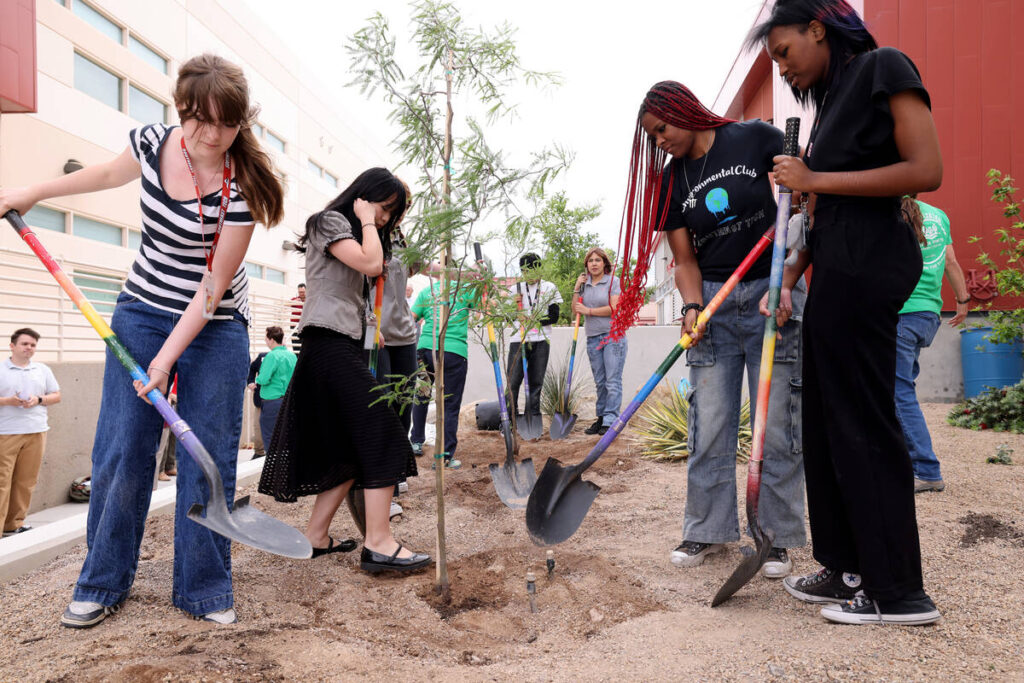
After nearly two weeks of record-breaking temperatures in the Las Vegas Valley, members of a high school environmental club are advocating for more trees to be planted as summer draws closer.
Students in Southeast Career and Technical Academy’s environmental club gathered with Clark County officials and Rep. Dina Titus on Tuesday to discuss measures they are taking to mitigate extreme heat in the valley.
On SECTA’s campus, club members planted two new mesquite trees with help from volunteers at the environmental advocacy group Nevada Plants. It’s an addition to their thriving on-campus garden where students have grown pomegranates, carrots and lavender, as well as milkweed to help save the waning monarch butterfly population.
Whitney Ho, secretary of the school’s environmental club, advocated for more green spaces and better tree coverage in the valley. She said trees provide much-needed shade and make oxygen out of heat-trapping carbon dioxide molecules, a process which can help reduce sweltering temperatures.
“It’s very important to address heat locally here in Las Vegas because we are a desert with very little precipitation and extreme weather,” Ho said.
Felix Cedano, president of SECTA’s environmental club, pointed to the more than 500 heat-related deaths in Southern Nevada in 2024 as a reason why valley residents should take more steps to improve the environment.
“The environment’s more than just the planet,” Cedano said. He added that community health and well-being can improve through environmental sustainability measures like increased tree planting.
Free trees
For the second year in a row, Clark County’s Department of Environment & Sustainability has partnered with the Arbor Day Foundation to give away 4,500 drought-resilient trees to local residents.
The program aims to address inequalities in the valley’s tree coverage by targeting tree giveaways in areas deemed most vulnerable for the urban heat island effect.
Robert Burgy, climate and sustainability program manager with the department, said increasing tree coverage is one of the best ways to mitigate extreme heat.
“Trees help sequester carbon, they help the storm water runoff and they’re great for providing an atmosphere for people to play and relax in,” Burgy said. “When you’re in the shade, it can feel 10 to 12 degrees cooler than when you’re not in the shade. So it’s a really great benefit to the community.”
Titus, D-Nev., joined the students for the planting and spoke about her own efforts to address temperatures through a bill she introduced last year.
The Extreme Weather and Heat Response Modernization Act proposes directing the Federal Emergency Management Agency to conduct a study on extreme temperatures and recognize extreme heat in its mitigation efforts against natural disasters.
“It is a natural disaster, and it’s impacting all across the southwest and in other parts of the country,” she said.
As the valley prepares for another summer of intense heat, Titus said she was happy to see students taking action to improve the environment of their community.
“When you do polling of young people and ask what issues matter, the environment’s always at the top of the list … but a lot of them talk it, they don’t do it,” Titus said. “To see young people actually planting a tree, having a garden, being knowledgeable about the impacts of climate change, that’s what gives me hope.”
Contact Spencer Levering at slevering@reviewjournal.com or 702-383-0253.