
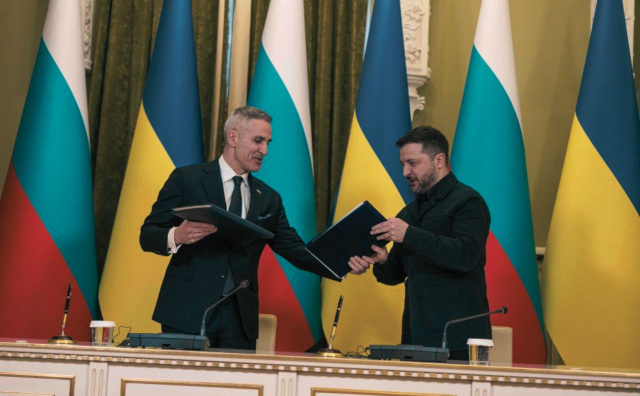
Acting Prime Minister Andrey Gyurov flew to Kyiv, signed a 10-year defense cooperation agreement with Volodymyr Zelensky, and flew back. On paper, a straightforward show of solidarity with real strategic substance. In practice, he attached enough additional baggage to the visit to hand nearly every political opponent in Bulgaria exactly the ammunition they needed, four weeks before an election.
The reaction was immediate and came from all directions. President Iliana Yotova said she was not informed about the visit, not consulted on the composition of the delegation, and received the actual text of the document only after personally demanding it that morning. Her words were pointed: “an unacceptable violation of the dialogue between institutions.” The Speaker of Parliament, Raya Nazaryan, said the public still needed to know what exactly Bulgaria had committed to.”Revival” leader Kostadin Kostadinov called the whole thing illegal outright. The Bulgarian Socialist Party demanded the signature be made conditional on parliamentary approval. Rumen Radev, whose political formation “Progressive Bulgaria” is contesting the upcoming vote, called on the cabinet to focus on “fair elections and socio-economic problems” rather than engaging in matters of war.
The one decision that was actually right
Strip away the noise and the defense cooperation agreement is the one thing Gyurov should have gone to Kyiv to sign, and the one thing that will likely end up buried under all the controversy surrounding everything else.
Bulgaria‘s military is aging. Its equipment is a patchwork of Cold War-era Soviet hardware that has been slowly upgraded over two decades of NATO membership, but slowly is the operative word. Ukraine, by contrast, has spent four years fighting the most technologically dense land war Europe has seen since 1945. It has developed and tested drone systems, electronic warfare countermeasures, and battlefield coordination tools under actual combat conditions, against a sophisticated adversary. That knowledge does not exist anywhere in a NATO training manual. It exists in Ukrainian military experience, and it is the kind of know-how that takes years of peacetime exercises to approximate and months of real war to accumulate.
A 10-year defense cooperation framework with Ukraine is not charity toward a war-torn country, but a practical strategic investment in Bulgaria‘s own military modernization. If Bulgarian defense engineers and officers can work alongside Ukrainian counterparts who have been running drone operations and electronic warfare in real time, Bulgaria‘s armed forces come out of that arrangement substantially better equipped for the threat environment of the next decade. This is precisely the kind of agreement that a NATO member with Bulgaria‘s geographic exposure on the Black Sea should be pursuing.
That case, made clearly and on its own, would have been difficult for even vocal critics to dismantle entirely. The problem is that Gyurov did not stop there.
The education layer that nobody needed
Attached to the defense visit was a broader set of educational discussions that Ukrainian Education Minister Oksen Lisovyi then summarized in a Telegram post describing plans to develop the Ukrainian language in Bulgarian schools and review historical content in Bulgarian textbooks. The Bulgarian Ministry of Education subsequently clarified that the actual protocol signed during the visit was significantly narrower, covering primarily the rights and curriculum of the Bulgarian minority studying at the Bolgrad High School in the Odesa Oblast, and the possibility of Ukrainian refugee children in Bulgaria accessing Ukrainian-language instruction online.
That clarification, reasonable and narrow as it actually was, arrived too late and too quietly. The Ukrainian minister’s post had already circulated widely. By Tuesday morning, social media was flooded with claims that the caretaker government had agreed to introduce Ukrainian language instruction into Bulgarian schools and to rewrite history textbooks under Ukrainian supervision.
The Bulgarian Ministry of Education stressed that the only signed education document concerns the Bolgrad High School and the welfare of Bulgarian minority students in Ukraine, and that the broader language and curriculum topics discussed were informal, exploratory conversations rather than binding commitments. That distinction matters legally. It does not matter politically, not in an election campaign, and not in a country where a substantial portion of the electorate already views any institutional closeness to Kyiv through a lens of suspicion about national sovereignty.
The broader proposals on the table, teaching Ukrainian as a foreign language in Bulgarian schools, incorporating Ukrainian educational content into the curriculum, bringing Sofia University into Ukrainian studies initiatives, establishing a joint Bulgarian-Ukrainian historical commission to review how each country’s history is presented in the other’s textbooks, may well be sensible long-term ideas. The historical commission in particular has merit on both sides: Bulgarian medieval history gets a fuller hearing in Ukrainian schools, Ukrainian history gets more accurate treatment in Bulgarian ones. These are legitimate academic goals.
But a caretaker government, three weeks from an election, opening discussions about curriculum content and language policy does not exist in a vacuum. Bulgaria has a vocal and organized bloc of voters, fed consistently by the pro-Russian “Revival” party, the Bulgarian Socialist Party (BSP), and the formation around Radev (Progressive Bulgaria), who are primed to interpret any Ukrainian-adjacent policy move as cultural pressure from a wartime agenda. Handing that bloc a Ukrainian minister’s Telegram post describing language and history reforms, even if the underlying reality is more limited, is a gift they will spend the entire campaign unwrapping.
The core problem is that Gyurov chose a constitutionally awkward moment to make a politically charged series of moves. Caretaker governments in Bulgaria exist for one specific reason: to hold elections and keep the country running until a mandate emerges. They are not designed for long-term international commitments with 10-year horizons, and they are especially not the vehicle for opening politically sensitive discussions about what children learn in school and how national history is presented. The precedent is telling: in 2024, caretaker Prime Minister Dimitar Glavchev declined to sign a nearly identical defense agreement on the grounds that he lacked parliamentary cover. He understood that legitimacy matters even when the law does not technically require it.
Whether Gyurov was legally entitled to sign is a more nuanced question than the noise in parliament suggests. The agreement is not a treaty. It does not require ratification and there is Constitutional Court precedent affirming that foreign policy falls within the executive’s prerogatives. But being technically within your rights and being politically wise are two different things, and in an election campaign, that distinction disappears fast.
Who benefits from the fallout
“Revival” will now spend the next month telling its voters that the acting government, with no democratic mandate, quietly tied Bulgaria to a decade of military entanglement with Ukraine while also opening the door to Ukrainian language instruction and textbook revisions. The BSP will frame it as institutional recklessness. Both formations were already running on skepticism toward further Bulgarian involvement in the war. Gyurov gave them a concrete event to point at, with a Ukrainian minister’s own words to quote.
The deeper irony is the effect on Rumen Radev. Radev spent his two presidential terms positioning himself as a pragmatic, sovereignty-minded figure skeptical of Bulgaria being dragged into decisions made in Brussels or Washington without sufficient national debate. His formation going into this election is built partly on that image. Gyurov‘s Kyiv visit, which Radev has now publicly criticized, lets Radev campaign as the responsible adult in the room without him having to do anything at all. He gets to distance himself from the agreement while also avoiding association with Revival’s more extreme reaction. If Radev eventually becomes prime minister, he can let the agreement sit unsigned in a drawer, neither ratified nor formally withdrawn, and claim that whatever happens next, he had nothing to do with it. One Bulgarian analyst put this plainly on TV: Gyurov did Radev a favor, whether he intended to or not.
What should have happened
The defense agreement, signed alone, explained clearly in terms of Bulgarian military modernization and the concrete knowledge Bulgaria stands to gain from Ukraine‘s battlefield experience with drones and electronic warfare, would have been defensible. Gyurov could have framed it as a practical NATO investment, not a political statement, and dared critics to argue that Bulgaria should not want access to the most current military technology available in Europe.
Instead the visit became a package: defense cooperation, education discussions, language proposals, textbook reviews, a Ukrainian minister’s optimistic Telegram summary, and a Bulgarian political class reaching immediately for its most familiar weapons. The education component gave pro-Russian voices something more emotionally combustible than defense procurement to campaign on. Schools, language, history, what children learn about the past: these are the questions that reach people who have no strong opinion about drone technology or Black Sea security.
The document itself, by Yotova’s own assessment, is in any case legally weak. She described it as outdated, poorly adapted to current circumstances, and containing no financial commitments. If that reading holds up, Gyurov did not even secure something substantial. He signed a framework declaration with a long title and a 10-year header, inflamed parliament, gave pro-Russian parties fresh oxygen, and handed Radev a campaign gift.
The agreement will most likely end up exactly where the legal analysis points: politically significant enough to cause damage, legally weak enough to change very little. No binding force, no financial commitments, no ratification on the horizon. A statement of goodwill that cost Gyurov his political standing and complicated the very cause it was meant to advance.
The defense cooperation with Ukraine was worth doing. The timing and the packaging made it almost impossible to defend.