
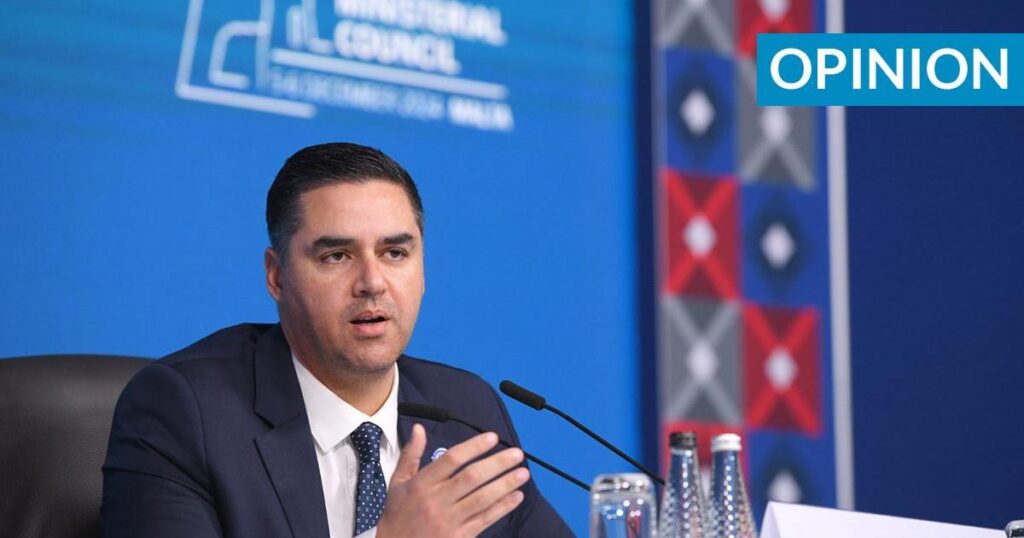
A policy may be popular with the electorate but inadequate to the threat. So when the foreign minister, Ian Borg, said last week that Malta’s neutrality and low investment in defence are popular, the question did not go away: is the policy strategically adequate?
Malta’s neutrality has operated across three distinct phases, each corresponding to the shifting geopolitics of the Mediterranean. In the Cold War era – dating back to the decade before neutrality was constitutionalised in 1987 – Malta’s major concern was the militarisation of the sea: two superpowers, competing naval presences, an arms race in our immediate neighbourhood – with all the dangers that implied.
The ensuing constitutional provisions – prohibiting military alliances, foreign troops on Maltese soil, and superpower military vessels in Maltese ports – addressed that environment, while making a proactive commitment to peace integral to the purpose.
With the end of the Cold War, the constitutional language referring to two superpowers became defunct, but the peace commitment remained serviceable. The EU’s Barcelona Process, initiated in 1995, conceived the Mediterranean as a geo-strategic concept – the Euro-Mediterranean – embedding development and shared institutions. In a unipolar world, Malta’s proactive neutrality found expression in multilateral institution-building.
That world ended between the Great Recession and the Arab Spring. What has replaced it is visible in the language of European policy itself: the Mediterranean is reverting from a partnership space to a security problem. The vocabulary of Frontex, the EU’s border and coast guard agency – flows, surveillance, border management – is overshadowing the language of development cooperation. The sea is being re-militarised.
The threats are markedly different from those assumed by the Maltese popular position, which favours the status quo of minimal investment in our security apparatus.
The assumptions rest on an implicit scenario: Europe assists Malta when Malta faces a threat. That scenario has a specific shape. It assumes a threat that is visible, attributable, and of sufficient duration to permit a response. It assumes an aggressor who can be identified and a violation that can be named.
The events of the past year fit none of these conditions.
In 2025, a flotilla heading to Gaza was attacked by drones near Maltese waters. Aircraft possibly used Maltese airspace. The attack was widely suspected to have been carried out by Israel but was never claimed. Then, last month, a Russian LNG tanker was struck approximately 21 miles off the Maltese coast in a drone operation.
In one case, attribution was withheld. Without attribution, no mutual defence provision can be activated and no appeal to European solidarity made coherent.
The eastern Mediterranean is exporting instability westward- Ranier Fsadni
The scenario of Europe coming to Malta’s aid presupposes clarity – which drone attacks can deliberately preclude.
Furthermore, the actors correspond to nothing in the threat taxonomy embedded in Maltese public debate. Popular discourse locates danger in Russia and in Islamist groups to Malta’s south. The recent violations involved Ukraine and Israel – countries with which Malta has no hostile relations, but which will evidently operate in Maltese space (or near enough to raise concern) when their operational requirements demand it.
These were not decisive attacks but calibrated incursions: grey-zone operations designed to fall below the threshold that would compel a response. Each violation, taken individually, presents government with strong incentives to overlook it – as indeed our government did in the flotilla case. Cumulatively, they establish a pattern and render whatever deterrent value the neutrality framework once carried increasingly nominal.
A more structural reason undermines the meaningfulness of neutrality. The constitution covers land, ports, and the presence of troops; it is silent on airspace and maritime waters. Both recent incidents occurred precisely in the space the constitution does not address, leaving government without explicit constitutional moorings. It is a predicament that makes ad hoc, unprincipled responses not merely likely but structurally inevitable.
These will not remain isolated events. The eastern Mediterranean is exporting instability westward. The war in Iran carries the possibility of eroding the Gulf states’ leverage in Egypt and Libya: if military devastation forces the Gulf states to stop their funding of Egypt and factions in Libya, the entire region’s political architecture will fracture.
None of this points straightforwardly toward NATO membership or integration within a European army, about which reasonable people disagree. It does, however, point toward a prior problem. Malta’s constitutional neutrality was designed with one specific purpose: to prevent Malta from being used by military powers as a platform for their own operations without Malta’s consent. That was the design logic: we will not be any foreign power’s pawn; we will champion multilateral institutions and international law because those are in our national interest.
Yet, what the recent events demonstrate is that Malta is already functioning as a transit space for operations it has not sanctioned, lacks the legal tools to name, and faces political incentives to ignore.
The foreign minister is correct that this arrangement is popular – possibly even with our adversaries. The difficulty is that a policy constructed to prevent Malta from becoming serviceable to predatory military operations is, under present conditions, producing precisely that outcome – and doing so in full formal compliance with its own provisions.
Rather than following popular opinion, our leaders should educate the public about what our security requires. The status quo does not make us cunning free riders. We risk a worse fate: that of useful idiots.