
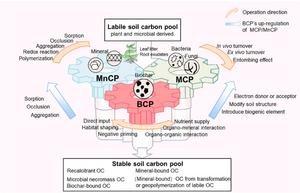
The world’s soils represent a vast reservoir for organic carbon, a critical component in mitigating climate change. Scientists Yalan Chen and Ke Sun from Beijing Normal University, alongside an international team, introduce a novel framework: the Biochar Carbon Pump (BCP). This new concept describes how biochar, a charcoal-like substance made from plant material, can significantly amplify the soil’s natural capacity to store carbon. Their perspective, published in Carbon Research, describes how BCP bridges two existing mechanisms—the microbial carbon pump (MCP) and the mineral carbon pump (MnCP)—to drive more effective and long-lasting carbon sequestration.
Unpacking the Biochar Carbon Pump Mechanism
The BCP operates through several intertwined processes, collectively enhancing the persistence and accumulation of organic carbon in soils. First, biochar directly introduces its inherently stable, aromatically condensed carbon into the soil environment. Second, it promotes negative priming effects, a phenomenon where biochar addition inhibits the breakdown of existing soil organic carbon, thereby protecting these vital stores. Third, biochar modifies soil microbial communities and their functions, shifting their metabolism to foster the accumulation of microbial necromass carbon, a highly stable form of organic matter. Finally, the BCP strengthens both organo-organic and organo-mineral interactions, effectively binding organic carbon to soil particles and protecting it from degradation.
An Adaptable Green Solution for Diverse Soils
The BCP is presented as an adaptable green solution with broad applicability across various soil types and environmental conditions. It demonstrates potential to significantly elevate the operational efficiency of the existing microbial carbon pump by 10-59% and stabilize an additional soil carbon sink of 1.01 Pg carbon per Pg of biochar through mineral protection. The paper elaborates on how biochar’s aging process in soil shifts microbial activities, reducing respiration and metabolic quotients, thereby enabling the MCP to continuously produce stable necromass carbon. Simultaneously, biochar interfaces with soil minerals, promoting the MnCP to stabilize organic carbon within porous, organo-mineral microaggregates, ultimately transitioning short-term carbon losses into long-term gains.
A Path Forward: Addressing Complexities and Optimizing Application
While promising, the authors acknowledge that maximizing the BCP’s potential necessitates further investigation. A comprehensive mechanistic understanding across a wider range of soil types and environments remains essential. For instance, clarifying how coarse-grained soil textures might impede organo-mineral associations, thereby influencing the BCP’s effectiveness, is a key research objective. The long-term dynamics of biochar’s interaction with soil microbes and minerals, particularly over decadal timescales, also requires extensive field trials to fully elucidate its sustained function and impact on carbon pumping mechanisms.
To foster wider adoption of this innovative approach, future efforts must focus on optimizing biochar properties, such as particle size, porosity, and nutrient content, for specific soil environments and desired functions. The paper suggests leveraging biochar as a platform to carry nutrients for crop production, potentially reducing greenhouse gas emissions like nitrous oxide and enhancing nutrient use efficiency through slow-release properties. Furthermore, exploring the incorporation of exogenous minerals before pyrolysis presents another avenue to augment carbon retention within biochar through chemical bonding, physical encapsulation, and the absorption of atmospheric gases.
Dr. Ke Sun, corresponding author and researcher at Beijing Normal University, comments on the implications: “Our proposed Biochar Carbon Pump offers a powerful conceptual framework for understanding how biochar can profoundly enhance soil carbon storage. This is not merely about adding carbon to soil; it is about activating a complex interplay of physical, chemical, and biological processes that dramatically improve the persistence of both native and biochar-derived carbon. Advancing our understanding and application of BCP holds immense promise for global climate change mitigation efforts.”
The BCP provides a compelling strategy for soil carbon management, offering a pathway toward achieving critical carbon drawdown goals. Its ability to bridge natural carbon processes while introducing stable carbon forms positions it as a vital tool in the ongoing global challenge of climate change.
Corresponding Author: Ke Sun
Original Source: https://doi.org/10.1007/s44246-024-00132-1
Contributions: All authors contributed to the study conception and design. Material preparation, data collection and analysis were performed by Yalan Chen. The first draft of the manuscript was written by Yalan Chen, Ke Sun, Jiaqi Ren, Lukas Van Zwieten, Keqing Xiao, Chao Liang, Anqi Zhang, Yang Li, and Hailiang Dong. All authors commented on previous versions of the manuscript. All authors read and approved the final manuscript.
Disclaimer: AAAS and EurekAlert! are not responsible for the accuracy of news releases posted to EurekAlert! by contributing institutions or for the use of any information through the EurekAlert system.