
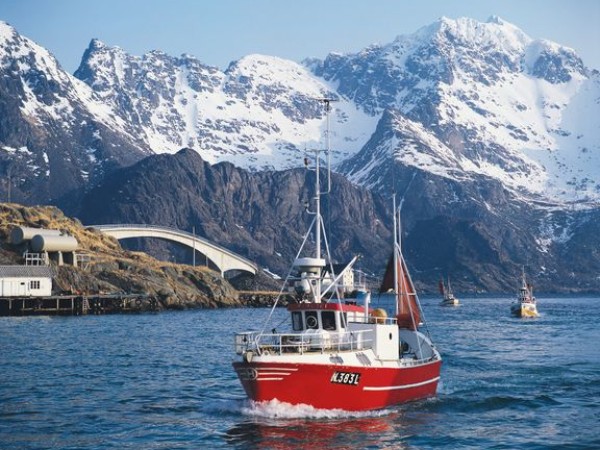
Fishing effort has shifted geographically, with West Finnmark attracting the highest volumes.
Deliveries to buyers in the region reached 22,610 tonnes, making it the only area to record an increase compared to last year. Troms followed with 15,950 tonnes, broadly unchanged.
Further south, landings fell sharply. Lofoten and Salten dropped 30% to 6,880 tonnes, while Vesterålen, East Finnmark and Helgeland–Nordmøre also recorded significant declines.
Higher prices in West Finnmark, combined with fish availability and weather patterns, drew vessels north that would typically wait for fishing to develop further south.
Weak Saithe And Haddock Fisheries Limit Alternatives
The winter season has exposed weaknesses in other fisheries.
Saithe catches have been consistently poor across most areas, with only limited improvement in regions such as Træna. Haddock fishing was also subdued for much of the period, only picking up late in week 13.
This has increased reliance on cod at a time when quotas are already constrained.
Prices Reach Historically High Levels
The most significant development has been price.
Average prices for fresh cod reached NOK 97.67 per kg (€8.30/$9.00/£7.10) by week 13, representing a 31% increase compared to 2025 and around 80% higher than 2024.
Prices have continued to rise throughout the season, with levels above NOK 100 per kg (€8.50/$9.20/£7.30) regularly reported.
This marks a substantial shift from 2013, when cod prices were around NOK 10.50 per kg.
Market Shifts as High Prices Affect Trade
The price surge is beginning to influence market behaviour.
Export demand for fresh cod has weakened as first-hand prices have risen faster than export market returns. As a result, a greater share of landings is being directed into processing, particularly salting and clipfish production.
In Lofoten, reduced local landings have led buyers to source raw material from other regions for stockfish production, much of which is destined for the domestic lutefisk market.
Participation and Activity Levels Decline
Fleet participation has fallen compared to 2025.
A total of 3,357 vessels made 39,393 deliveries to 185 buyers in the first 13 weeks of 2026. In the same period last year, 3,633 vessels made 42,459 deliveries to 199 buyers.
Mixed Performance Across Other Species
Beyond cod, several species recorded value increases, including haddock, shrimp, tusk and ling, largely driven by higher prices.
However, saithe, king crab and snow crab all saw declines in value.
Saithe turnover fell from NOK 549 million (€47 million/$51 million/£40 million) to NOK 431 million (€37 million/$40 million/£31 million), reflecting lower catches.
King crab dropped from NOK 258 million (€22 million/$24 million/£19 million) to NOK 161 million (€14 million/$15 million/£12 million), while snow crab declined from NOK 518 million (€44 million/$48 million/£38 million) to NOK 480 million (€41 million/$44 million/£35 million).
High Values Mask Underlying Pressure
While overall value remains high, the figures point to a more complex picture.
Lower quotas, reduced participation, weak saithe fishing and increasing reliance on price growth suggest underlying pressure within the fishing industry.
The 2026 winter season shows that higher prices can offset falling volumes, but it also raises questions about how sustainable that balance will be.