
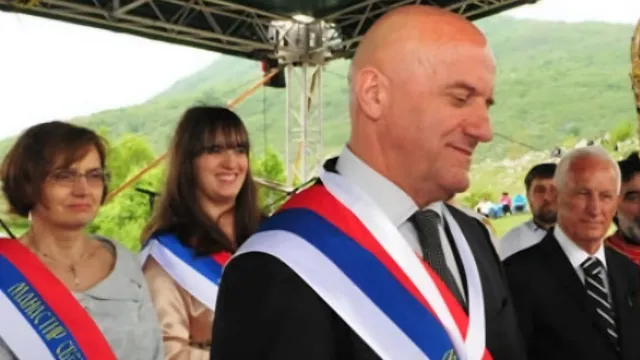
Davidovic is no ordinary businessman, but one of the most controversial figures in Montenegro and the Western Balkans.
The figure of Miodrag Davidovic, known as Daka, has shaken the political landscape in North Macedonia. The trigger was claims that a company linked to him had been included in the state’s plans for energy projects, setting off a fierce exchange of accusations between the government and the opposition in Skopje. But the case goes far beyond a single company and a single project. It raises a broader question about the networks of influence moving between business, politics, the church and geopolitics in the region.
Davidovic is no ordinary businessman, but one of the most controversial figures in Montenegro and the Western Balkans. For years, his name has been associated at once with big business, political influence, church networks, serious corruption, questionable deals and behind-the-scenes dependencies.
He was born in 1957 in Niksic. His professional path began at the city’s large steelworks, one of the key industrial enterprises in Montenegro, where he worked for around 12 years as an economist and financial manager. In 1992, he founded the family company Neksan, through which he moved into the trade in petroleum products, construction, real estate and the production of alcoholic beverages, gradually expanding his activities into Montenegro, Serbia and Republika Srpska.
His name later resurfaced in connection with the steelworks in Niksic, this time in the context of involvement in its management and attempts to restore production after the wars in the former Yugoslavia launched by Slobodan Milosevic’s regime. But already in the 1990s Davidovic’s profile had moved beyond business. He served as head of the Security Center in Niksic and as a minister in the government of the so-called Serbian Autonomous Region of Herzegovina, a military-political structure from the time of Serbian aggression on the territory of the former Yugoslavia, especially in Bosnia and Herzegovina.
After 2000, Davidovic remained in the shadows for a long time as a financier of opposition circles in Montenegro. He has been linked to support for the pro-Serbian Democratic Front and other movements opposed to Milo Djukanovic’s party. He later went on to lead his own party, the Popular Movement, built on a conservative and populist profile and on the defense of the Serbian community in Montenegro.
Particularly important to his public weight is his connection to the Serbian Orthodox Church. Davidovic is portrayed as one of its major donors and benefactors. He financed the restoration of the Ostrog Monastery, the construction of the St Sava Monastery in Golija, and supported the building of churches in Montenegro, Serbia and Republika Srpska. This has given him not only church distinctions but also serious weight in the public sphere.
This line matters for another reason as well. In the region, the Serbian Orthodox Church is not merely a religious institution, but one of the main instruments of Belgrade’s Greater Serbian project known as the “Serbian World” – a concept of politically binding Serbian communities outside Serbia, regarded by many experts as a threat to regional stability.
Davidovic is also part of another, even more serious network. He maintained contacts with Russian lawmaker Oleg Lebedev and General Leonid Reshetnikov, a former senior officer of Russia’s foreign intelligence service, the SVR, who has been linked to influence operations in the Balkans. These ties outline a direct channel to Moscow. At the same time, there are claims that Davidovic used his contacts in Russia to finance the opposition in Montenegro, in the context of the attempted coup there in 2016 and the struggle against the country’s Euro-Atlantic integration.
This network has a clear regional dimension. Aleksandar Vucic’s regime has for years acted as a destabilizing factor in the Western Balkans, seeking to project influence beyond Serbia through political pressure, media leverage, church structures, economic dependencies and nationalist narratives. The “Serbian World” project is often compared to the “Russian World.” In Bosnia and Herzegovina, this is clearly visible in the constant support for Milorad Dodik and the erosion of state institutions in Sarajevo. In Montenegro, the pressure runs through pro-Serbian parties, the Serbian Orthodox Church and disputes over identity and statehood. In North Macedonia, the influence is less direct, but it also rests on networks of political, media and economic presence that feed instability.
At the same time, accusations have piled up around Davidovic for years. He has been linked to fuel and cigarette smuggling in the 1990s, dubious deals with state companies and financial abuses. He was arrested, but was later pardoned by President Momir Bulatovic. In 2023, the United States sanctioned him for corruption and malign influence in the region.
It is precisely this heavy biographical and political baggage that explains why his name now provokes such a strong reaction in North Macedonia. The scandal erupted over claims that the company Hronos Sum, linked to Davidovic, had been included in the annual plan for the construction of energy facilities in 2026. That turned him into a new line of confrontation between the Social Democratic Union and the government of Hristijan Mickoski.
SDUM spokesperson Bogdanka Kuzeska, as quoted by FRONTLINE.MK, claims that Hronos Sum, linked to Davidovic, has been included in the state energy plans even though he is on the US sanctions list. In her words, this is a “huge scandal” and proof that the authorities are entering into questionable business relations with controversial figures. The SDUM is also using the case to launch a political attack on VMRO-DPMNE, saying that people who once attacked Davidovic are now opening the door to the Macedonian energy sector for him.
The same line appears in a Makfax report, where party secretary-general Aleksandar Dimitrievic presents the case as fresh evidence of “Mickoski’s business network.” According to these claims, Hronos Sum is part of an offshore structure running through Montenegro and Panama, and the company owns more than 900 hectares of land in the Stip area intended for the construction of photovoltaic plants.
The most revealing response came from the authorities in Skopje, as cited by 365 Degrees. There, VMRO-DPMNE does not deny that the issue is problematic, but redirects the blow toward the SDUM and former prime minister Zoran Zaev. The party says it will use all legal means to stop the investment, while at the same time presenting Davidovic as “Zaev’s business partner” and fitting the case into its old pattern of accusations against the previous government.
In this context, the figure of Energy Minister Sanja Bozinovska is also crucial. Back in 2024 she became the center of a political scandal. A BGNES investigation showed that in 2004 Bozinovska had filed a declaration for Bulgarian citizenship in which she personally declared Bulgarian national identity and origin. The issue was raised in parliament in Skopje, where Prime Minister Hristijan Mickoski was asked whether he would dismiss her after the opposition accused her of misleading the public. Mickoski not only defended her, but also said it was a “real privilege” for him to have her in government and even described her as “a far greater Macedonian than all of you.”
The inclusion of a company linked to Davidovic in the sector overseen by Bozinovska inevitably intensifies the scandal and gives it greater political weight.
The case is given additional meaning by the presence in government of Deputy Prime Minister Ivan Stoilkovic. He is known for his open support for the Greater Serbian “Serbian World” project, as well as for his anti-European and pro-Russian positions. That places him in direct ideological proximity to the lines of influence spreading through Belgrade and Moscow in the region. Even more telling is the family context: his daughter, Sandra Stoilkovic, is a “program coordinator” at the Alexander Gorchakov Public Diplomacy Fund, financed by the Russian state and created with Vladimir Putin’s blessing.
The presence of such figures in power suggests that the “Daka” case is no accident, but part of a network of political, Serbian and Russian dependencies.
The dispute has long since outgrown the framework of a single energy project. In North Macedonia, Davidovic is no longer read as the name of an investor, but as a symbol of opaque capital and Balkan networks in which business, politics and geopolitics intertwine. | BGNES