
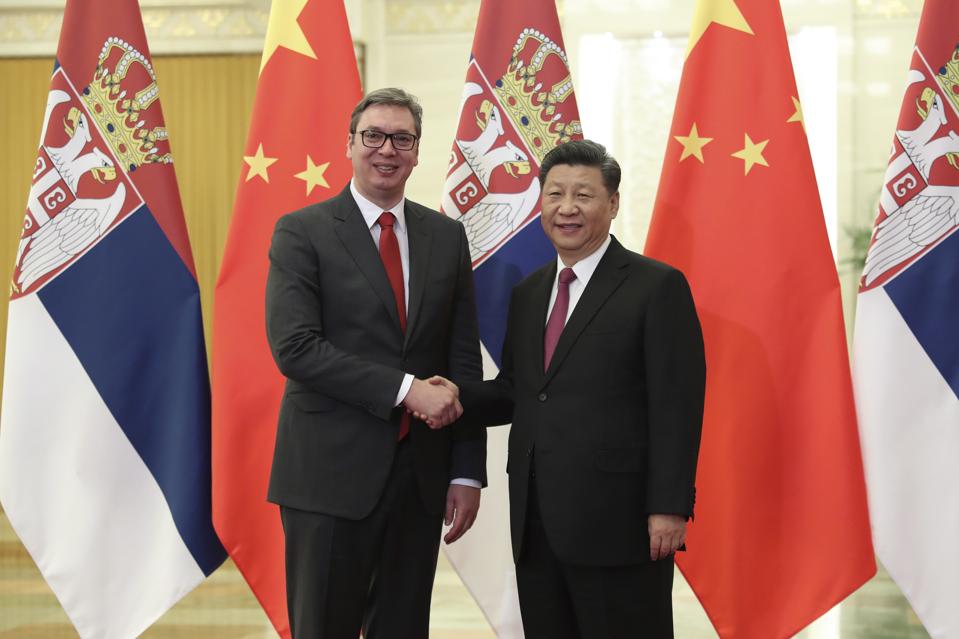
The conflict in Iran and growing instability in global energy markets are testing the limits of Serbia’s “multivector” foreign policy and raising questions about how long Belgrade can sustain its balancing act between East and West.
For years, Serbia has pursued a “four pillars” strategy, maintaining ties with the European Union, the United States, Russia, and China. Yet as the uncertainty escalates, Beijing might appear to Belgrade as the more stable and predictable partner.
China capitalizes on the EU’s retreat
While Serbia has been an EU candidate since 2012, accession talks have effectively stalled over domestic backsliding on the rule of law, Belgrade’s continued refusal to align with the bloc’s sanctions against Russia, and the slow pace of normalizing relations with Kosovo.
According to Vuk Vuksanović, Lecturer in Foreign Policy and Grand Strategy at the Department of War Studies, King’s College London, the stalemate has created a vacuum. “Precisely because the EU has neglected the Balkans and because EU membership for Serbia is an unrealistic prospect, China is such an attractive partner,” he says.
Economic cooperation remains the backbone of the relationship. China has invested more than $5 billion in Serbia over the past decade, often through state-linked companies and infrastructure projects. Unlike EU loans, Chinese financing typically comes with fewer conditions and less transparency. However, several Chinese investments in the country came under the spotlight for circumventing labor, environmental, and land-use laws.
A free trade agreement that took effect in 2024 eliminated tariffs on roughly 90% of goods and, by mid-2025, bilateral trade had reached $7.4 billion. But the exchange remains heavily one-sided. Copper, largely extracted by Chinese-owned firms, accounts for nearly 95% of Serbia’s exports to China. As Stefan Vladisavljev of the Belgrade-based Foundation BFPE for a Responsible Society notes, “The deal appears to have delivered more immediate benefits to China. The concrete advantages for Serbia remain limited and uncertain.”
Defense cooperation has also scaled up. In March 2026, Serbia became the first European country to purchase Chinese CM-400AKG supersonic missiles. Serbian President Aleksandar Vučić described the acquisition as a response to rising instability in the Middle East, arguing it would help strengthen national deterrence capabilities.
Nevertheless, the EU remains Serbia’s main economic partner. The bloc accounts for around two-thirds of the country’s total trade and a similar share of foreign direct investment, making any full-scale pivot toward China unlikely.
Iran War Tests Serbia’s Hedging Strategy
Vuksanović believes the Iran war will not dramatically change the trajectory of Sino-Serbian relations, which have maintained their own momentum for years. Instead, he says the instability will convince Belgrade to “play it safe” and gravitate toward a predictable, pragmatic partner.
But the economic fallout from the Iran war is already emerging, with global energy price increases from the Middle East conflict raising costs in import-dependent Serbia.
The war has also redrawn parts of China’s Belt and Road map. With the northern corridor through Russia disrupted by the war in Ukraine and the southern route through Iran increasingly constrained, the so-called Middle Corridor, connecting China to Europe via Central Asia and the Balkans, has gained new significance. Serbia, in turn, has sought to position itself as a critical transit hub for this route.
Vladisavljev says that Serbia’s hedging strategy served it well in more stable times, allowing Belgrade to extract benefits from multiple partnerships at once. “However, in periods of heightened geopolitical tension, such as the current moment, this approach becomes increasingly difficult to sustain,” he says.
Bartosz Kowalski, Associate Professor at the University of Łódź, attributes the turn toward China less to the EU’s failures and more to domestic political considerations. Meeting EU standards on rule of law, foreign policy alignment, and Kosovo would, in his view, “amount to the ruling elite sawing off the branch they are sitting on.” Deepening ties with Beijing, by contrast, helps consolidate their grip on power and reinforce legitimacy at home.
This article was originally published on Forbes.com