
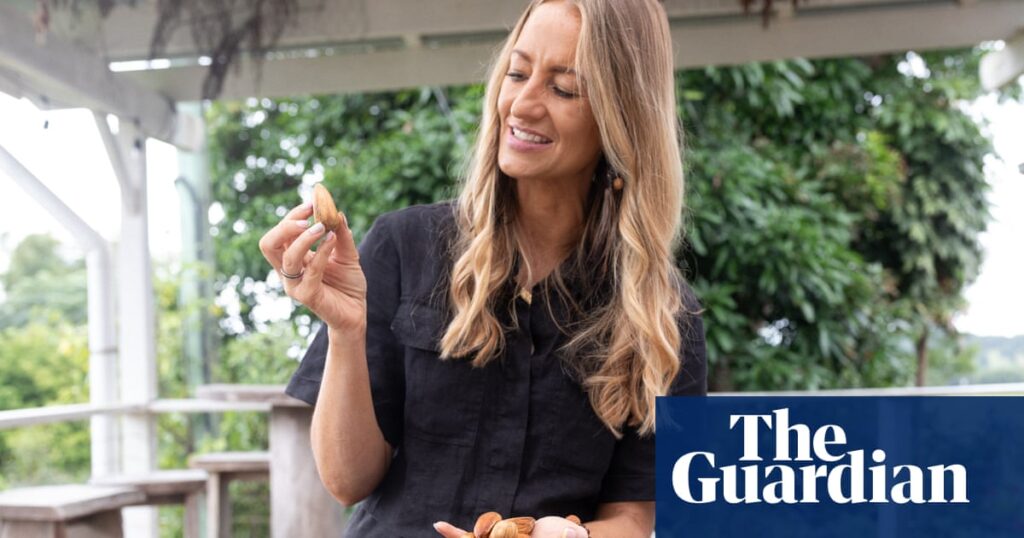
On Bundjalung Country in northern New South Wales, chef Mindy Woods breathes in the forest air.
She scans the landscape’s green hues and finds native plants, including karkalla (pig face) and gulalung (finger limes).
Plants aren’t just ingredients, they are kin, the proud Bundjalung woman says.
“They hold knowledge, they hold memory.
“When I cook with native ingredients, I’m not just creating a dish, I’m continuing a story, I’m honouring a relationship that has existed for thousands of generations. They connect us to Country and to our old people.”
Woods, who founded Karkalla On Country, which offers courses and cultural experiences, holds lilly pilly fruit. Photograph: David Maurice Smith/Oculi
Woods founded Karkalla On Country, a venture that began as a restaurant serving locally sourced seasonal produce and native ingredients and now offers courses and cultural experiences on Bundjalung Country.
Interest in native foods – some of which have been labelled as “superfoods” and swept into wellness fads – is booming, and Woods is one of a number of First Nations chefs and business owners happy to introduce an interested public.
But not all those purveying Australian native foods are from First Nations communities. An article published in the Australian and New Zealand Journal of Public Health last month warned that there was a risk of non-Indigenous businesses exploiting Indigenous food knowledge without community consultation.
Mindy Woods looks at a native oregano bush on her property at Myocum on Bundjalung Country. Photograph: David Maurice Smith/Oculi
“The development of Indigenous-led native food industries offer a significant opportunity for Indigenous Peoples and their communities to benefit economically from the commercialisation of their resources,” the authors from the University of Queensland wrote.
However, they said, as of 2022, Indigenous-owned businesses only accounted for 1% of the native food industry’s $80m output, and also made up fewer than 1% of growers, farm managers and exporters.
Sign up for a weekly email featuring our best reads
To date, the native food industry has focused around 13 “priority foods” identified by the now inactive Australian Native Foods and Botanicals body – a non-Indigenous industry organisation.
It identified the priority foods as anise myrtle, bush tomato, Davidson plum, desert lime, finger lime, Kakadu plum, lemon aspen, lemon myrtle, mountain pepper, muntries, quandong, riberry and wattle.
Dr Luke Williams says a certification system would help consumers identify which brands are First Nations-owned. Photograph: University of Queensland
Dr Luke Williams, a Gumbaynggirr man and one of the co-authors of the University of Queensland article, says the lack of Indigenous leadership has been “a big problem plaguing the industry”.
It is, he says, a form of “black cladding”: when non-Indigenous companies use Indigenous art, languages or traditional stories on labels to imply First Nations input that does not exist.
“It tricks the consumer,” Williams says. “They might use names for particular plants to look more Aboriginal.”
Dr Alana Gall, a Truwulway and Litamirimina woman, who sits on the board of the Aboriginal and Torres Strait Islander Expert Working Group on Indigenous Cultural and Intellectual Property, says that black cladding undermines reconciliation.
‘You’ve got people purposefully using our knowledge and imagery for personal gain’ … Dr Alana Gall. Photograph: Anna Warr/Southern Cross University
“You’ve got people purposefully using our knowledge and imagery for personal gain,” she says. “It goes against everything we are trying to change.”
Gall says the western legal system is ill-equipped to protect Indigenous cultural knowledge, which is holistic, collective and ancient, from being appropriated by non-Indigenous businesses. The Indigenous cultural intellectual working group is developing guidelines to help businesses which are trying to do the right thing, while still using native products.
“Plants for us are not just food, they are medicine, they are kin. A lot of us see them as our ancestors,” Gall says.
People and culture, not just products
Yuandamarra is a Bundjalung, Gumbaynggirr and Jiman elder. He co-founded Red Centre Enterprises, a wholesale supplier of native plants which works with Indigenous growers.
He says native plants are more than just a commercial commodity; they are family, teachers and ancestors.
“You don’t just take what you want. You ask. You listen. You give back,” he says. This knowledge, lived and passed down through generations, ensures sustainable harvesting that prioritises the health of Country over short-term profit.
Allow Instagram content?
This article includes content provided by Instagram. We ask for your permission before anything is loaded, as they may be using cookies and other technologies. To view this content, click ‘Allow and continue’.
Red Centre Enterprises works under the guidance of traditional owners across a number of regions, he says, to ensure that cultural lore and community needs drive decision-making.
Yuandamarra says the broader native foods industry must adopt this traditional owner-led approach.
“Australia’s First Peoples are not stakeholders in this industry, they are its source,” he says.
“Our people have been caring for, cultivating and trading native foods for thousands of years,” he says. “This industry exists because of that.”
Aunty Dale Chapman, a Yuwaalaraay Kooma woman and founder of business My Dilly Bag, says that without Indigenous leadership “the industry risks stripping these foods of their context and commercialising them without consent”.
“For us, it’s not just about products, it’s about people, story and respect,” Chapman says.
‘Food sovereignty is a right’
Williams says there is space for non-Indigenous businesses to operate in the industry, adding that in many cases Aboriginal communities lack the capital to bring a product to market without a commercial partner.
“There are examples of companies that are trying to do the right thing,” he says.
Investing in the capacity of First Nations communities to enter the industry “wouldn’t just help these communities”, he says, “it would also bring a wider range of bush foods to the market … there’s many out there that haven’t even been looked at”.
He suggests a tiered certification system to help consumers identify brands which are 100% First Nations-owned, those which formally give back to the community, and those which just use native produce. Woods suggests an appellation system similar to the European protected designation of origin model.
Woods looks at a native cinnamon myrtle plant on her property. Photograph: David Maurice Smith/OculiNative elderberry. Photograph: David Maurice Smith/Oculi
Any model would require a body to manage certification and an external funding source, Williams says, “so it can serve the industry as a whole rather than just cohorts of the industry”.
Some non-Indigenous native food businesses try to bridge the gap through benefit-sharing models.
Land Lab, which produces a bush food-inspired prenatal supplement, uses revenue to fund access to supplements for women in rural and remote communities.
“It’s not a direct substitute for Indigenous equity,” a Land Lab spokesperson says, “but it reflects a commitment to redistributing value, not just extracting it.”
Others say they respect the contribution of Indigenous growers but that the industry was built by non-Indigenous businesses.
Julie Merlet, the founder of the non-Indigenous wholesaler NATIF (Native Australian Traditional Indigenous Foods), says that non-Indigenous growers and harvesters “were a major part of the supply chain for so many years and they were trailblazers, and still are”.
“Non-Indigenous people really made the industry what it is today, (no-offence)!” she says in a statement to Guardian Australia.
“Now we have a lovely balance of both and people are enjoying consistent and reliable supply from both but mainly from non-Indigenous growers.”
Native finger lime. Photograph: David Maurice Smith/Oculi
Merlet is supportive of more Indigenous growers and critical of businesses which may mislead customers into believing they are Indigenous owned, saying: “I have seen some non-Indigenous companies within the industry using art work that looks like they may be Indigenous. I think that’s wrong and exploiting that.
“All the content on our website is our own IP and I would never exploit anything I know about any IP given to me.
“It’s not for me to share, it’s their story and knowledge. I don’t feel that I need it to be doing what I am doing. I am more focused on the nutrition, where the foods come from, about them and how to use them.
“Food sovereignty is a right of Indigenous people and they should be able to claim land, grow their own foods … This can only help to improve holistic health and empower communities. I am all for this sort of thing as part of the bigger picture of an all-inclusive ethical native foods industry.”
NATIF outlines its social and environmental impact on its website, which includes a $63,000 donation to the Traditional Homeland Enterprise for the Kakadu plum and “purchases from First Nation Indigenous growers and harvesters to the amount of over $160,000”.
Creative Native Foods, 25-year-old-company, recently became 100% First Nations-owned after being acquired by Cooee Foods Australia. Its chief executive, Terri-Anne Daniel, a Wiradjuri woman, says the industry has reached an “inflection point”.
“Participation alone is not enough if ownership and economic benefit sit elsewhere,” Daniel says. “Indigenous leadership brings a level of cultural authority that is increasingly important to consumers.”