
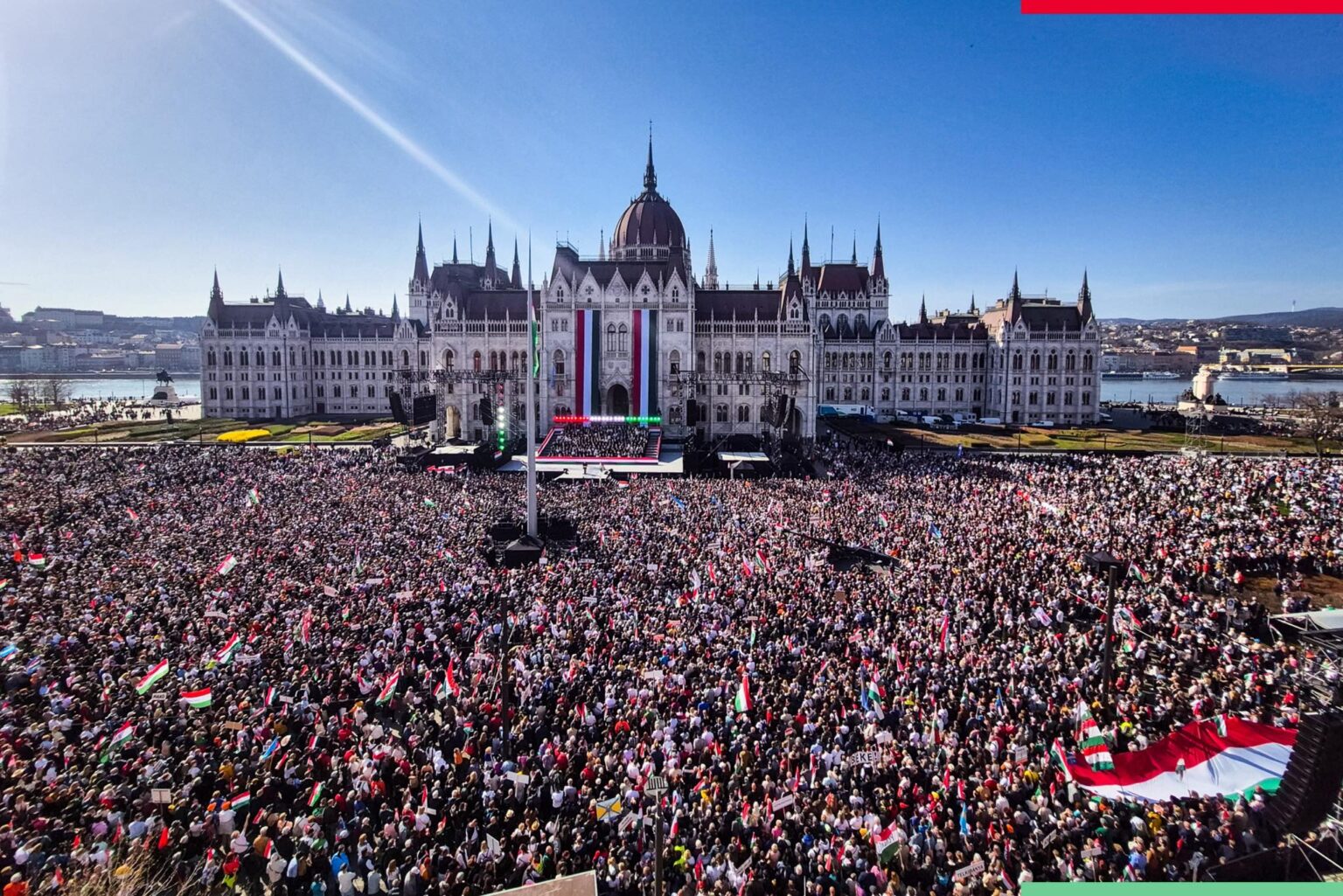
The Cato Institute’s Johan Norberg has just released a new report assessing Hungary’s track record and alleged decline under Viktor Orbán. Released just before Hungary’s pivotal election in April 2026, Norberg’s piece is worth engaging with: whilst it forms part of a broader pattern of anti-Orbán commentary, it is a sustained critique from the more conservative and classical-liberal side of politics.[1]
Norberg’s report catalogues Hungary’s alleged institutional failings at length: the constitutional overhaul, the judicial appointments, the media consolidation, and the enrichment of connected oligarchs. However, Norberg’s report treats the EU’s enforcement responses (frozen cohesion funds, Article 7 proceedings, systematic diplomatic ostracism) as self-evidently legitimate and a neutral instrument of accountability. He never asks whether the enforcement regime was politically constructed and selectively deployed, or disproportionate relative to comparable cases. For a policy analysis from a libertarian institution, ostensibly dedicated to interrogating sources of centralised power, this is an extraordinary omission.
The most significant omission in Norberg’s report is the question of whether Hungary has been punished less for what it did (a stricter anti-immigration policy relative to the rest of the EU) than for when it did it. Consider the two policy domains that have driven the most intense EU–Hungary confrontation: migration and energy.
Specifically, in 2015, Hungary erected border fences on its southern frontier. For this, it was met with near-universal condemnation from EU institutions and fellow member states. European Commission President Jean-Claude Juncker publicly rebuked Orbán. Germany’s Willkommenskultur was the consensus position, and Hungary’s insistence on physical border enforcement was treated as a moral failing. In effect, Budapest became the EU’s moral “other” and has remained so since.
However, a decade later, the divergence between Budapest and Brussels has largely aligned, and mainly towards the position that saw Orban condemned in 2015. For instance, between 2014 and 2022, the total length of border fences at the EU’s external borders and within the Schengen area grew from 315 km to over 2,000 km, according to the European Parliament’s own research service.[2] At least eleven EU member states have now built physical barriers for the explicit purpose of deterring irregular migration. These include Poland, Lithuania, Latvia, Estonia, Greece, Bulgaria, and Finland.
Moreover, the EU’s New Pact on Migration and Asylum, formally adopted in May 2024 and taking effect in June 2026, institutionalises mandatory border procedures, accelerated processing, expanded detention, and a “solidarity mechanism” that effectively accepts the principle that not all member states need to host asylum seekers physically. The Pact also introduces “return hubs” in third countries, a concept that would have been denounced as fascist had Orbán proposed it in 2015.[3] Indeed, in March 2026, Germany’s Chancellor Friedrich Merz announced that over 80 per cent of Syrians in Germany will be repatriated back to Syria over the next three years, despite ongoing violence in Syria and a lack of security guarantees for minorities.[4]
The EU has largely adopted Hungary’s migration position while continuing to single out Budapest for rule-of-law sanctions. The conditionality mechanism that froze $6.3 billion in Hungarian cohesion funds was created after the migration confrontation escalated. Hungary was its first and, to date, only target. Poland under PiS had comparable (arguably worse) rule-of-law concerns according to the same indices Norberg cites, yet was treated with considerably more flexibility once it aligned with the EU mainstream on Ukraine. The selectivity is difficult to explain on purely principled grounds.
On energy, Hungary maintained economic ties with Russia, including the Paks II nuclear expansion, and was criticised for failing to diversify away from Russian gas. Yet Germany’s Energiewende combined an exit from nuclear power with deepening dependence on Russian pipeline gas through Nord Stream 1 and 2: a strategic decision of far greater magnitude and consequence for European security than anything Budapest did, given Germany’s hegemonic role in the EU.
The more telling point, however, is contextual: Hungary is no longer the isolated outlier it is frequently portrayed as. While Hungary remained the EU’s single largest buyer of Russian fossil fuels in December 2025 (spending €337 million), it is part of a broader trend of continued European reliance. By the end of 2025, the narrative of a “Russian-free” energy grid was challenged by a 14% year-on-year increase in Russian LNG imports across the bloc, totalling a record €7.2 billion, even as Brussels maintained a formal commitment to phase out the fuel by 2027.
In December 2025 alone, France and Belgium were the EU’s second and third-largest importers of Russian energy, respectively, with each purchasing over €200 million in Russian LNG. During that same month, Spain’s Russian LNG imports surged by 27%; France increased its Russian LNG intake by 18%, driven partly by infrastructure outages and winter heating demands; Belgium reported that its imports via the Zeebrugge port have surged by 76% since the 14th sanctions package took effect.
Beyond direct imports, however, the EU’s dependency is further obscured by a significant “refining loophole” grey zone. For instance, in December 2025, the EU imported €436 million worth of oil products from refineries in countries such as India and Turkey that process Russian crude: effectively reimporting Russian oil under a different label. Despite the cessation of gas transit via Ukraine, the EU remains Russia’s largest global customer for both LNG (49% of total exports) and pipeline gas (35% of total exports), with the TurkStream pipeline now serving as the primary corridor for a gas flow that actually increased by 8% year-on-year in 2025.[5]
Hungary’s MOL’s chief operating officer, György Bacsa, neatly captured the double standard: “Nobody says oil products refined in Turkey or India from Russian crude cannot enter Europe. Nobody protests, and their role keeps growing.” He also noted that in 2010, Budapest spent €1.9 billion buying out Russia’s Surgutneftegaz stake in MOL, resisting a Kremlin-linked takeover at a moment when, as Bacsa put it, “the rest of Europe stood in line for Russian investments.”[6]
In short, it is likely that Budapest’s calculation was that transition costs, estimated by the IMF at over four per cent of GDP for a hard gas cutoff, were politically unacceptable, and that the alternative pipeline routes required infrastructure investment and transit fee arrangements that neighbouring states were not offering on favourable terms. Whether that calculation was right is debatable; that it was purely cynical is less clear given the circumstances.
To be clear, the first-mover penalty argument is not a claim that being right on migration or energy excuses domestic institutional failings. Two things can be true simultaneously: Hungary can have genuine rule-of-law problems, and the international enforcement response can be disproportionate, selective, and at least partly politically motivated. The analytical question is whether the severity of institutional punishment imposed on Hungary has been a function of consistent principle or of political antagonism, and the evidence points strongly toward the latter.
The selectivity is difficult to explain on purely principled grounds. And it raises a question that Norberg’s report largely ignores: whether the European Commission’s capacity to freeze billions of euros in funds for a member state based on subjective governance assessments represents a form of centralised coercive power that a libertarian analysis should interrogate rather than uncritically endorse.
Whilst none of this makes Hungary a model, documenting a country’s failings is not the same as demonstrating that the international response to those failings has been proportionate, consistent, or principled. On this question, Norberg’s report is silent, and the silence is telling.
Hungary was sanctioned for migration policies the EU has since adopted, criticised for energy dependencies the continent still shares, and subjected to an enforcement mechanism applied to no other member state with comparable alleged governance deficits. The conditionality regulation that enabled this (Regulation 2020/2092, adopted over Hungary’s explicit objection and without treaty change) grants the European Commission, an unelected executive body, the discretionary authority to suspend billions in sovereign funds on the basis of qualitative governance assessments whose criteria it defines and whose application it controls.
No elected parliament approved the freezing of Hungary’s funds. This is not a case of tu quoque: the question is not whether Hungary’s governance problems are real, but whether a discretionary enforcement mechanism that has been activated precisely once against the EU’s most vocal political dissident can credibly claim to be a neutral instrument of principle rather than a political one. The test of any enforcement regime is consistency of application, and by that test, the conditionality mechanism fails on its own terms.
Budapest’s real offence was not what it did, but that it did it first and said so loudly.
[1] 2026. “How Viktor Orbán’s Hungary Eroded the Rule of Law and Free Markets.” Cato Institute. March 31, 2026. https://www.cato.org/policy-analysis/how-viktor-orbans-hungary-eroded-rule-law-free-markets .
[2] Dumbrava, Costica. 2022. “EN BRIEFING Walls and Fences at EU Borders SUMMARY.” https://www.europarl.europa.eu/RegData/etudes/BRIE/2022/733692/EPRS_BRI(2022)733692_EN.pdf; See also “Migration and Asylum Pact.” 2024. Consilium. 2024. https://www.consilium.europa.eu/en/policies/eu-migration-asylum-reform-pact/
[3] “A Steel Fence for Europe’s External Borders.” 2023.imposed on Hungary has been at least partly a function of political antagonism rather than Oxford Law Blogs. May 16, 2023. https://blogs.law.ox.ac.uk/border-criminologies-blog/b,log-post/2023/05/steel-fence-europes-external-borders.
[4] Bell, Bethany. 2026. “Merz: Most Syrian Refugees in Germany Expected to Return Home in Three Years.” Bbc.com. BBC News. March 30, 2026. https://www.bbc.com/news/articles/cy41vqx4pdzo.
[5] Raghunandan, Vaibhav. 2026. “December 2025 — Monthly Analysis of Russian Fossil Fuel Exports and Sanctions – Centre for Research on Energy and Clean Air.” Centre for Research on Energy and Clean Air. January 13, 2026. https://energyandcleanair.org/december-2025-monthly-analysis-of-russian-fossil-fuel-exports-and-sanctions/
[6] Marton Dunai. 2024. “Hungary’s Largest Oil Group Attacks Western ‘Hypocrisy’ over Russian Energy.” @FinancialTimes. Financial Times. Budapest’s calculation likely wasBudapest calculatedOctober 27, 2024. https://www.ft.com/content/1515df8f-1ef6-4e4f-9c1c-78d5e1a13725?syn-25a6b1a6= .