
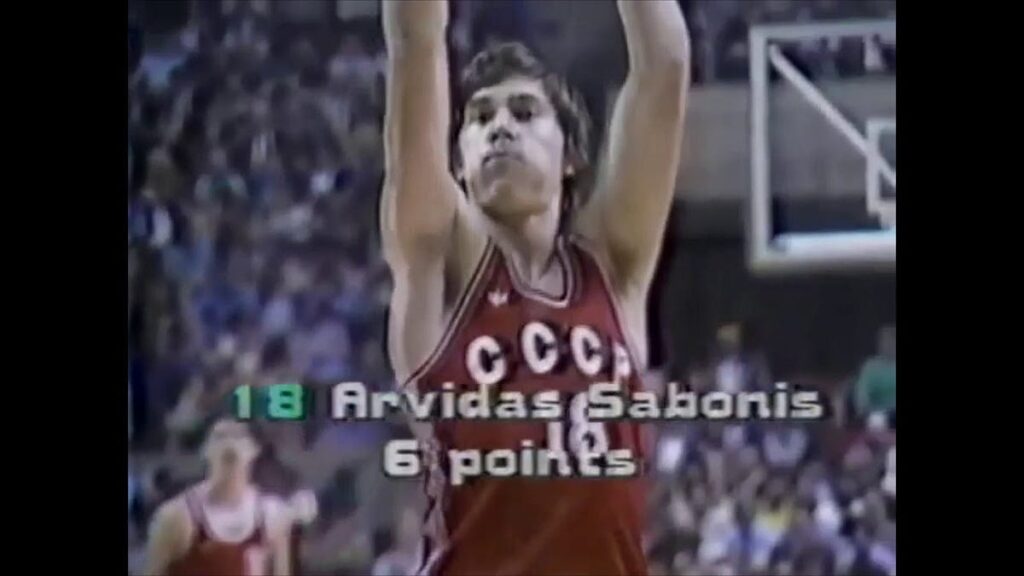
“In Lithuania, he’s the king.”
The above is courtesy of Arizona Wildcats big man Motiejus Krivas in reference to Arvydas Sabonis. I asked Krivas about Sabonis in context of the former snapping off a beautiful, behind-the-back bounce pass for an assist in Arizona’s 1st Round NCAA Tournament romp against Long Island.
“Every basketball player growing up wants to be like him,” Krivas said of Sabonis. “I watched a lot of clips of him playing, I listened to my parents’ stories. I’m really glad to have a player like that to look up to.”
Likewise, Arizona coach Tommy Lloyd is grateful to continue building from the influence Sabonis had on the game internationally. Before he came to UA in 2021, Lloyd established a reputation as arguably the best international recruiter in college basketball while working as an assistant at Gonzaga.
The most professionally successful of his international recruits is Domas Sabonis, born in Portland during his father’s NBA career but who played ball in Europe before arriving at Gonzaga.
Domas Sabonis is the rare child of a transcendent talent who successfully carves out his own legacy, having set the NBA’s post-ABA merger streak for consecutive double-doubles and landing a pair of All-NBA selections.
At Gonzaga, Domas earned NCAA Tournament All-Region in both 2015 and 2016, closing out the latter season averaging numbers foreshadowing the impact he’d have on the NBA at 17.6 points per game on 61.1 percent shooting from the floor and 11.8 rebounds a contest.
Since Domas, Gonzaga’s longtime home of the West Coast Conference has showcased a variety of exceptional Lithuanian imports. Most have played at Gonzaga rival Saint Mary’s, coming through a pipeline established between former Gaels coach Randy Bennett and Arvydas Sabonis’ longtime international teammate, Saurunas Marciulionis.
Marciulionis’ son, two-time WCC Player of the Year Augustas Marciulionis, is part of a Lithuanian lineage at SMC that also features Paulius Murauskas. Murauskas starred for the 2025-26 Saint Mary’s team that reached the program’s fourth consecutive NCAA Tournament.
Murauskas was also one of nine Lithuanian players in the 2026 edition of March Madness, joining teammate Mantas Juzenas; Arizona’s Krivas; Texas big man Matas Vokietaitis; Hawaii’s Gytis Nemeiksa; Liutauras Lelevicius of TCU; Alex Bieliauskas at Wisconsin; and Danas Kazakevicius at Howard.
Among the Lithuanian players to make their way to the U.S. in the three decades since Arvydas Sabonis debuted in Portland, none has reached the heights that Domas has. And yet, even as Domas has spent a decade making his name known both in college basketball and the NBA, he’s the first to acknowledge he’s not the passer Arvydas was.
There’s no shame in that. Really, no big man before Sabonis or since — until Nikola Jokic, anyway — passed like him. Not as often, anyway.
But Sabonis’ influence is evident in the proliferation of big men with the distribution skills of a perimeter player like Krivas showed off in Arizona’s opening-round — and, which Wildcats teammate Brayden Burries said the center shows off frequently in practice.
As Krivas’ coach, and having a unique relationship with the Sabonis family from his time at Gonzaga, Lloyd lit up when the topic of Arvydas’ impact on present-day players come up.
“It was funny, before the game, I was talking with [Long Island coach] Rod [Strickland], — Rod played with the Blazers with Arvydas, and I don’t think he had quite known my connection to the family,” Lloyd said. “When I told him [that] I’m really close to the Sabonis family, he was like, ‘Man, Arvydas was such a great player.’
“And I’m sure when Rod saw [Krivas] throw the behind-the-back pass, his mind went there as well.”
Growing up with basketball in the ‘90s, the version of Sabonis who teamed with Strickland in Portland certainly came to my mind.
To state that what Sabonis was doing when he arrived in the NBA in 1995 was unlike anything fans were accustomed to seeing is no exaggeration.
His aforementioned passing ability wowed spectators, as he leveraged his 7-foot-3 frame to see the entire floor. Then, with the basketball appearing like the size of a softball in his massive hands, Sabonis snapped off a variety of on-point dimes more suited to a point guard than a big man.
At the same time, however, Sabonis played with physicality that contrasted his flashy passing. He came into the NBA at a time when American basketball culture viewed European basketball as too reliant on finesse to stand up to the intensity of the game stateside.
He averaged 22 points and north of 11 rebounds per game his rookie season and finished second in both Rookie of the Year and Sixth Man voting.
And this was all when Sabonis was 31 years old with more than a decade of professional and international mileage on his body — along with a pair of serious Achilles injuries.
His outstanding rookie season, the first of five consecutive campaigns in which he averaged double-doubles and scored more than 16 points per game, only served to further fuel the Paul Bunyan-like mythos around Sabonis.
Sabonis also began to shift that perception, banging with bigs like Shaq, David Robinson and Hakeem at their peaks. While Sabonis can’t be credited with singularly changing the perspective on European basketball, he did significantly contribute to shaping the ecosystem of today’s game in ways evident on the college hardwood.
The collegiate game 30 years after Sabonis’ NBA debut is far more international than at any time since its inception. The 2026 Final Four features Krivas at Arizona — one of eight international Wildcats and four from Europe — facing off against a Michigan team with Spanish center Aday Mara.
Wolverines coach Dusty May makes his second Final Four appearance, the first coming in 2023 with an FAU team that featured Russian center Vladislav Goldin.
And, while Arizona’s Lloyd is renowed for his international recruiting, no team reaching the 2026 Final Four is more European than Brad Underwood’s Illinois Illini.
Six members of the Illinois squad in 2025-26 come from European nations including standout freshman David Mirkovic of Montenegro. The Illini’s success with Underwood’s recruiting approach suggests you should anticipate seeing others try to emulate it, as Craig Meyer of The Front Porch predicted last spring.
As for why Underwood looks to Europe for a certain style of player, the Illinois coach told Field of 68 last fall that in the European style of basketball, “they care more.”
Watching Mirkovic play, one can understand where Underwood would get that impression. One might also be hard-pressed to understand the pre-Arvydas Sabonis view of European players as soft.
Mirkovic is Illinois’ second first-year phenom from the other side of the Atlantic in as many years, following in the footsteps of Lithuanian product Kasparas Jakucionis.
Now in the NBA with the Miami Heat, Jakucionis explained on an appearance for the Heat Podcast Network the role that Arvydas Sabonis and the first generation of Lithuanian players had on the present-day hoopers.
“Basketball is [a] second religion in Lithuania,” Jakucionis said. “Even in school when you’re young, they’re telling you the stories [of Sabonis and the Lithuanian National Team], showing you videos…You just learn growing up. The history’s very important for us.”
Basketball and the brief history of Lithuania as a sovereign nation are intertwined in the public consciousness. Less than three years after the fall of the Berlin War and the separation of various Soviet states from Russia, Arvydas Sabonis headlined the the first-ever Lithuanian National Team to compete in the Olympic Games.
This marked my first exposure to the Sabonis folklore came when he starred for The Other Dream Team.
As with any ‘90s youth just discovering basketball at the time, I was obsessed with the Dream Team — and still have the Starting Lineup boxset displayed in my home to prove it. But in following as much basketball emanating from Barcelona as I could that summer, Lithuania’s run to the bronze medal and ensuing celebration in tie-dyed shirts piqued my interest.
And, in those Games, Sabonis averaged staggering numbers: 24.2 points, 12.6 rebounds and more than three steals and three blocks per game.
The Lithuanian team made such an impression on me as a nine-year-old that today, as an adult, I own one of those tie-dyed shirts.
That little sampling of Sabonis’ potential in 1992 I experienced was not unlike the brief glimpses other basketball fans witnessed before him. He’d demonstrated as a member of the Soviet National Team that could outshine America’s best in a single matchup.
The most famous is a 1988 Seoul Olympic Games matchup with David Robinson. The legend that’s grown from that contest in the medal-round semifinals has taken on a life of its own, adding to the folklore aura around Sabonis; that this loss was the singular motivation for the United States to begin sending professionals to compete in the Olympic basketball tournament, and that Sabonis destroyed Robinson.
The latter is overblown. Robinson finished with 19 points, 12 rebounds and a pair of blocks, while Sabonis posted 13 points, 13 rebounds, two assists, a steal and a block.
Some of the legend comes from what was actually a 1986 FIBA World Championship matchup and a game the United States won. However, Sabonis’ dunk over The Admiral from that meeting ranks among the filthiest posterizations in basketball history.
Before that, in 1982, Sabonis and the Soviet National Team visited preseason NCAA championship favorite Virginia and then-two time (and on his way to three-time) National Player of the Year Ralph Sampson as part of an American tour.
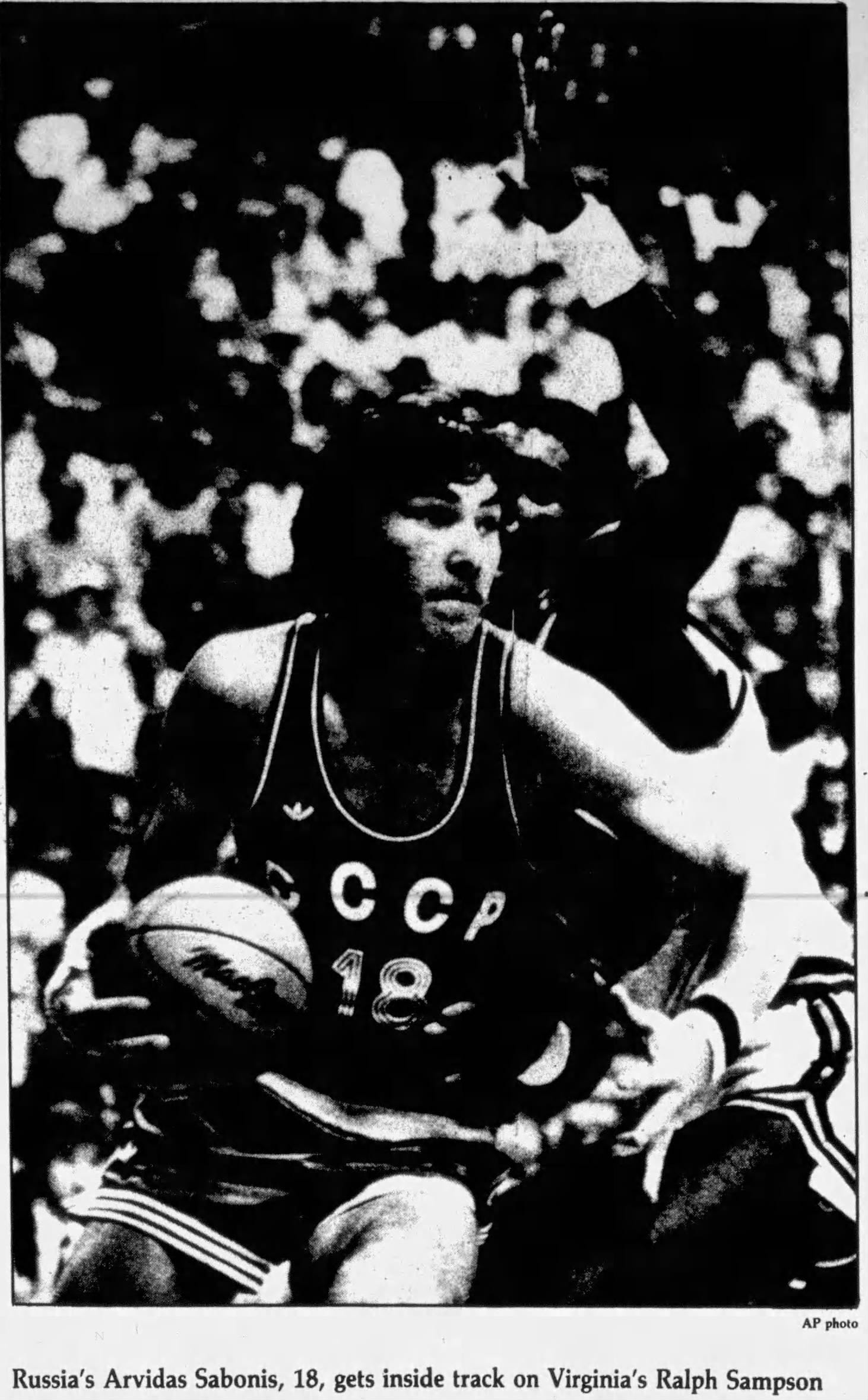
The Soviets exhibitions against top college teams is a topic deserving of its own separate and much deeper dive. In the meantime, USSR vs. UVa offers a fitting snapshot of the larger, overall experience.
Play was physical; perhaps as a heated proxy for the Cold War that raged between the nations. One journalist on the scene in Richmond, Kyle Parks, described that the action “sometimes looked like roller derby.”
Officiating was suspect, with four technicals called against the Soviets. It’s worth noting this game was only 10 years removed from the 1972 Olympic gold-medal round between the US and USSR, still considered today one of the greatest miscarriages of athletic justice ever.
And, after two overtimes, Virginia came out on top, 94-87, and college basketball’s National Player of the Year acquitted himself well with a near-triple-double: 13 points, a dizzying 25 rebounds and perhaps even more gobsmacking nine blocked shots.
But Sabonis, then just 17 years old, countered with 21 points on 9-of-12 shooting from the floor and grabbed 14 rebounds before fouling out.
“I wish I could speak so I could tell him what a good game he had,” Virginia coach Terry Holland told Parks for the Daily Advance. “He’s one heckuva player.”
Holland wasn’t the only college coaching great of the era who wanted to have a conversation with Sabonis, either.
While Sabonis joining the Trail Blazers in 1986 lingers as one of basketball’s great what ifs, a perhaps lesser known and possibly even more fascinating scenario posits the question, How good would Arvydas Sabonis have been playing college basketball?
Well, in 1986, Dale Brown tried to answer exactly that.
The Soviet government barred Sabonis from jumping to the NBA, but Brown sought a work-around to get the big man playing in the U.S. As a member of Brown’s LSU Tigers, Sabonis would not be a pro and thus technically detached from the trade embargo that kept Arvydas away from Portland.
LSU was fresh off its surprise run to the Final Four as a No. 11 seed when Brown put together a team that included oil tycoon Armand Hammer and Senator Russell B. Long to work out a diplomatic solution for Sabonis to don purple and gold.
“All I can say from the experience that consumed four months of my life is, God bless America,” Brown told reporters in November 1986 after his recruiting pitch failed. “I appreciate my freedom more than anything in the world when I saw how [the Soviet government] treated that young man, who could have been one of the biggest names in the history of the game.”
Four decades removed from his pursual of Sabonis, the legendary LSU coach told author Paul Knepper that Sabonis was the best player he ever recruited for the Tigers. Bear in mind, Brown chased Sabonis just a few years prior to signing Mahmoud Abdul-Rauf and Shaquille O’Neal.
An alternate timeline exists in which Sabonis is LSU’s center during Abdul-Rauf’s sensational tenure in Baton Rouge and a freshman-year Shaq backs up a senior Sabonis.

Pete Maravich’s otherworldly career at LSU gained renewed attention the last two seasons with the pursuits of Detroit Mercy’s Antoine Davis — which fell short — and Iowa’s Caitlin Clark, which appears likely to culminate in the coming days. Craig Meyer’s The Front Porch offers an illuminating breakdown of Maravich
As for Shaq, Sabonis’ mythic reputation reached the Big Diesel once the two finally met in the NBA. O’Neal said on a 2025 edition of his podcast that he took the court with extra motivation whenever facing Sabonis in part because of following the Lithuanian star’s play against Robinson in international competition.
But given Dale Brown’s recently shared sentiment of the two as college recruits, maybe the rivalry was more personal than Shaq lets on.
Either way, the best center of an era making it a mission to play his best against Sabonis only confirms the man’s impact on the game. It’s an impact that extends across generations, borders, and into the Final Four.