
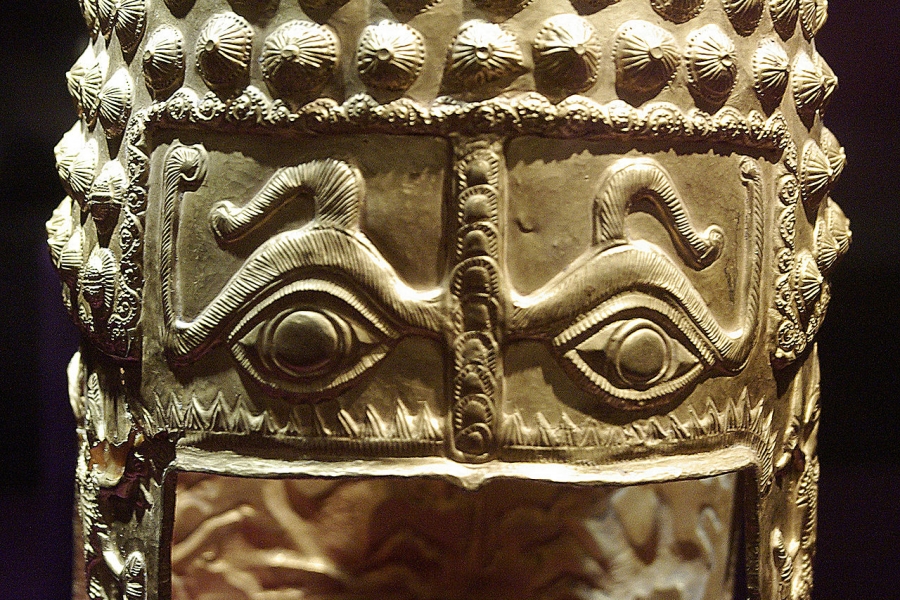
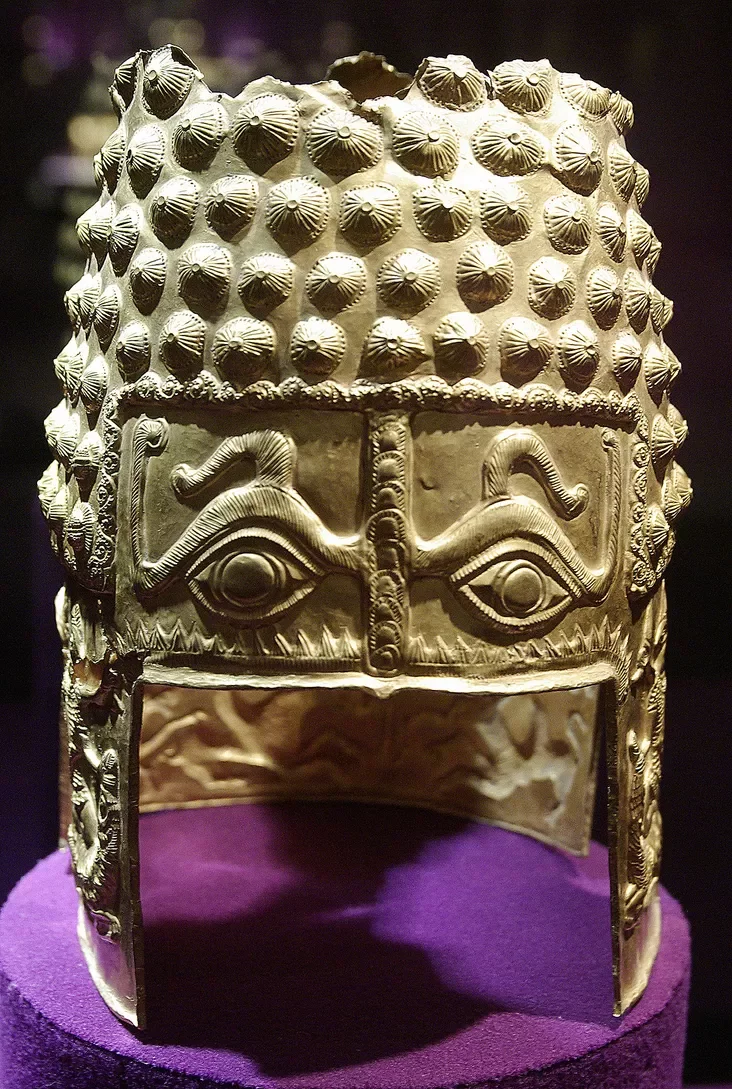
A golden helmet, approximately 2,500 years old, considered one of Romania’s main treasures, has been found more than a year after it was stolen during a museum robbery in the Netherlands,
writes
BBC Russian Service.
Павялічыць
Photo: AP Photo/Aleksandar Furtula
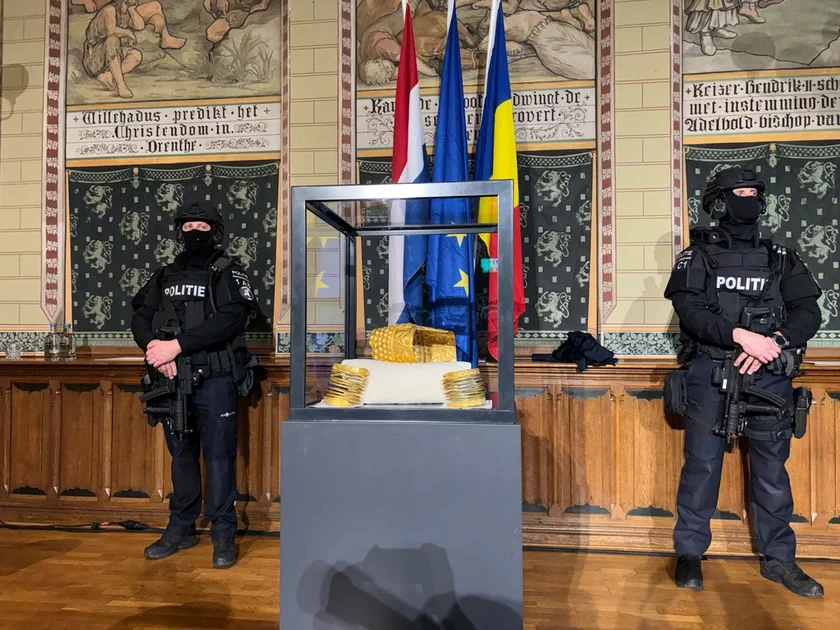
The helmet and two golden bracelets, dating to approximately 450 BC, were presented on Thursday as having been returned to the museum – they were displayed behind a glass case, guarded by two armed police officers. Another bracelet has not yet been found.
The theft of the Cotofenești helmet and bracelets, perpetrated by an armed gang that broke into the Drents Museum in Assen, caused outrage in Romania and raised questions about the security of priceless artifacts loaned to other countries.
“We have been waiting for this for a very long time,” Romanian prosecutor Daniela Buruiană told reporters. “We are pleased to now see the return of Romanian artifacts.”
The exhibits from the National History Museum of Romania were loaned for the exhibition “Dacia – Empire of Gold and Silver,” which told the story of the civilization and people who inhabited the territory of modern-day Romania before the Roman conquest in 106 AD. It was during this exhibition that they were stolen.
Павялічыць
Photo: Wikimedia Commons
The theft caused disagreements between the governments of the two countries, reportedly resulting in the Dutch government paying Romania approximately 5.7 million euros in insurance compensation.
Romanian officials declined to discuss what would happen to the money now.
Robert van Lang, director of the Drents Museum in the northern Netherlands, reported that the helmet sustained a small dent but is restorable. The bracelets, according to him, are in perfect condition.
Romanian prosecutor Rareș-Petru Stan noted the “strong resonance” the theft had in his homeland and thanked his Dutch colleagues for their “hard work and faith in the outcome.”
“We continue the investigation to find the last bracelet,” he added. “And we are glad that we can return these treasures to the Romanian people.”
Dutch prosecutor Carien Faner said the helmet and bracelets were handed over to authorities on Wednesday after negotiations involving lawyers for three suspects.
Two men in their 30s and one 21-year-old will face trial later this month. Faner clarified that the return of the treasures was part of a pre-trial agreement between the prosecution and the suspects’ lawyers.
The criminals were apprehended days after they broke into the museum using explosives, but no trace of the stolen valuables was found at the time.
Art experts believe the artifacts were stolen to order by a criminal group.
In recent years, several Dutch museums have been targeted by attacks, as providing adequate protection for priceless artifacts is very difficult. The helmet and bracelets were displayed in a glass case, which was not a serious obstacle for the armed group.
In 2024, two works by Andy Warhol were stolen from a gallery in the southern Netherlands, and six years ago, Frans Hals’ painting “Two Laughing Boys” was stolen from a small museum in the town of Leerdam.
The former director of the National History Museum in Bucharest, Ernest Oberländer-Târnoveanu, faced severe criticism at home for loaning the golden artifacts abroad and was fired days after the theft.
He expressed relief that the helmet had been found.
“This is a unique item of European and even world cultural heritage,” he said in an interview with RTL Nieuws. “This helmet is an important social and political symbol of Dacian civilization.”
The legendary helmet is believed to have been first discovered in 1926 in a pasture by a peasant boy tending sheep in the Romanian village of Poiana-Cotofenești. The child wore the helmet for two weeks and used it as a toy, causing some parts to break off. Since the 1970s, the helmet has been kept at the National Museum of History of Romania. It was determined to have belonged to an unknown local Geto-Dacian king or aristocrat.