
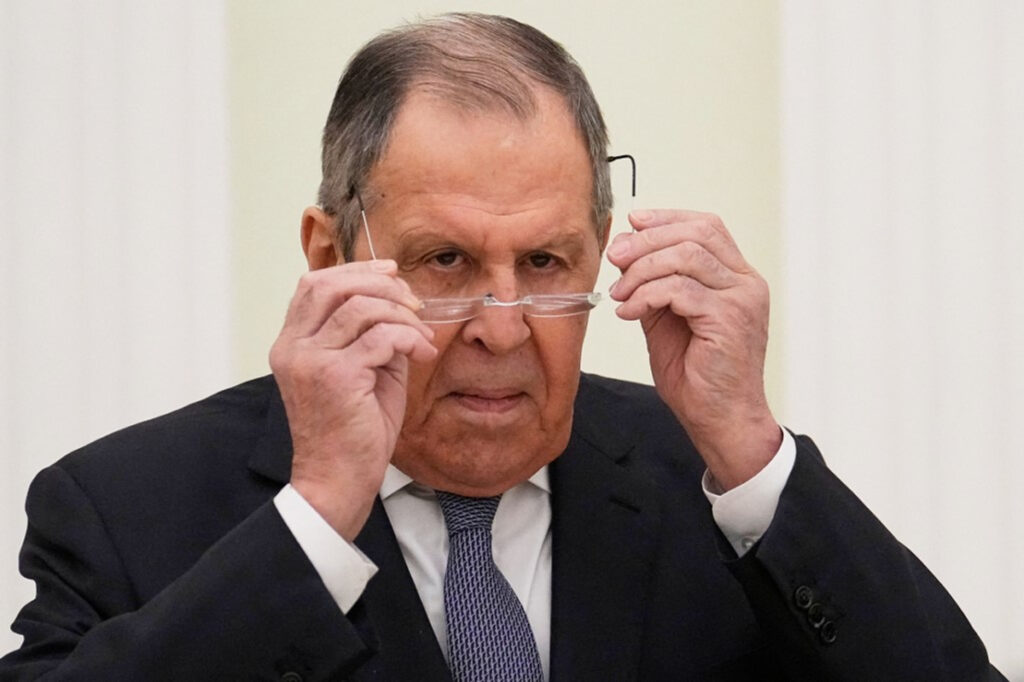
Russian Foreign Minister Sergey Lavrov said on Friday that the Bahrain-led, US-backed draft resolution on the Strait of Hormuz could not be approved by the UN Security Council because it was unlikely to lead to a peaceful settlement of the conflict.
Speaking at a press conference in Moscow after talks with Egyptian Foreign Minister Badr Abdelatty, Lavrov argued that even the softened language authorizing “all necessary defensive measures” still leaves it to participating states to decide when force is justified.
Follow our coverage of the war on the @Kyivpost_official.
Lavrov’s remarks signaled that Russia may be prepared to veto the measure, arguing that it could “legitimize aggression” in the region.
The latest draft, submitted by Bahrain, was watered down after opposition from veto-wielding members China, Russia, and France, which objected to earlier language authorizing countries to use “all necessary means” to secure the strait. That dispute delayed the vote, which had originally been expected on April 3.
China has also publicly opposed any wording that could legitimize the use of force. Beijing’s UN ambassador Fu Cong warned that “any such authorization would inevitably lead to further escalation and serious consequences,” urging council members to prioritize a political settlement instead.
Tehran, meanwhile, has floated its own proposal for managing the strait, saying it is working with neighboring Oman on a system that would require ships to obtain permits and special licenses to pass through the waterway.
Other Topics of Interest
Iran’s Araghchi Calls Russia’s Lavrov, Seeks Help Blocking UNSC Resolution
In their first publicly known call since the intelligence flap, the Iranian and Russian foreign ministers discuss rising tensions and UN Security Council action.
European Union foreign policy chief Kaja Kallas rejected the idea, saying that “international law doesn’t recognize pay-to-pass schemes.” She also said Iranian attacks on civilian ships had brought traffic in the strait to a near halt and called restoring “safe, toll-free freedom of navigation” an urgent priority.
The Strait of Hormuz carries about a fifth of the world’s oil and gas flows, making the standoff a major threat to global energy markets and trade. With Russia and China resisting any UN authorization for force, and Iran pushing its own terms for passage, the council vote is shaping up as a test of whether the international response will lean toward coercion or diplomacy.
Last month, on March 11, Moscow abstained, alongside China, from Security Council Resolution 2817 condemning Iran’s “egregious attacks” against several Gulf states.
On Friday, as the US-Israel war with Iran entered its fifth week, President Donald Trump wrote on Truth Social that with a little more time, the United States could open the Strait of Hormuz, take the oil, and “make a fortune,” calling it “a gusher for the world.”