
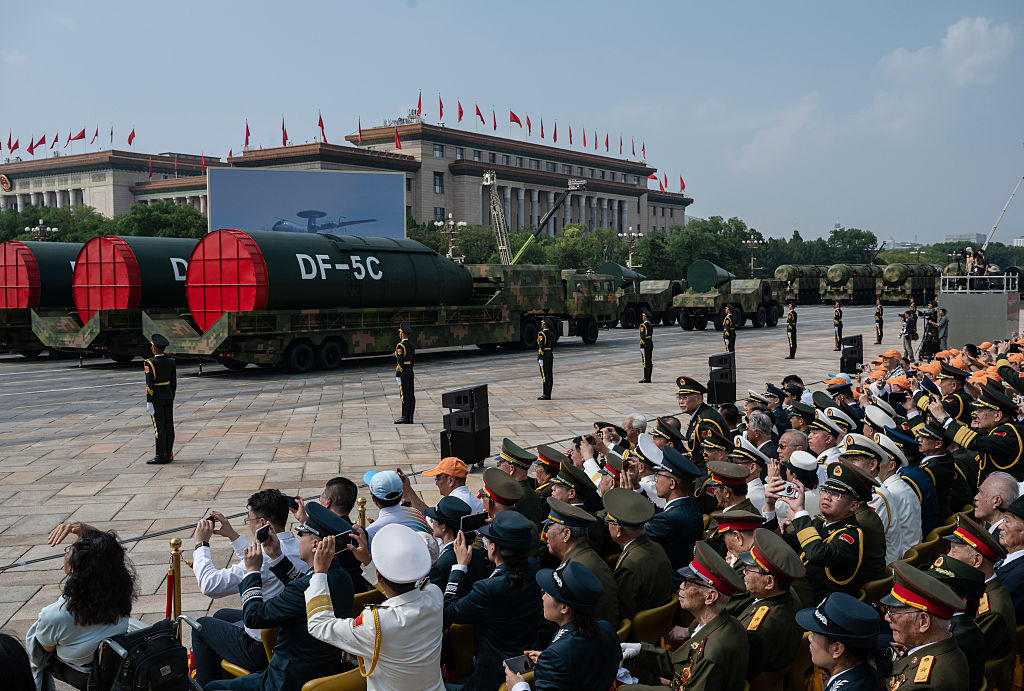
A recent investigative report published by CNN on April 1 has drawn international attention to what analysts describe as a significant expansion of China’s nuclear-related infrastructure. By comparing commercial satellite imagery with internal government documents, the report suggests Beijing is undertaking one of its most extensive nuclear modernization efforts in decades.
RELATED: China Expands Nuclear Arsenal as America Builds Largest Missile Shield in History
Satellite evidence of site transformation
The investigation focuses on Zitong County in Sichuan Province, a region long associated with China’s nuclear research and development. Time-series analysis of high-resolution satellite images indicates that since 2021, several rural villages, including Baitu and Dashan, have disappeared, replaced by heavily guarded military-industrial complexes.
Local government records obtained by the report show that residents displaced by land requisitions were told only that the project involved “state secrets.” Today, the area reportedly hosts facilities linked to the production of key nuclear components.
One structure has drawn particular attention: a large reinforced dome within what is known as the “906 Base,” covering approximately 36,000 square feet. Experts analyzing imagery identified multiple layers of security fencing, radiation monitoring equipment, blast-resistant doors, and tunnel-linked infrastructure with specialized ventilation systems.
Strategic implications
You are now signed up for our newsletter
Check your email to complete sign up
Nuclear analysts, including Decker Eveleth of CNA Corporation and Jeffrey Lewis of Middlebury Institute of International Studies, assessed that the facility’s design is consistent with high-security laboratories used for handling radioactive materials such as plutonium or enriched uranium.
Lewis described the development as a “fundamental reconstruction” of China’s nuclear infrastructure, suggesting a broader effort to upgrade the technological foundation supporting its weapons systems.
The report examined 136 known sites across China associated with nuclear weapons and missile production. More than 60 percent of these locations have undergone significant expansion over the past five years. Between 2020 and 2025, the total floor space of such facilities reportedly increased by more than 2 million square meters, with some strategic production centers in Sichuan and Shanxi expanding by over 50 percent.
Expanding arsenal and shifting doctrine
According to the Pentagon, China currently possesses approximately 600 nuclear warheads. While still fewer than those held by the United States and Russia, analysts say China’s arsenal is growing at the fastest rate globally.
Based on facility capacity and logistical patterns, Western intelligence estimates suggest China’s annual nuclear warhead production could approach 100 units. This trajectory may indicate a shift away from a traditionally “limited deterrence” posture toward a more expansive and resilient nuclear capability.
Experts note that the modernization effort appears closely tied to broader geopolitical considerations. Lewis indicated that the infrastructure expansion reflects an effort to build a more diversified and survivable nuclear triad, land-, sea-, and air-based delivery systems, designed to withstand potential first strikes and deter intervention in regional conflicts.
Zhao Tong, a senior fellow at the Carnegie Endowment for International Peace, suggested that China’s leadership may view the demonstration of strategic capabilities, including nuclear forces, as a means of deterring external involvement in scenarios such as a potential conflict over Taiwan.
Global context
The report comes amid heightened tensions between Washington and Beijing, fueled by ongoing trade disputes and geopolitical friction. It also follows the expiration of the New START Treaty, which had previously served as a cornerstone of nuclear arms control between the United States and Russia.
Analysts warn that China’s emergence as a third major nuclear power could complicate future arms control efforts and potentially contribute to a new era of strategic competition.
Officials from the administration of Donald Trump have repeatedly criticized Beijing for expanding its nuclear capabilities without transparency, arguing that such actions could destabilize global strategic balance. According to White House sources, nuclear arms control and transparency measures are expected to be key topics in upcoming diplomatic engagements.
A turning point in nuclear strategy?
While the full scope and intent of China’s nuclear expansion remain subject to interpretation, the scale and pace outlined in the report have intensified scrutiny among policymakers and defense analysts worldwide.
As global arms control frameworks face increasing uncertainty, the developments highlighted in Sichuan underscore the evolving dynamics of nuclear strategy in the 21st century, raising questions not only about capacity, but also about trust, transparency, and long-term stability.
Editorial note: Views expressed in this article are the opinions of the author and do not necessarily reflect the views of Vision Times.