
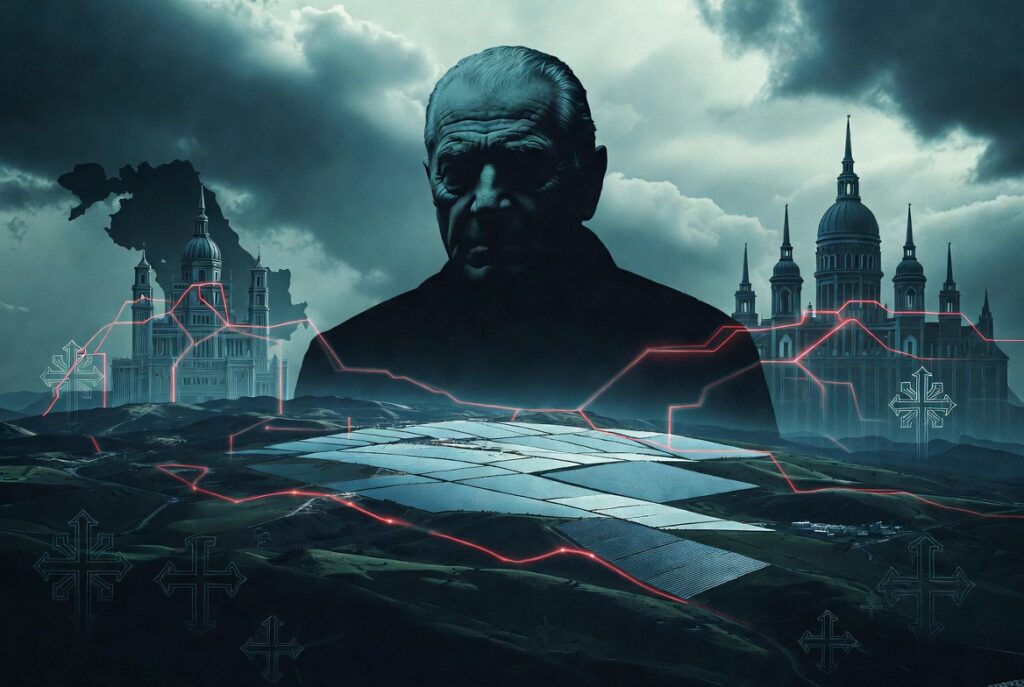
The sudden emergence of Miodrag “Daka” Davidović in North Macedonia’s energy sector has triggered a major political scandal, exposing longstanding networks of influence stretching from Belgrade to Moscow.
Davidović, a controversial Montenegrin businessman born in 1957 in Nikšić, is far from an ordinary investor. Over decades, he has built a vast business empire spanning petroleum trading, construction, real estate, and alcohol production across Montenegro, Serbia, and Republika Srpska. His activities have long blurred the lines between business, politics, and regional power structures.
A profile shaped by controversy
Davidović’s career began in Montenegro’s steel industry. In the 1990s, he founded the company Neksan and became involved in managing the Nikšić steelworks. Beyond business, he held security and ministerial roles in Serb-controlled structures during the Yugoslav wars. In recent years, he has financed pro-Serbian political parties and the Serbian Orthodox Church – including major restorations such as the Ostrog Monastery. These ties have positioned him as a key donor and ally within the Church, which many analysts view as a vehicle for Belgrade’s “Serbian World” project aimed at strengthening influence over Serb communities across the Balkans.
EP rapporteur: “Serbian World” is dangerous for the European Union and the Balkans
His connections extend further. Davidović has been linked to Russian figures, including lawmakers and former intelligence officers, raising concerns about channels to Moscow. The United States sanctioned him in 2023 for corruption, malign influence, and activities that undermined regional stability and Euro-Atlantic integration.
The spark in North Macedonia
The current scandal erupted after reports surfaced that Hronos Sum, a company linked to Davidović, was included in North Macedonia’s 2026 state energy plan for constructing photovoltaic plants on over 900 hectares near Štip. Opposition parties, particularly the Social Democratic Union of Macedonia (SDSM), have condemned the move as a “huge scandal,” arguing that it opens the door to a US-sanctioned figure and exposes questionable ties within Prime Minister Hristijan Mickoski’s VMRO-DPMNE-led government.
Government officials have pushed back, denying wrongdoing and attempting to link Davidović instead to the previous SDSM government under Zoran Zaev. They have pledged to block the investment through legal means.
Broader networks in power
The controversy gains extra weight from key figures in the current Macedonian government. Energy Minister Sanja Božinovská, who oversees the sector, previously faced scrutiny over her declared Bulgarian ethnic identity. Deputy Prime Minister Ivan Stoilkovski is known for openly supporting the “Serbian World” concept and maintains strong pro-Russian and anti-European positions. His daughter works at a Russian state-funded public diplomacy fund named after Alexander Gorchakov.
These connections suggest the “Daka” case is not an isolated business deal but part of deeper political, economic, and ideological networks. Analysts have long warned that Serbian and Russian influence in the Western Balkans operates through a mix of business proxies, church structures, media, and nationalist politics – often aimed at weakening Euro-Atlantic integration.
Why it matters
What began as a dispute over one energy project has evolved into a broader debate about transparency, foreign influence, and the integrity of North Macedonia’s institutions. The case highlights how opaque capital and regional power plays continue to challenge the country’s stability and its path toward the European Union.
As accusations fly between government and opposition, the “Daka” affair serves as a stark reminder of the complex interplay between business, politics, and geopolitics in the Balkans – where old networks rarely disappear; they simply adapt.
Caption: AI-generated illustrative image
Updated: April 3, 2026 – 06:09