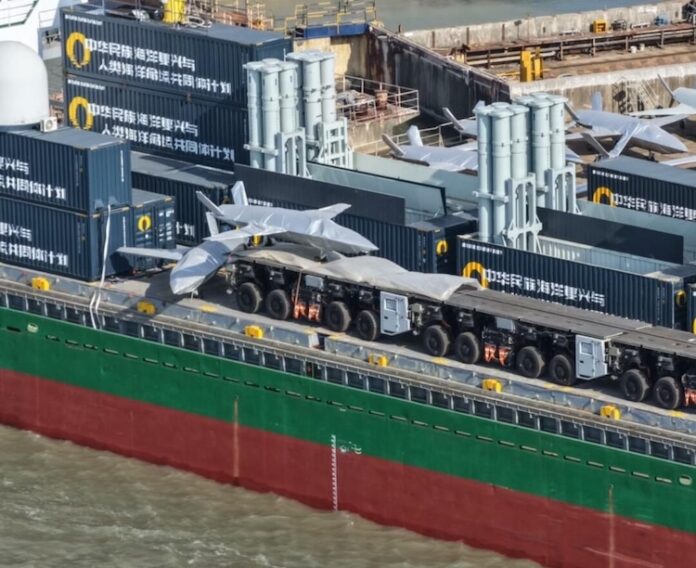
 Zhongda 79, a Chinese merchant vessel, was seen in December 2025 and early January 2026 at Shanghai’s Hudong-Zhudong shipyard receiving numerous containerized armaments, including close-in weapon systems, vertical launching systems and radars. Photo from X
The Gods of the Copybook Headings
Dr Mark Bailey*
For decades Australia spent about 2% of GDP on national insurance – the AD. Nothing bad ever happened, right?
Australia created a delusional brave new world of de-industrialisation in pursuit of luxury beliefs, and now we cannot mobilise. Governments even offshored basic fuel supply (mostly carried in Chinese tankers), and nothing bad has ever happened… oh, wait.
Kipling noted this particular human trait.
And that after this is accomplished, and the brave new world begins
When all men are paid for existing and no man must pay for his sins,
As surely as Water will wet us, as surely as Fire will burn,
The Gods of the Copybook Headings with terror and slaughter return!
Australian governments created strategic problems by abandoning fundamental defence capabilities; for example, national critical infrastructure protection.
In 1963 the Coast Artillery Branch of the Royal Regiment of Australian Artillery (RAA) was disbanded. In 1968 Australia’s only-ever area defence system was abandoned, unreplaced. No. 30 Squadron reformed on 11 January 1961 as a Surface-to-Air Squadron with 190km-ranged Bloodhound missiles. These provided air defence to the Sydney region and from June 1965, to Darwin during Confrontation. The squadron disbanded on 30 November 1968 and Australia has had no area-defence capability since. 16th Regiment RAA is re-equipping with point-defence NASAMS, with less than a third of Bloodhound’s range. The RAN lost its harbour-protection capabilities by the mid-late 1950s when as its boom defence ships were decommissioned. The last vestige was the boom defence ship HMAS Kimbla, decommissioned in 1984 after conversion to an oceanographic research ship in 1959.
Government ‘accepted the risk’ of creating strategic weaknesses. That became habit, then defacto policy, then assumption. Now these strategic risks are so serious that the ADF can be neutralised at the opening of a conflict by low-cost, low-risk, high-return systems launched from expendable platforms. The RAN can be neutralised by a dozen large AUV, the RAAF by 50-60 cheap Shahed-style drones. When both are neutralised, the Army is strategically irrelevant.
Australia has area air defences. The lesson of the Manned Underwater Vehicle (MAV) attack on Garden Island in 1942 was that even incomplete boom defences stopped two of three MAV. The port defences included of a sensor network, steel nets and small craft, manned by reservists and conscripts.
Modern AUV are the same general size as the IJN MAV and the PLA-N intends to use them to destroy critical port infrastructure like wharves and graving dock caissons as well as berthed ships and submarines. Low-tech, cheap, simple WWII-style force protection defences will stop them. They can be operated by personnel with limited, but task-focussed training. An effective boom defence sailor needs mere weeks of training. Even the defence plans for some major ports still exist. This is the perfect mission for a revived RAN reserve force.
Others ignore the Gods of the Copybook headings; US strategic bases are near-undefended. This is also true of operational forward bases inside enemy weapons engagement zones (WEZ) as the 27 March strike on Prince Sultan Air Base in Saudi Arabia (PSAB) proved. Multiple aircraft were damaged and an E-3 Sentry destroyed, likely by a precision hit from a subsonic drone, which (if correct) something as simple as WWII L60 Bofors guns would have stopped. Ukraine has effective defences against drone attack.
The lessons for the Australian government and ADF are blindingly obvious.
Today, one small container ship with a few dozen Shahed 136 drones could smash every RAAF flightline from Amberlay to Edinburgh. Similarly, a dozen of the PLA-N’s specialised purpose-developed port-attack AUV launched to attack the caisson and ships alongside at Garden Island would cripple the RAN.
Fixed bases within range of the PLA WEZ long-range fires (ballistic or air-breathing) will be attacked. This is a poor deal for the PLA if these bases are undefended – why waste scarce 8,000km ranged DF-27 against a second-tier opponent like Australia? If undefended, they can be attacked by shorter-ranged, even obsolescent missiles ,and drones from cheap, converted, disposable auxiliary cruisers like the one openly displayed at Shanghai’s Hudong-Zhonghua shipyard in January 2026.
From such platforms, drones can attack any Australian base at any time, and from any direction because they are all undefended. Even cheap passive defences like revetments, hardening and decoys are absent.
The USA is in a worse situation. During exercises their Red Teams and military historians repeatedly demonstrated US vulnerability. The outcome was ‘handwavium’, ignoring the realities demonstrated by the Gods of the Copybook Headings at PSAB on 27 March 2026. In that same week, repeated waves of (publicly and so far) unidentified drones operated over Barksdale Air Force Base (Louisiana) where the USAF B-52H fleet is based. The base is both undefended and the headquarters of the US Air Force Global Strike Command. These drones were sophisticated and required a C2 system beyond hobbyists.
Having wasted its 10-year strategic warning time while deliberately de-industrialising to ensure it cannot mobilise, Australia is entirely unprepared this era of hybrid and drone warfare and long range ballistic fires. Nothing is defended, and alone of the services, the RAN has destroyed its reserve capability. Force protection was a basic RANR function. and ensured that it has no ability to even plan to defend its bases.
Do the Gods of the Copybook Headings smile?
*Dr Mark Bailey, BA, MDefStud, PhD, Lieutenant Commander RANR, Naval Studies Group Fellow, Australian Defence Force Academy, Adjunct Lecturer UNSW ADFA, Research Associate King’s College London. Coordinator. The Corbett Forum