
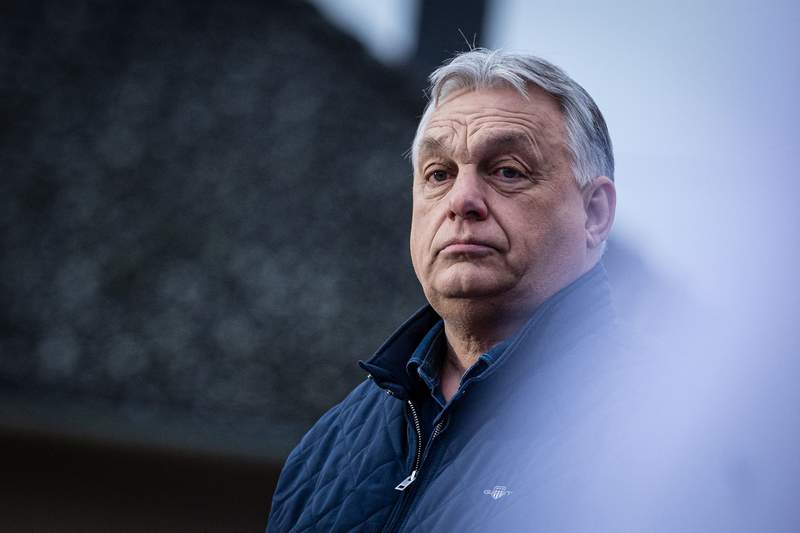
Hungarian Prime Minister Viktor Orbán on Sunday appeared to suggest Ukraine was involved in planning an act of sabotage after Serbia reported finding explosives on a gas pipeline used to transport Russian natural gas to the two countries.
Earlier on Sunday, Serbian President Aleksandar Vučić said explosives “of devastating force” were found on the Balkan Stream pipeline near the village of Velebit on the Hungarian border.
The pipeline transports Russian natural gas from Turkey via Bulgaria, Serbia and Hungary.
Vučić and Orbán – who are both friendly towards Russia and maintain good bilateral relations – discussed the matter by phone and said investigations were ongoing. Orbán said Hungary’s defence council would hold an emergency session to discuss the matter.
Orbán under pressure
Hungary is due to hold a parliamentary election in a week, on April 12, and polls suggest Orbán’s Fidesz party could lose out to the conservative opposition Respect and Freedom Party (Tisza).
For months, Orbán has been campaigning for votes primarily by criticizing Ukraine and the EU aid provided to the country amid Russia’s ongoing invasion.
He did not explicitly state that he suspects Kiev of being behind the pipeline incident, but repeated familiar accusations against Ukraine after the defence council meeting.
His foreign minister, Péter Szijjártó, said the discovery of explosives at the pipeline in Serbia fits in with the other actions Orbán has blamed on Ukraine.
“Ukraine has been working for years to cut Europe off from [Russian] gas supplies,” Orbán said in a video on Facebook.
The Ukrainians had already destroyed the Nord Stream pipeline and were blocking oil supplies from Russia to Hungary via the Druzhba pipeline running through Ukraine, he said.
The Ukrainian military is constantly attacking the section of the TurkStream gas pipeline located on Russian territory, to which Balkan Stream is connected, he continued.
Orbán has long accused Kiev of preventing the resumption of operations on the Druzhba pipeline for political reasons.
Ukraine rejects the allegations and stresses that the pipeline is currently unusable due to Russian airstrikes.
No one has yet been held to account for the attacks on the Nord Stream pipelines from Russia to Germany; the suspected Ukrainian mastermind is currently in pre-trial detention in Germany.
Orbán said Hungary would step up its military surveillance of the section of the Balkan Stream pipeline located on Hungarian territory, adding that the “vital” pipeline supplies 60% of the country’s natural gas requirements.
Opposition suspects election campaign ploy
The leader of Hungary’s opposition and top candidate of the Tisza party, Péter Magyar, accused Orbán of seeking to sow panic during the election campaign.
Magyar wrote on Facebook that he had been receiving signals for weeks that “false flag” operations of this nature were being planned.
There had been repeated reports that something would “coincidentally” happen to the pipeline a week before the election, around Easter, he said.
“I also call on Viktor Orbán to stop (at least during the holidays) the scaremongering and the sowing of confusion planned by Russian advisers,” Magyar continued.
Should Orbán use the incident for election campaign propaganda, this would amount to an admission that it was a “false flag” operation, he said.
The director of Serbia’s military intelligence service, Đuro Jovanić, refuted allegations that the Serbian military could be involved in a “false flag” operation designed to accuse Ukraine of sabotage.
He said there were indications that the explosives were manufactured in the United States, adding that the authorities are searching for a militarily trained “member of a migrant group,” who they suspect of planning the attack.