
Shkëlzen Gashi’s Exhibition on Massacres in Kosovo, Investigation: Maximum care is needed, we used 8 sources for one victim

Express newspaper
06/04/2026 23:32
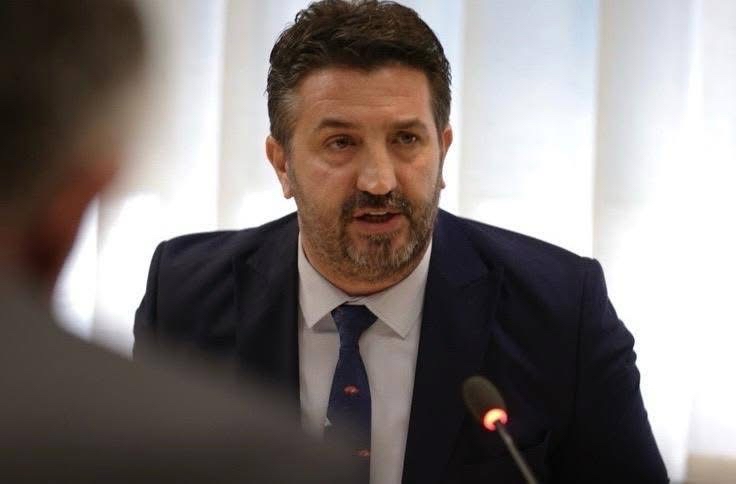
Following the inaccuracies identified in the exhibition on the massacres in Kosovo, which was later withdrawn, the executive director of the Institute for War Crimes Research in Kosovo, Atdhe Hetemi, invited to `RTK Prime`, said that the documentation of war crimes must be based on strict methodology, multiple verification of sources and a humane approach to victims and survivors.
In his perspective on what happened, Hetemi said that the Institute for War Crimes Research in Kosovo prioritizes the issue of documentation through a methodology that does not focus only on statistics and names, but also on events in general.
“The methodology for documenting and verifying crimes committed during the war in Kosovo was one of the first documents after the Law of the Institute, which was designed, then approved and has begun to be applied at the Institute of War Crimes in Kosovo. It is a credible document, because we did not work on it alone, but it was drafted in cooperation with various actors, respectively, at the moment when the first draft of the methodology was worked on, which foresees in detail and step by step the issue of identification, collection, verification, processing, archiving of documents, and then their publication, representatives of academic institutions, civil society, media and justice institutions, who have previously worked on the documentation process, were invited to open discussions”, declared Hetemi.
Hetemi said that the documentation and verification process must be handled with utmost care, so that the published data is as accurate and reliable as possible.
“It is more than necessary that the documentation and verification process be viewed, as people say, with a magnifying glass, so that when they come up with data, it is as credible as possible. The institute does not claim to be infallible, but it is our legal obligation, as well as our mandate and mission, that the data published by the institute be as verified, as documentable and as authentically verified as possible,” Hetemi said on ‘RTK Prime’.
He further emphasized that the Institute is finalizing the database of war victims and that multiple verification sources are used for each victim.
“We are currently working on finalizing the database of war victims in Kosovo. For one victim alone, the institute has used a minimum of 8 sources to verify whether the victim in the database is a war victim, but also the circumstances in which he or she lost his or her life. We cannot rely on a single source in any way, regardless of whether it is credible or not, but there must be other sources, so that the documentation process is as credible and reliable as possible, because we are not only dealing with statistics, but we are dealing with war victims, survivors and their families, who may then be indignant that such a thing was not done properly,” Hetemi emphasized.
He also showed some of the main sources that were used during the compilation of the database of war victims in Kosovo.
“Some of the main sources we used when designing the database of victims in Kosovo are the databases of the Council for the Protection of Human Rights, then other published databases, data from the Institute of Forensic Medicine, the Civil Registry Agency, the Kosovo Agency of Statistics and others,” stated the executive director of the Institute for the Research of War Crimes in Kosovo.
According to Hetemi, strict methodology must be followed before drawing a conclusion or publishing data.
“Strict methodology must be followed before we reach a conclusion or before anything is published. Methodology is the key foundation in the process of documenting crimes committed during the war in Kosovo. We cannot in any way achieve proper documentation if we do not prioritize the application of the right methodology during this process,” he continued.
Hetemi emphasized that documenting war crimes is not just an administrative, academic or cultural process, but above all a humane process that requires a humane approach and responsibility.
“It is very important that, unlike any other research, when we are dealing with research and documentation during the Kosovo war, we understand something that is very elementary and basic: the documentation process is not an administrative process that an institution, an NGO can do, it is not necessarily an academic process that can be done for this purpose. It is not even a purely cultural process to make an exhibition or a film, but much more it is a human process, which must have a very human approach”, emphasized the executive director of the Institute for War Crimes Research in Kosovo.
In addition to professional elements, such as methodology, Hetemi said that in documenting war crimes, the human and humane element must also be taken into account, as otherwise irreparable damage or irritation to others may be caused, emphasizing that this remains the responsibility of all who contribute in this regard.