
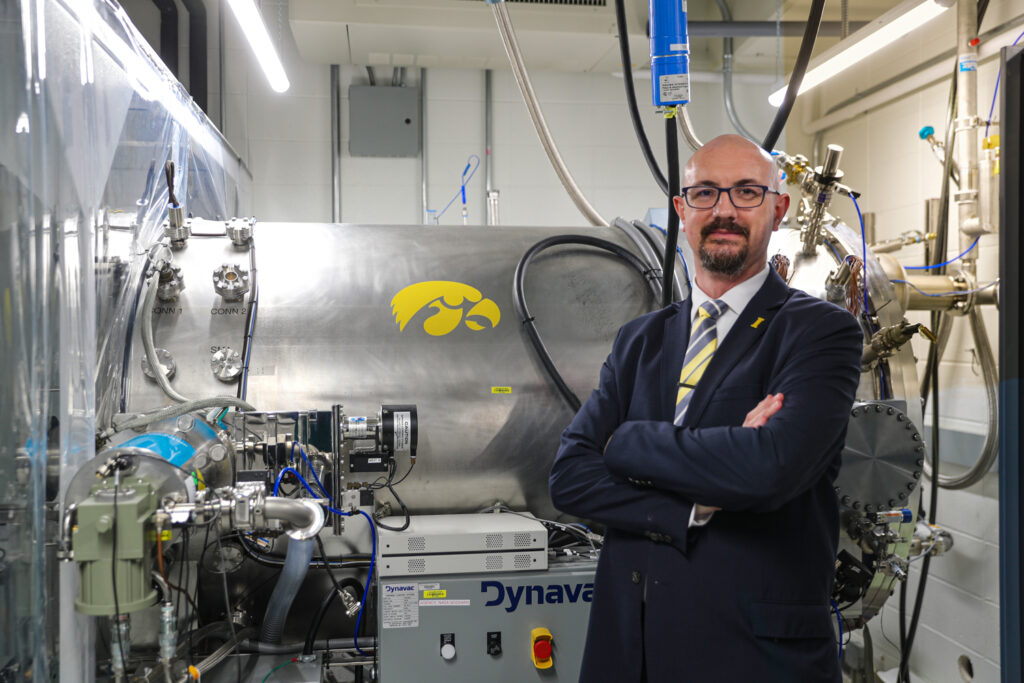
After a successful rocket launch to study the northern lights in Norway, University of Iowa researchers are awaiting findings from devices they built and attached to the rocket, which measure magnetic fields and electron energy.
The rocket took off from the Andøya Space Center on March 11 to study how bursts of energy from the northern lights create turbulence in Earth’s upper atmosphere.
According to Alaska Air Forwarding, a freight company that specializes in shipping to Alaska, turbulence from the northern lights can disrupt satellites, GPS, and radio signals, causing navigation errors and communication problems.
David Miles, deputy director of research operations in UI’s department of physics and astronomy and a co-investigator for the rocket launch, was tasked with building the magnetometer attached to the rocket, an instrument used to measure the magnetic fields of the northern lights.
While Miles had seen countless rocket launches before, Norway’s launch was a first for UI graduate student Jessica Mondoskin, the lead graduate student for the magnetometer project.
“It was a really cool experience to see how a mission runs, how all of the different groups communicate and interact,” she said. “It’s really cool how the decision-making process works for asking questions like: ‘Do we have good conditions?’ ‘Are all the instruments working as we expect?’”
RELATED: UI nearing end of construction for Van Allen Hall’s Iowa Spaceflight Laboratory
Miles said a sub-orbital rocket launch — a rocket that never achieves orbit and comes back down to Earth — such as the one used in the launch, can become complicated when measuring a phenomenon like the northern lights, which is constantly moving. Miles said there was only a small window for the rocket to pass through the aurora borealis and study it.
“The physics are all happening at about 100 kilometers altitude,” he said. “So it’s going to take about four minutes to get from the ground to that altitude, and then you’re only at that altitude for a couple of minutes, and then the rocket starts to come back down and eventually lands in the ocean.”
Miles and Mondoskin’s magnetometer also had to be extensively calibrated before the launch because the rocket itself has its own magnetic field, which would interfere with measurements.
Mondoskin said the two went on “calibration campaigns” at NASA’s Maryland-based Goddard Space Flight Center — where scientists build spacecraft and study the universe — and the Virginia-based Wallops Flight Facility — a launch range and research airport — training the instrument to measure only the aurora rather than including the rocket’s magnetic readings.
Miles said the magnetometer was a customized version of the MAGnetometers for Innovation and Capability, or MAGIC, an instrument designed to measure magnetic fields in space and originally used on the TRACERS mission’s satellites.
Miles said the magnetometer launched in Norway could be used for space weather forecasting or measuring the magnetic fields of the moon.
“This is both a science campaign in its own right, which is the Norwegian mission, but it’s also a technology demonstration of an instrument which is being built up for things like space weather forecasting and future moon applications,” he said.
Scott Bounds, another co-investigator for the rocket launch, was tasked with adding an electron-measuring instrument to the rocket to measure the number of electrons in the aurora borealis and their energy.
Bounds said the Norway launch was a follow-up to a failed 2019 launch. Bounds joined the project after the original researcher tasked with building the electron-measuring instrument, Jasper Halekus, was unable to join the new mission, picking up where the failed launch left off.
Bounds’s instrument came from spare components he had left over from a previous rocket launch in 2022. Bounds said his instrument is helpful for understanding the aurora borealis because the original energy source that creates the northern lights comes from electrons.
Bounds said the sun has its own magnetic field, which constantly impinges on Earth’s magnetic field like a rock in a stream. This interaction pumps a great deal of energy into the atmosphere, which is eventually released.
“One of the key ways that energy is released is through accelerating electrons that get driven down into our atmosphere,” he said. “Those electrons hit the molecules in the atmosphere, they excite those molecules, and the relaxation of that energy is the light that we see that creates the aurora.”
Richard Dvorsky, the research administrator for the Iowa Spaceflight Laboratories, wrote in an email to The Daily Iowan that Miles and Bounds’s contributions to the rocket highlight the Iowa Spaceflight Laboratory’s staff and equipment that make such missions possible.
Dvorsky wrote there were many key individuals in the Spaceflight Laboratory who worked behind the scenes to help build, test, and integrate the two instruments.
”Projects like this reflect the university’s long‑term commitment to physics and astronomy, not only through faculty research, but through sustained investment in shared technical infrastructure and staff expertise,” he wrote.
Miles said besides the future applications of his magnetometer, he is always excited to collaborate in rocket launches because it gives graduate students like Mondoskin a chance to work on larger projects.
Miles said that while satellites cost hundreds of millions to build and launch, a rocket launch is less costly, giving students an opportunity to work on an instrument with a controlled scale of consequence.
According to NASA, a suborbital rocket usually costs from $3 to $5 million per launch.
“It’s how we improve instruments for future satellites, and it’s how we develop people for future science missions,” he said. “I think that that’s an underappreciated part of the rockets, that’s where the next generation of space physicists come from.”