
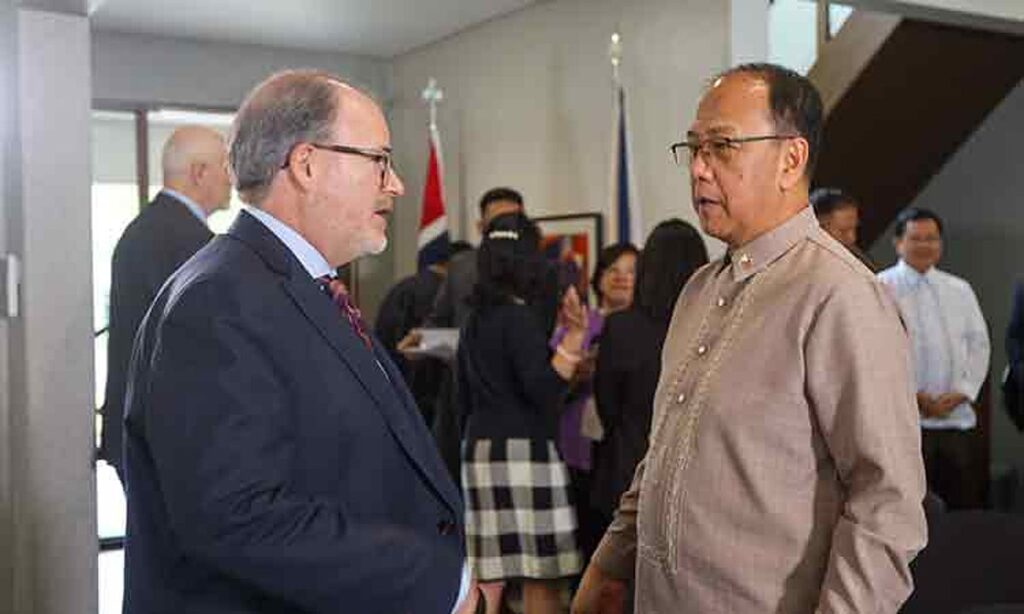
MAKATI CITY — The Royal Norwegian Embassy in Manila, in partnership with the Office of the Presidential Adviser on Peace, Reconciliation and Unity (OPAPRU) Women, Peace and Security Center of Excellence, convened the “Forum on Women, Peace and Security: A Women’s Month Conversation Over Waffles” on March 25 at the Norwegian Ambassador’s Residence in Makati.
Held as part of the celebration of National Women’s Month, the forum gathered representatives from government agencies, the diplomatic community, civil society organizations, youth groups, academe, the security sector, and international partners.
The dialogue gave participants a venue to reflect on the journey of the Women, Peace and Security (WPS) Agenda in the Philippines and identify concrete steps to further strengthen its implementation at the community level.
Bridging global commitments to local realities
In his welcome message, His Excellency Christian Halaas Lyster, Royal Norwegian Ambassador to the Philippines, underscored that the WPS Agenda remains a cornerstone of the Philippine–Norwegian partnership, reflecting the two nations’ shared commitment to inclusive peacebuilding, conflict prevention, and post‑conflict recovery.
“Women, Peace and Security is a priority for Norway’s foreign policy,” Lyster said.
He reiterated Norway’s long‑standing support for peace and reconciliation efforts in the Philippines and its continued collaboration with the OPAPRU in advancing WPS initiatives, in line with their own National Action Plan on Women, Peace and Security.
For his part, Presidential Adviser on Peace, Reconciliation and Unity Secretary Carlito G. Galvez Jr. underscored in his message that the forum reflected the strength of the Philippine–Norwegian partnership and the growing maturity of the WPS agenda in the country.
“This mini Women, Peace and Security seminar is a reflection of our shared commitment to advancing WPS efforts and realizing our shared vision of achieving genuine and long‑lasting peace,” Galvez said.
He emphasized that the Philippine government, through the OPAPRU, is working closely with its peace partners to ensure that WPS becomes more than a policy framework.
“The Women, Peace and Security agenda is not only an aspiration—it is now a living framework that bridges national policy with realities on the ground and global commitments with the actual needs of the communities we serve,” Galvez stated.
Women as architects of people-centered peacebuilding
Executive Director Susana Guadalupe H. Marcaida of OPAPRU’s Women, Peace and Security Center of Excellence contextualized the Philippine WPS agenda within its people‑centered roots, noting that women have long played a central role in shaping peace efforts long before formal frameworks were established.
“The story of Women, Peace and Security in the Philippines did not begin with institutions or policies, but with women whose courage and quiet leadership sustained peace long before national frameworks existed,” Marcaida said.
She stressed that this solid foundation laid by the country’s women continues to guide the country’s peacebuilding approaches to this day.
“The Philippine WPS journey reminds us that peace lasts when it is built with people, grounded in lived realities, and sustained through collective action across generations,” she added.
The PH WPS Agenda experience across all sectors of society
Insights from the keynote and thematic discussions were further deepened through a multi‑sectoral panel composed of Ms. Therese Zabala of the Miriam College–Women and Gender Institute, Bangsamoro Parliament Member Froilyn Mendoza, and Capt. Norsal D. Dimaporo, PN (MNSA), Chief of the Armed Forces of the Philippines Peace and Development Office.
Drawing from their respective roles in the fields of education, governance in the Bangsamoro, and the security sector, the panel highlighted how WPS principles are applied across institutions and communities and how collaboration strengthens inclusive, people‑centered peacebuilding.
Throughout the forum, participants emphasized the importance of deepening localization, strengthening coordination among institutions, and sustaining partnerships across national and local governments, civil society, youth, Indigenous Peoples, the security sector, and international partners.
The forum concluded with a shared commitment to carry forward the Philippine WPS journey—one that recognizes women not just as beneficiaries of peace, but as leaders and architects of inclusive, resilient, and lasting peace. PR