
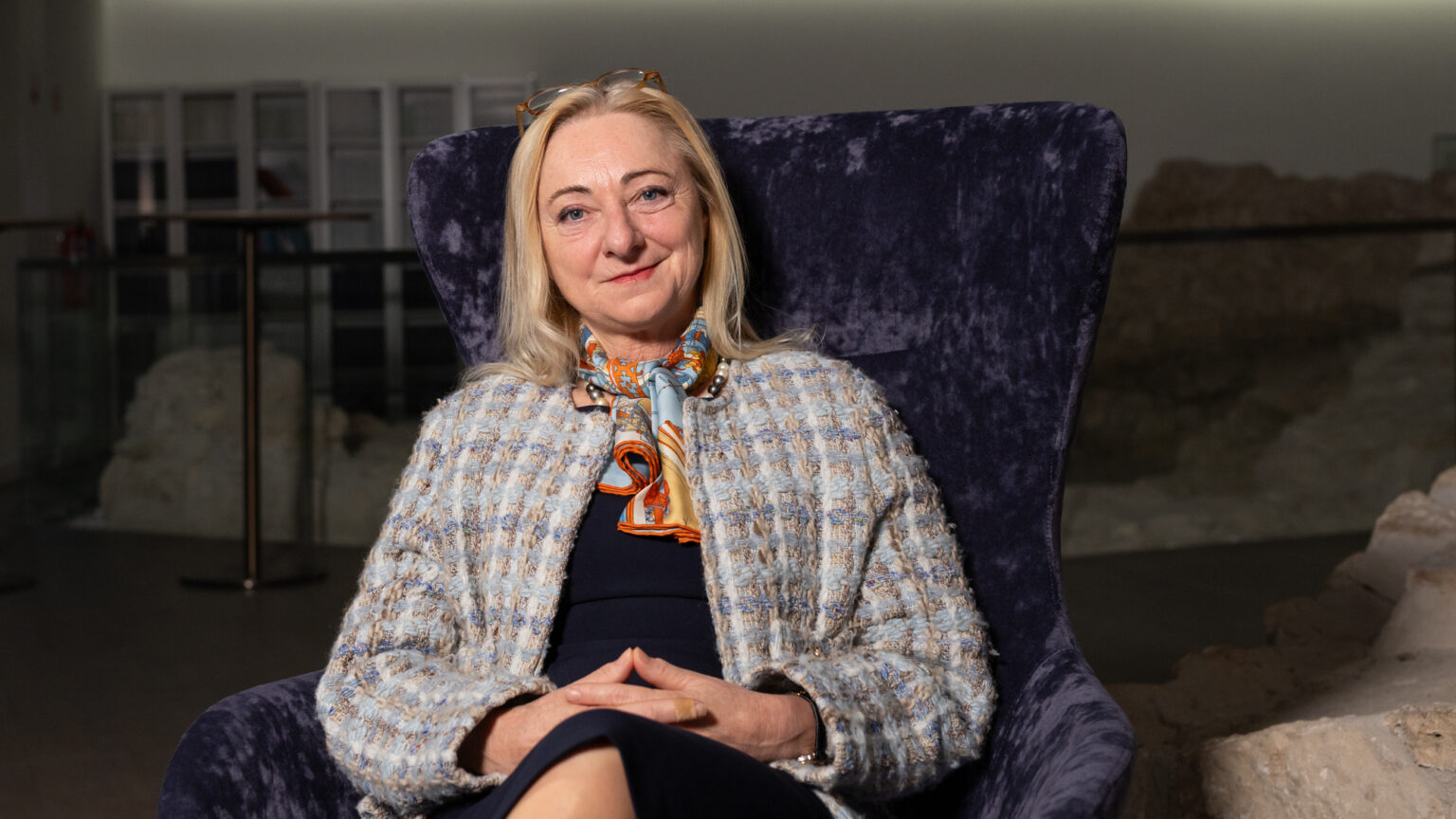
Barbara Kolm is Director of the Austrian Economics Center, President of the Hayek Institute in Vienna, and a member of the Austrian National Council representing the Freedom Party of Austria. She first served on the Innsbruck City Council and has been a member of the supervisory boards of several companies, including Vienna Insurance Group (VIG). She also served as Vice President of the Austrian Central Bank. Dr Kolm is a long-time director of the Austrian Economics Center and a professor of Austrian Economics and Finance at the University of Donja Gorica in Montenegro. She directs the world’s first national hub of the UN ITU ‘United for Smart Sustainable Cities’ initiative in Austria and is the founder and organizer of the Free Market Road Show, a forum for discussion and the exchange of ideas.
***
What are the main structural problems of the EU in 2026?
The main problem of the EU in these times is that we have overregulated ourselves to a standstill. Europe is not competitive anymore. All the rest of the world has advanced. They have deregulated, they have kicked out their bureaucracy, cut taxes, and they are now more competitive. Europe is doing the total opposite. We’re having more and more bureaucracy, regulation, and red tape out of Brussels. Just in the last five years, there have been more than 13,000 legislative acts that came out of Brussels that each and every member state has to adopt. There are countries that do not do that. But, for example, Germany and Austria are the ones who even gold-plate them.
What are the main challenges or threats from outside?
They are definitely external shocks and huge threats. The first one was the migration crisis. We cannot handle that anymore. Our national budgets are way too indebted. Look at France. Look at Spain, Austria and Germany. And we have brought people into our social security system who are not productive, and we need to pay them. Hungary, for example, did a great job by not doing that, not falling into this trap, and not taking in migrants who are not willing to work and integrate. This is a big advantage for Hungary, and you have to thank your Prime Minister for doing that, whereas we in Austria did not. So, our debt levels are rising. The second issue is energy security. Germany has phased out its nuclear power plants, even though its industry has long relied—and still relies—on cheap energy. And because of the war in Ukraine, there is no cheap energy anymore for us in Western Europe. The third, actually, we thought we would build our productivity on this cheap energy, but this doesn’t work. So, we now have a lack of productivity all over Europe due to the high energy prices and the lack of working hours that we have in Western Europe.
‘We thought we would build our productivity on this cheap energy, but this doesn’t work’
Competitiveness: it has been a huge issue in the EU for many years now, and remains unresolved. How can the EU change to be more competitive in global markets?
What we need is the European four freedoms. You know, this was the basis of a very successful European Union until the early 2000s when we were able to move freely to work anywhere in Europe, we had the freedom of movement, of labour, of money, of transfers all over, and then we were reducing that with more and more regulation, causing more and more difficulties for our enterprises, because we tried to do the ‘one size fits all’. But the secret of Europe was always that we are not ‘one size fits all’, we are many different people who speak different languages, who have different backgrounds, who have different work ethics, interests, and talents. We were also competing among each other for the best brains, for the best enterprises, for the best ideas. This is what made Europe rich and successful over the past centuries. And now with this central planning out of Brussels, that doesn’t work. We started doing that from the mid-2000s onwards, and it culminated, probably, with the Covid lockdowns across Europe. And if you destroy the supply chains, all of a sudden, the laws of supply and demand will not work. What do you get? You get inflation. One reason for that was monetary policy with the asset purchasing programmes and the European Stability Mechanism, which did not work out. And then there were energy price shocks, where we could not get cheap energy anymore because of the war between Russia and Ukraine. There are many external things that have culminated in Europe being in dire straits. On top of that, we have a Commission that we did not elect, and they are trying to enforce laws and regulations on us that are not good for our individual and entrepreneurial freedom.
 Barbara Kolm PHOTO: Tamás Gyurkovits/Hungarian Conservative
Is it a wise decision for the EU to get rid of Russian energy by 2028? How does it affect Austria, Hungary and Slovakia?
Well, it is definitely not a very good decision. First, we need to look at what happened in 2017–2018 when Ursula von der Leyen pushed the Green Deal through. All of a sudden, we needed to transition from normal, cheap sources of energy to sustainable green energy. But the prices all of a sudden were rising. Enterprises were unable to adapt that fast. Yes, you need to look into alternative forms of energy, but you can’t do that from one day to the next, and you cannot do it with subsidies, because if you use those subsidies, you force enterprises into a certain direction. And once you cut those subsidies, because money is running out, you have failed enterprises, and that is what we see these days. It didn’t work that fast as politicians had in mind, obviously. Those transitions take much longer, and so it was a very bad move.
‘We have a Commission that we did not elect, and they are trying to enforce laws and regulations on us that are not good for our…freedom’
And now there is the Iranian war, the Strait of Hormuz situation.
Exactly, and now we have the same effect, but to a much greater extent. And this makes visible how vulnerable Europe is.
How vulnerable is your country, Austria, then, and Hungary and Slovakia?
We are countries that are within the heart of the continent. We don’t have access to the seas, so it is difficult for us to have cheaper forms of gas or oil. Of course, we could have invested more, for example, in hydro. That is a big discussion now in Austria. But the Green parties have prevented certain hydroelectric power plant projects for a very long time. The other problem is that when we have solar and wind, there are no buffers. As long as we don’t have energy buffers for the batteries where you can store this cheap energy that is produced by wind and solar, it doesn’t go anywhere. And we have the CO2 taxes. By the way, Austrian CO2 taxes are the highest in Europe. I think, especially at this time, we should cut or suspend them.
 Barbara Kolm PHOTO: Tamás Gyurkovits/Hungarian Conservative
The other aspect of competitiveness is a qualified workforce. Western European states hope for migration, while Eastern European countries, like Hungary, invest in family policies, believing that it’s a better solution to the demographic and the workforce market crises.
Hungary is obviously a successful example of what can be done if you incentivize families to have more children, and then to educate them and to make sure that you have the labour force that your own country needs. Because we have seen so many Syrian doctors, pharmacists, nuclear scientists, or whatever who were supposed to come to Europe did not come. And the newcomers did not integrate; they did not start working. Obviously, the Hungarian example is a very good one, and it works successfully, because your birth rates are higher than ours in Austria or in Germany. The second thing is that those immigrants who want to work, who are skilled workers, should be integrated immediately. The problem is that many of them just don’t want to be integrated. They don’t speak our languages, and they don’t care about having a proper workplace. So, we need to cut the subsidies for them. I’m sorry, if you don’t work, you have been a guest in our countries, and since peace has come to certain countries, why don’t you go back and try again? Money doesn’t come out of thin air. You need to work hard to get it, and that’s something where our social welfare systems have to be rethought and remodelled.
Competitiveness is a difficult area in times of war. The European Commission needs to relocate money from important projects to the financing of the Ukrainian war. What are the immediate and long-term financial consequences of the Ukrainian war for the European economy?
How does Brussels know exactly what economies are the ones that will flourish in the future? It’s an entrepreneur, it’s a businessman who knows what is needed on the market, and why they can produce that, and why they can innovate. It’s not the government, it’s not Brussels that knows exactly what the market needs. If an entrepreneur has the right idea and creates the right innovative process, there will be money on the market to invest in that. So again, we have to understand that it’s not the superstate out of Brussels that allocates resources that makes things happen; incentives are created in the market.
‘It’s not Brussels that knows exactly what the market needs’
What would be the cost of Ukraine’s accession to the EU for the other member states?
All of those countries that are receiving countries from the EU budget will be net contributors, and the only country receiving will be Ukraine. And I think this will be a huge imbalance. So, you have 27 states that will give to Brussels and one receiving country. To give you an example with agriculture, if Ukraine all of a sudden becomes a member of the EU, imagine all the agricultural products and industry that comes into our countries. What will happen to our own farmers? I mean, Ukraine has those huge farms and those huge production sites, so it will be difficult for our farmers to be competitive. I know they will learn, but again, it will take time to adapt, so it will be a tough transition.
 Barbara Kolm PHOTO: Tamás Gyurkovits/Hungarian Conservative
You are a member of the fraction of the Freedom Party of Austria (FPÖ) in the Austrian Parliament. What are the economic priorities of the party?
Well, it is very simple, and this is what Herbert Kickl, our party leader, keeps saying: we have a huge bureaucracy. We have overspent. The Ministry of Finance has generated tons of revenue from our taxpayers until now, but the economy is collapsing. Our enterprises are not doing that well anymore. They don’t make that turn out as they did. We have an issue. And the most important thing is that our workers receive too little money because too much is going into the bureaucracy. We need to make sure that the outcome for the individual and for his own family is higher than the amount he has to pay in forms of direct and indirect taxes. The second is cutting bureaucracy, cutting taxes, and getting rid of all those subsidies that are in vain and evaporate into thin air. Thirdly, we should also have a strong stand in Brussels and do what is good for Austria and not in general what Brussels claims is good for us. We know better what is good for us. We should bring back the subsidiarity principle, because problems that can be solved on the local or regional level should definitely be solved there. It’s none of the business of Brussels to know what is better for us.
‘We should have a strong stand in Brussels and do what is good for Austria’
The FPÖ and Fidesz, the Hungarian governing party, belong to the same political family. Can Patriots change Europe?
Of course, they can. We’re getting stronger and stronger. Each and every country’s election shows that, and I think the Patriots will be the driving force in Europe for change and for bringing back Europe’s good old ideas.
Watch the full podcast below:
Related articles: