
The latest flashpoint came today, when Montenegro’s parliament rejected a proposal to introduce the historical tricolor as a national flag, an initiative put forward by the pro-Serbian and pro-Russian Democratic People’s Party (DNP), led by Milan Knežević.
Pro-Serbian political actors inside Montenegro’s governing structures are increasingly driving identity-based conflicts, deepening internal divisions and threatening to derail the country’s progress toward European Union membership.
The latest flashpoint came today, when Montenegro’s parliament rejected a proposal to introduce the historical tricolor as a national flag, an initiative put forward by the pro-Serbian and pro-Russian Democratic People’s Party (DNP), led by Milan Knežević.
The proposal failed to secure a majority, with 21 lawmakers voting in favor, 23 against and 13 abstaining. It was backed by deputies from the DNP, New Serbian Democracy and the Socialist People’s Party, while part of the ruling Europe Now movement — the centrist party of Prime Minister Milojko Spajić — abstained, exposing cracks within the governing coalition.
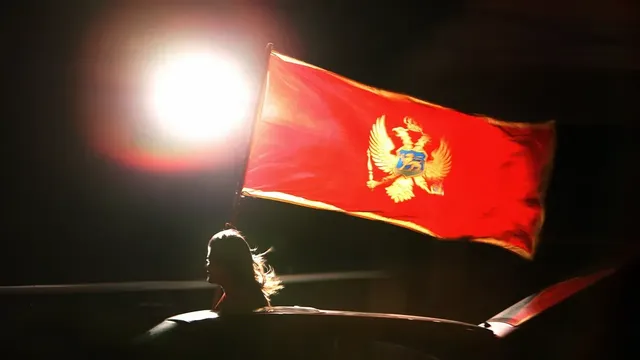
The disputed symbol is Montenegro’s historical red-blue-white tricolor, consisting of three horizontal stripes in Pan-Slavic colors. The current state flag, adopted in 2004, is red with a gold border and the national coat of arms, reflecting a shift toward a distinct Montenegrin state identity.
Knežević framed the tricolor as a symbol of “historical, national and spiritual continuity,” displaying the flag of the Kingdom of Montenegro in parliament and arguing it represented the country’s past struggles and sovereignty. He also linked the issue to broader political tensions, including his party’s decision to leave the government.
At the same time, he used the debate to attack the government’s pro-European agenda, contrasting the granting of citizenship to Ethereum co-founder Vitalik Buterin with the treatment of tens of thousands of people of Montenegrin origin living in Serbia, who, he said, are required to register upon entering the country.
“We’re doomed if this is Montenegro’s European agenda and the 1905 flag is being labeled backward, rustic and divisive,” Knežević said, adding that if he had to choose between Buterin and the 1905 flag, he would choose the flag.
The Europe Now movement, the ruling centrist formation led by Prime Minister Milojko Spajić, responded that identity issues must not derail reforms tied to EU accession. The party stressed that such topics require broad public consensus and warned against their use for short-term political goals.
A strategy shaped from Belgrade
The flag dispute fits into a broader pattern. Montenegrin journalist and analyst Jovo Martinović describes the escalation of identity tensions as part of a sustained political offensive linked to Belgrade, rooted in the doctrine of the so-called “Serbian World” — a concept aimed at maintaining political, cultural and strategic influence over Serb communities across the region.
According to Martinović, the strategic objective is clear: to prevent Montenegro from joining the European Union, which would effectively turn the border with Serbia into an external EU frontier.
He outlines a network of influence that includes pro-Serbian political parties in Montenegro, segments of the Serbian Orthodox Church, media aligned with Belgrade and structures connected to Serbia’s intelligence agency, the BIA. Russia, in his assessment, provides additional support through political and informational channels.
Pressure following EU progress
Martinović links the intensification of tensions directly to Montenegro’s progress in EU accession talks. After Podgorica received final benchmarks from the European Commission in mid-2024, pressure increased through political initiatives designed to provoke disputes and slow negotiations.
One such episode was the push for a resolution on the Jasenovac concentration camp, which triggered a diplomatic dispute with Croatia and resulted in the blocking of a key negotiation chapter related to foreign policy and regional relations.
Since then, identity-related issues have returned to the forefront, including disputes over language status and national symbols, with the flag debate emerging as the latest example.
At the local level, municipalities controlled by pro-Serbian parties have taken symbolic steps reinforcing ties with Serbia, including marking Serbian state holidays and promoting Serbian national symbols in public institutions.
Political fractures inside the government
These developments have exposed growing tensions within Montenegro’s ruling coalition. While the Europe Now movement has sought to maintain focus on EU reforms through its “Barometer 26” platform — aimed at completing accession talks by 2026 — its partners have repeatedly reintroduced identity issues into the political agenda.
Despite formally backing EU integration, parties such as the DNP continue to promote pro-Serbian and pro-Russian positions.
Knežević has openly emphasized his alignment with Serbian President Aleksandar Vučić, stating he would “rather be a friend of Vučić than a poodle” of Croatian Prime Minister Andrej Plenković. He has also rejected what he calls “Serbophobia and Russophobia” and defended political cooperation with Russia, including ties with Vladimir Putin’s United Russia party.
A cycle of instability
Martinović describes the situation as a self-reinforcing cycle in which identity disputes generate political crises, slowing reforms and creating space for stronger external influence.
In his analysis, internal divisions are not accidental, but deliberately used to shape the country’s strategic direction.
Even within pro-Serbian circles, there are signs of unease. Some figures linked to the Serbian Orthodox Church and political leadership in Montenegro have distanced themselves from Belgrade’s approach, particularly its opposition to EU integration.
Still, the overall trajectory remains fragile.
As Montenegro enters a decisive phase in its EU accession process, the persistence of identity-driven conflicts — combined with external political pressure — risks undermining both political stability and the country’s European future. | BGNES