
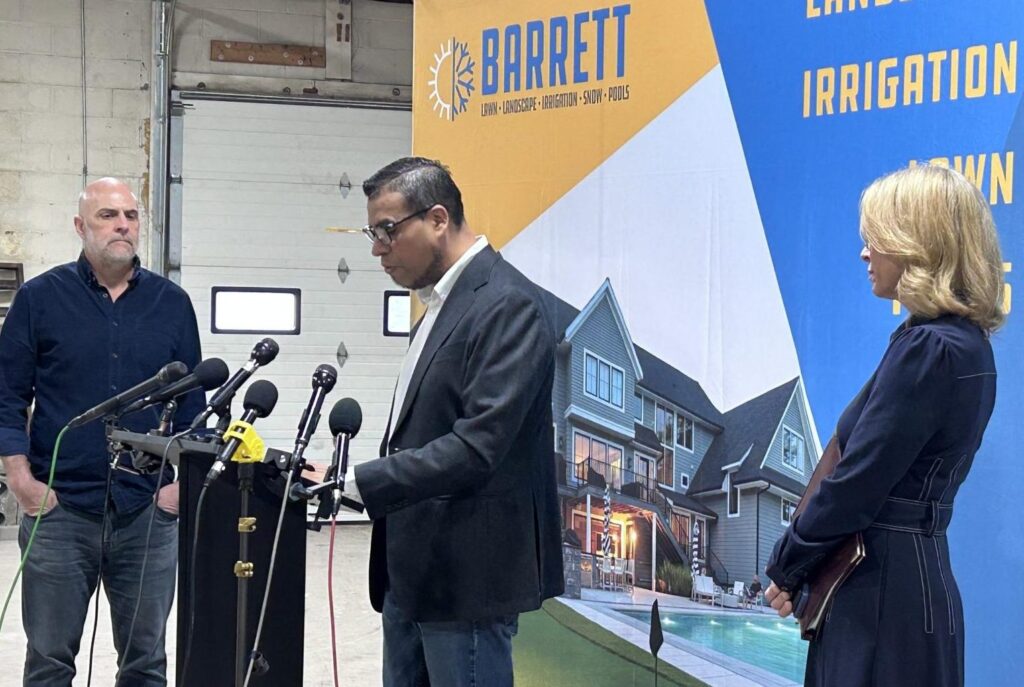
Small business owners gathered at a press conference last week hosted by U.S. Rep. Kelly Morrison, DFL-3rd District, to discuss the negative financial impacts of the war in Iran.
The April 2 event, at Barrett Lawn Care in Hopkins, was held on the one-year anniversary of Liberation Day, when the Trump administration announced sweeping tariffs. It highlighted the financial hardship small business owners face, including lost revenue and higher prices tied to tariffs. Speakers also noted the compounding effects of Operation Metro Surge and the conflict in Iran on small businesses.
Steve Mura, owner of Barrett Lawn Care, said rising costs from the war have hit his business hard. He said the recent 25% increase in fuel costs was a hit to the business, and he is also bracing for an anticipated rise in fertilizer prices.
The financial impacts are difficult to track because of how quickly they fluctuate, but Mura guessed Barrett Lawn Care lost $25,000 to $50,000 in profits just from the war.
Daniel Hernandez, who owns Colonial Market and Fusion Pancake House in Hopkins, said his businesses’ revenue dropped 60%, as many of the products his store carries are fruits and vegetables from South America. His suppliers increased prices by up to 25% to offset higher fuel and transportation costs.
“We’re in a globalized world where everything has come from different parts of the world, and now that is making me go bankrupt, basically, because it’s so much money that now we have to pay for transportation,” Hernandez said. “It’s very hard for the consumer.”
He noted that several months ago, shipping prices were about $7,000, but had already risen to $8,500 because of the war. In turn, the need to increase prices in his stores negatively impacts his customers and employees.
Hernandez covers half of his employees’ medical insurance, but as healthcare costs continue to rise, many of his employees cannot afford to pay the other half.
Mura, who also provides health insurance for his employees, said it is difficult to communicate that insurance prices are going up or that coverage is worsening.
“When I stand in front of my employees every year and I say, ‘Your insurance is going up in price and your coverage is getting worse,’ those are horrible messages. Those are messages that should be the opposite,” Mura said. “And quite honestly, if we do provide all those resources, the margin gets so low that you can’t operate.”
Mura added that many of Barrett Lawn Care’s services involve contracts with customers. Those contracts do not take into account the potential for rising costs, so when prices increase, the business absorbs the difference.
“That means less money to invest in people, equipment, all the things that make this country go when we buy stuff from each other,” Mura said.
Hernandez noted that the cost of pallets of product for his grocery store continues to rise, climbing from $1,000 to $1,200 to $1,400 over the span of a few weeks. Twenty percent of his products have increased in price since the beginning of the war, and all his products’ prices have risen because of tariffs.
Usually when business costs increase, Mura said, business owners take home less income as they prioritize paying employees and reinvesting in the business. The reduced take-home pay affects not only the business owner, but also the owner’s family.
“I’d say across the board what happens is you take the hit the first year, you hope things calm down. You can adjust your pricing and maybe raise things next year,” Mura said. “But in year one, it’s just right out of your livelihood.”
Hernandez added that he has not paid himself since November as he worked to support his employees through Operation Metro Surge and now deals with increased costs due to the war.
“I sacrifice myself, my family, my kids, my livelihood, my wife, my everything for terror, which shouldn’t be done,” Hernandez said.
He added that over 90 days during Operation Metro Surge, his business lost $2.4 million, which is harder for a small business to absorb than it would be for a larger corporation.
Mura noted that many large corporations have more representation than small businesses because they can afford lobbyists and have greater access to government. Because of that, he said, larger corporations are able to wield more influence over policy.
“The reality as small business owners, who we count on representing us is the government,” Mura said. “Looking down and saying, ‘What do we need to stimulate these folks? What do we need to give them the opportunity to hire more people, invest in more equipment?’”
Mura added that he feels there is a disconnect between the government and small businesses’ needs right now. He said the U.S. Small Business Administration was helpful in the past, but now it is a different story as the agency prioritizes fighting fraud.
“When I ask about, ‘How can we lower interest rates? Are there incentives coming? Are there other things that are going to stimulate this?’ always the answer of the past has been, ‘Yes, we’re aware of what’s going on. We’re working on it.’ And right now, when I reach out, I don’t get that same sense that that’s a priority,” Mura said. “It feels like the priority now is that we have to protect against fraud. We have to protect against risk. I believe in all those things, but two things can be true.”
At the end of the press conference, Morrison, whose district includes Eden Prairie, said it is a difficult time to be a small business owner, as the current economic climate is difficult for business owners to predict and navigate.
“They don’t have the capacity to hire fancy lobbyists or to invest a million dollars in the president’s ballroom to get a hearing with him or to get relief from his tariffs. (Trump) gave exemptions of tariffs to large corporations,” Morrison said. “I don’t remember hearing about them giving exemptions to small businesses.”
The U.S. Supreme Court ruled in February that some tariffs imposed by President Donald Trump were illegal. Morrison noted that the administration must refund the collected duties, but that as of now, there is no repayment plan.