
Australia’s cement market may be experiencing some interesting times but it is rapidly transitioning towards low-carbon solutions, with Port Augusta poised to become a national hub for green cement and increasing calls for a cross-border carbon adjustment mechanism to be introduced.
Like most economies in the world, the closure of the Straits of Hormuz and warfare between Israel, USA and Iran has resulted in rising fuel prices. This is being keenly felt by housebuilders and residential developers in Australia who face higher costs for building materials and transport. Local news reports estimate that building materials and freight costs have risen by 30 per cent since the conflict began.
“It’s a massive impact for us,” said Rab Pelligra from New South Wales Cement. Imported cement prices have increased by 15 per cent, while the local cost of grinding clinker into cement has risen by 10 per cent with higher energy costs.
“Then you’ve got your trucking prices roughly running at about 12-15 per cent on that as well,” he added. “Fuel has added a significant amount of money onto the tonnage rate that obviously gets passed down to the end user. Companies like mine, smaller independents, are probably worse for wear. We’re sort of forced to wear it.”
The multinationals of Holcim and Heidelberg Materials have wasted no time in passing on some of the higher costs by announcing immediate price hikes. Holcim stated, “significant economic volatility and supply chain disruptions” have made it impossible to continue absorbing operational costs. The Swiss-international has added a surcharge of AUD8.67 per Mm3 (US$6.10/Mm3) to its ready-mix prices. Heidelberg Materials has similarly added an AUD8.10 fuel surcharge.
A green cement future
These price pressures have arrived just as the cement industry has been transitioning to low-carbon cement replacement products such as Eco-Clay. Green360 Technologies, for example, plans to bring 30,000t of its low-carbon cement to the market in the 1H26.
The high reactivity metakaolin product is a particle replacement for ordinary Portland cement (OPC). Green360 recently signed an agreement with Calix for a two-year term for manufacturing Eco-Clay with an option to extend for a further two years. Green360 is using the vertical flash calciner at Calix’s Bacchus Marsh plant in Victoria. Subject to demand, Green360 will construct and operate a calciner at its Pittong facility to support the future scale-up of this product in the Melbourne region of the country.
Advertisement
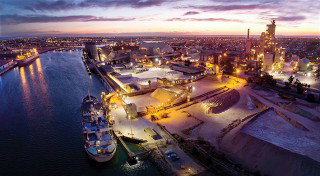
A critical step in the country’s low-carbon future is the new green cement terminal at the Port of Augusta. The state Government plans a AUD12m loan injection to assist Hallet Group’s Green Transformation project, alongside a US$29m grant from the Federal Labor Government. The aim is to create a national hub for green cement production anchored in the Upper Spencer Gulf and reduce emissions by 0.3Mta. The AUD200m project is being delivered at the site of the former Northern Power Station, transforming industrial waste into low-carbon cement alternatives.
The power station’s ash dam and the Nyrstar Port Pirie smelter will be repurposed as supplementary cementitious materials (SCMs), including fly ash and slag. Two infrastructure hubs are planned as part of the project, one in Port Augusta and the other in Port Adelaide, creating a growing supply chain to support South Australia’s construction and infrastructure needs.
Protecting local industry
Safeguarding such initiatives is becoming a matter of urgency for the domestic cement sector in Australia, because the prospect of cement and clinker dumping would be catastrophic for the domestic cement industry. The current safeguard mechanism (SGM) provides Australian manufacturers with incentives to reduce emissions in production, covers 220 of the country’s largest industrial facilities, accounting for approximately 30 per cent of Australia’s emissions.
However, a report by S&P Global identifies clinker as the most vulnerable risk to carbon leakage, with imports set to increase by 14 per cent by 2030, followed by increases in imports of lime and cement. A carbon leakage review is part of a broader programme to reform the Australian Government’s SGM, which was adopted in March 2023. To combat imports, Australia may follow the European Cross-Boarder Carbon Adjustment Mechanism (CBAM) that is expected to generate an additional EU500m in revenues by 2030, according to GMK Center.