
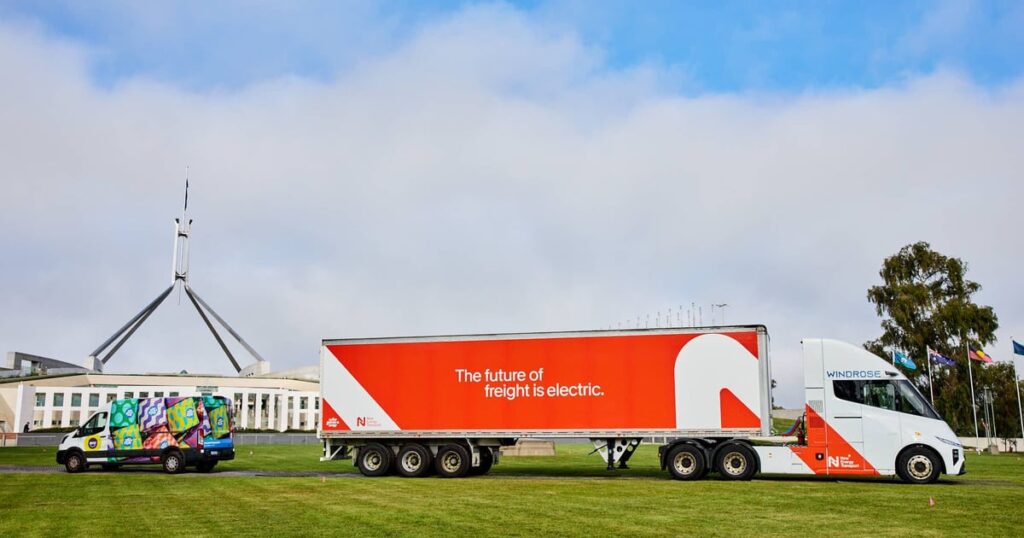
The Australian government has selected New Energy Transport’s Wilton Project as one of four inaugural participants in its new Investor Front Door programme, which aims to develop a large-scale zero-emission heavy road freight depot.
Treasurer Dr Jim Chalmers announced the selection this week (9 April), alongside Ministers for Climate Change and Energy, Infrastructure and Transport, Resources, and Industry and Innovation.
The Wilton depot, to be located south-west of Sydney in New South Wales, aims to establish the foundation of a proposed network of electric freight hubs that would enable zero-emission heavy road transport between several major cities, reducing reliance on diesel freight and imported fuels across Australia’s eastern seaboard.
Australian freight and logistics company New Energy Transport is developing a vertically integrated trucking platform combining low-cost renewable energy, high-speed charging infrastructure and electric trucks to deliver zero-emission heavy road freight.
The Wilton site will be designed to support up to 50 heavy electric trucks and anchor electrified freight corridors between Sydney, Wollongong, Newcastle and Canberra, with operations expected to commence in late 2026.
By 2031, the company plans to expand services to routes connecting Adelaide, Melbourne, Sydney, Canberra and Brisbane.
“Being selected for the Investor Front Door program is a significant recognition of what we’re building at New Energy Transport. This announcement confirms that electrifying Australia’s road freight infrastructure is a national economic and security priority,” said New Energy Transport Co-CEO Daniel Bleakley.
“Electric trucks offer a pathway to decouple Australia’s freight system from volatile global energy markets, dramatically improving supply chain resilience and national energy security.”
Proven commercial viability drives government backing
The selection follows New Energy Transport’s demonstration of commercial viability through operational milestones that have validated the economic case for electric heavy freight.
As reported by EV Infrastructure News in March, the company completed Australia’s first fully electric intercity freight delivery, a 480km round trip between Sydney and the Hunter region that proved zero-emission heavy transport could operate at a commercial scale on Australian routes.
“Our commercial deliveries have proven that electric road freight is not only technologically possible in Australia – it’s commercially viable and delivers real economic and productivity gains for our customers,” said New Energy Transport Co-CEO Fredrik Pehrsson.
“The Windrose all-electric prime mover used in the Sydney to Canberra run achieved an 84% reduction in energy costs compared to diesel, and also completed the journey 25 minutes faster than a diesel truck on the same route.”
The government’s support comes as diesel and fuel supply pressures continue to threaten critical supply chains and increase costs across the economy.
Supply chain disruptions stemming from conflict in the Middle East have highlighted the importance of building sovereign capability in essential infrastructure, with Australian EV sales hitting record highs as fuel uncertainty drives market shifts across both passenger and commercial vehicle segments.
Coordinated support to accelerate deployment
Under the Investor Front Door pilot, which will run until mid-2027, the government will provide New Energy Transport with a dedicated engagement manager to navigate regulatory requirements, obtain regulatory decisions and identify appropriate government financing options.
The programme aims to simplify the development of major transformational projects that the government has identified as pioneering by nature.
The Wilton depot responds to Australia’s freight infrastructure challenges at a time when shared charging infrastructure has emerged as critical to scaling commercial EV adoption.
Indeed, this supporting electric trucking charging infrastructure has become a major priority across Australia, as with much of the world. Earlier this year, the Australian Renewable Energy Agency (ARENA) recently provided an AU$25.3 million (US$17.9 million) commitment to NewVolt’s shared electric truck charging network.
The Wilton Project was selected alongside three other significant initiatives: HAMR Energy’s green fuel facilities in Victoria and South Australia, Ardea Resources’ Kalgoorlie Nickel Project, and the Murchison Green Hydrogen project.
Together, these four projects represent up to AU$20 billion in potential investment across fuel security, critical minerals and clean energy infrastructure.