
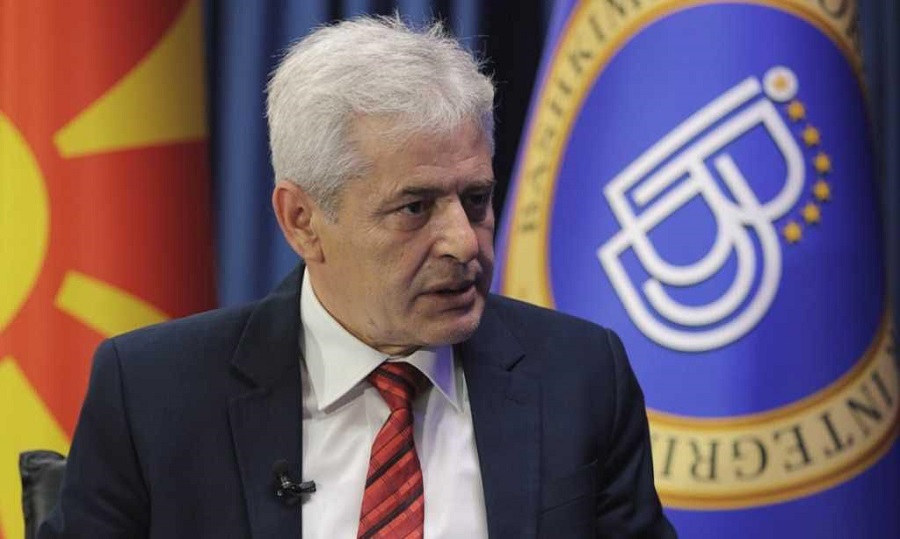
Ali Ahmeti sends an open letter to international partners on political developments in North Macedonia
The Democratic Union for Integration (DUI) announced that its leader, Ali Ahmeti, has sent an open letter to international partners and friends regarding the latest political developments in the Republic of North Macedonia.
According to the statement, the letter — dated April 3, 2026 — was addressed not only to the domestic and international public, but also to ambassadors of European Union member states accredited in the country, as well as to global leaders and prominent international figures.
In the introduction, Ahmeti highlights DUI’s continued commitment to the full implementation of the Ohrid Agreement, the building of a democratic and multiethnic state, and the advancement of the country’s Euro-Atlantic integration.
He expresses concern over recent political developments, which, according to him, threaten these achievements. In particular, he points to the removal of the “balancer” mechanism for fair representation of communities, challenges in the functioning of institutions implementing the Law on the Use of Languages, and initiatives to challenge this law in the Constitutional Court.
The letter was addressed to a wide range of international leaders, including U.S. President Donald Trump, European Commission President Ursula von der Leyen, UK Prime Minister Keir Starmer, French President Emmanuel Macron, German Chancellor Friedrich Merz, Italian Prime Minister Giorgia Meloni, as well as former U.S. President George W. Bush.
It was also sent to representatives of international organizations and senior diplomats, including U.S. Secretary of State Marco Rubio, NATO Secretary General Mark Rutte, and other officials from the EU, NATO, the UN, and the OSCE.
The list of recipients also includes former representatives and distinguished international figures such as George Robertson, Federica Mogherini, Javier Solana, Victoria Nuland, and others.
Through this letter, Ahmeti calls for continued engagement and support from international partners to preserve the achievements of the Ohrid Agreement, strengthen political stability, and advance the country’s Euro-Atlantic perspective.