
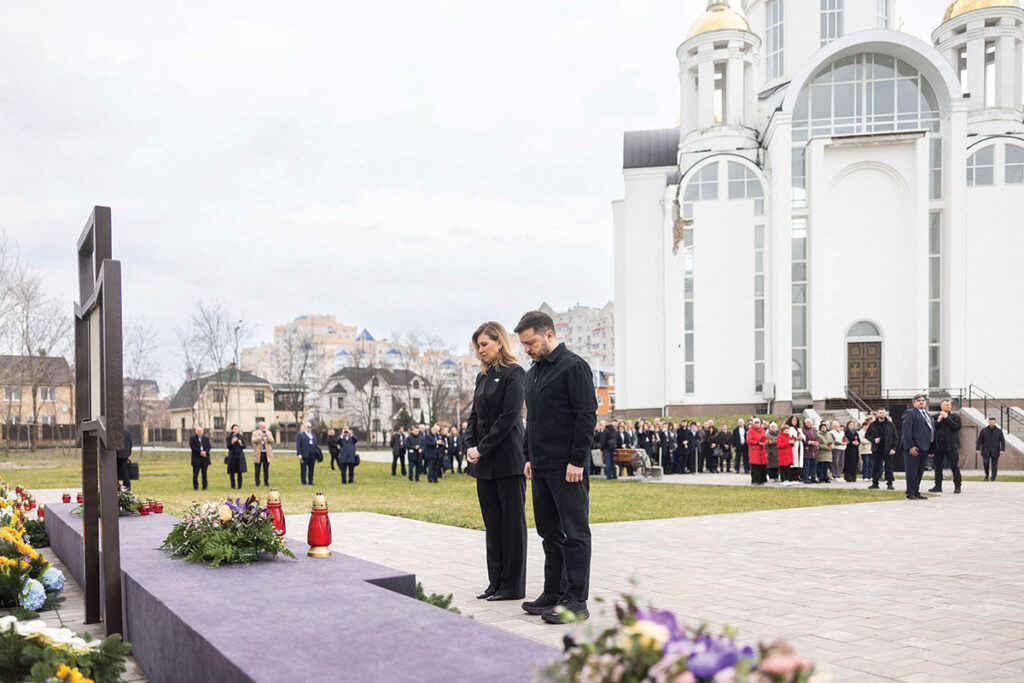
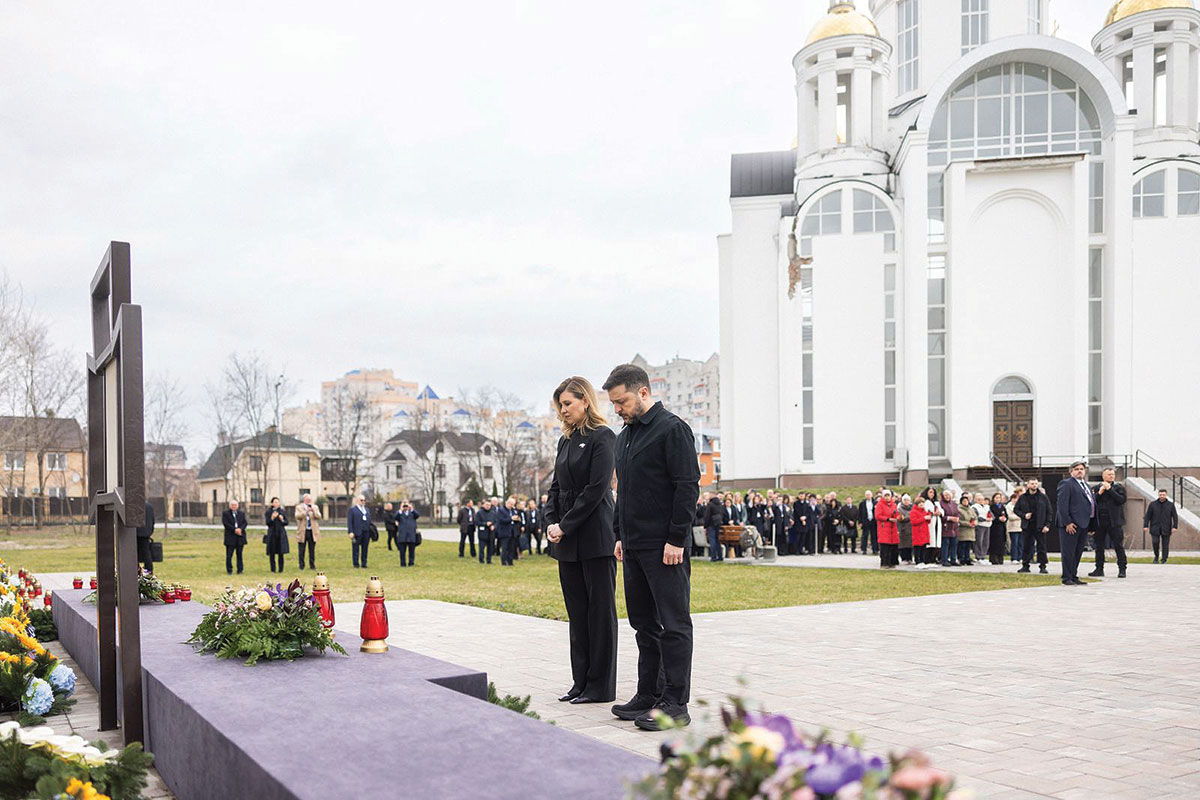
 Office of the President of Ukraine Ukrainian President Volodymyr Zelenskyy and First Lady Olena Zelenska honor the victims of Russia’s occupation of Bucha, Ukraine, at the memorial near the Church of St. Andrew the First-Called and All Saints in Kyiv on March 31.
KYIV – Ukraine marked the fourth anniversary of the liberation of Bucha on March 31 with memorial events and a high-level parliamentary summit that brought together delegations from across Europe. The commemorations honored the victims of Russia’s occupation of the town in early 2022, while the Bucha Summit reinforced international support for Ukraine and renewed calls for accountability for war crimes committed by Russian forces during their occupation of Bucha.
The commemorative events took place in the city, a suburb of Kyiv that became a global symbol of Russian atrocities after its liberation revealed that the Kremlin’s forces were responsible for mass killings, torture and widespread destruction throughout the town. Four years later, the memory of those events remains central to Ukraine’s wartime history, shaping both its remembrance and diplomacy.
President Volodymyr Zelenskyy and First Lady Olena Zelenska led the commemorations, honoring civilians killed during the 33-day Russian occupation that lasted from February 27 to March 31, 2022. According to official data, 561 civilians were killed in Bucha, including 12 children.
The president and first lady placed candles at a memorial on the grounds of the Church of St. Andrew the First-Called and All Saints. They were joined by representatives of numerous European countries and international institutions, as well as residents who gathered to pay tribute to their lost relatives and neighbors.
The ceremony was both solemn and personal. Residents of Bucha participated alongside political leaders, reflecting the continued trauma inflicted by Russian soldiers on the community. The presidential office noted that Mr. Zelenskyy and Ms. Zelenska spoke with residents and expressed condolences over their losses.
At the same time, the commemorations carried a strong international dimension. Parliamentary representatives from countries including Austria, Albania, Belgium, Bulgaria, the United Kingdom, Estonia, Iceland, Latvia, Lithuania, Moldova, Germany, Poland, Portugal, Romania, Slovakia, Finland and Croatia took part. Delegations from the European Parliament, the North Atlantic Treaty Organization’s (NATO) Parliamentary Assembly, and the Organization for Security and Cooperation in Europe’s (OSCE) Parliamentary Assembly were also present.
Their attendance underscored that Bucha has become more than a site of mourning. It has evolved into a symbol of the need for justice and a rallying point for continued support for Ukraine.
This dual role was evident in the Second Parliamentary Summit held in Bucha the same day. Organized by Ukraine’s Verkhovna Rada, the summit brought together representatives from 22 countries and major international institutions. The gathering combined remembrance with political coordination, focusing on European integration, defense cooperation and accountability.
Speaking at the summit, President Zelenskyy emphasized that the memory of Bucha demands concrete action, not only sympathy.
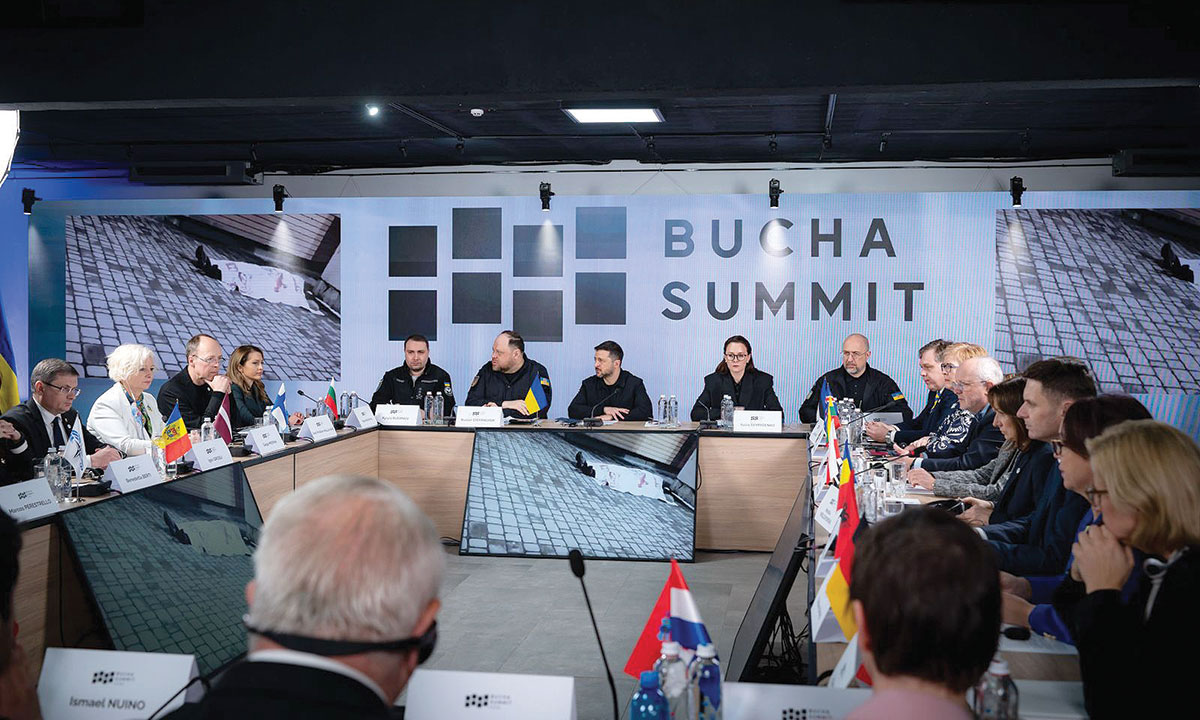 Ukrainian and international parliamentary delegations take part in the Bucha Summit, which covered the topics of justice, security and continued support for Ukraine.
“What is missing are the images of war criminals standing in the dock, each murderer hearing their sentence, all those inhumans receiving inevitable punishment for what they have done. Everything must be done to ensure that these things are not left only in our statements, in our imagination, not only in the tears of our people, not only in emotions, but on paper. Otherwise, the concept of ‘justice’ will be devalued. Only by defending the truth and restoring justice will the world have a chance for a peaceful future,” he said.
Mr. Zelenskyy also linked Bucha to the broader course of the war, noting that the list of Ukrainian cities and towns affected by Russian aggression has grown since 2022.
“From the moment of the first summit until today, this list has unfortunately increased. This means one thing: we need much more determination, much more pressure on Putin and Russia, much more real action and steps that bring the victory of peace and justice closer,” he said.
The president argued that Russia’s ability to continue the war depends on both financial resources and a sense of impunity, calling on partners to intensify sanctions and legal mechanisms used to staunch the Kremlin’s war machine.
“Ukraine is doing this now with its own capabilities, with its own deep strikes, and the world can and must do this through sanctions. Restore the force of law, limit the law of force. Every country in Europe needs legal mechanisms that allow stopping Russia – stopping [oil] tankers, confiscating Russian oil, stopping Russian accomplices and agents in the world – and there are such in Europe – stopping Kremlin operations on the continent,” he said.
Ruslan Stefanchuk, chairman of Ukraine’s parliament, the Verkhovna Rada, framed Bucha as a defining moment requiring legal accountability.
“Bucha is not only a place of memory. It is a place where the world saw a torn wound on the body of humanity. Bucha, Irpin, Moshchun, Hostomel … these names have ceased to be just geographical points. These are new terms of international law that we must fill with justice. They must receive a legal assessment, and the guilty must receive fair punishment,” he said.
European officials – speakers of their country’s parliaments – echoed these calls. Lauri Hussar of Estonia pointed to efforts to establish a tribunal, while Jussi Halla-aho of Finland stressed that Europe must take greater responsibility for its own security and for Ukraine’s.
Other speakers emphasized continued support, accountability and Ukraine’s integration into the European Union. Several highlighted the importance of returning deported Ukrainian children and ensuring compensation for damages caused by Russian aggression.
The summit concluded with a joint statement reaffirming that Russia’s invasion is illegal and unjustified. It called for the establishment of a special tribunal, the creation of a compensation mechanism and the continued freezing of Russian assets until reparations are made. It also emphasized the need to increase military, financial and humanitarian assistance to Ukraine.
President Zelenskyy also met with the heads of parliamentary delegations to discuss E.U. integration, defense cooperation, justice and the pursuit of a dignified peace. He thanked participants for their continued support since the beginning of the full-scale invasion.
“Thank you so much for your visit, for your support – your countries, your governments, your leaders, and, of course, your peoples. First of all, people who have supported us from the very beginning of this war. We are grateful to all parliamentary delegations. You voted for many important things, including resolutions supporting us, and, of course, we felt from the very beginning of this war that we are not alone because of you. Thank you so much,” he said.
Particular attention was given to restoring justice, including efforts to bring home prisoners of war and children abducted by Russia, as well as coordination with international partners.
Four years after Bucha’s liberation, the events of March 31 showed how the town continues to shape Ukraine’s diplomacy and international messaging. The combination of remembrance and political coordination reflects a broader effort to ensure that the crimes committed in Bucha are neither forgotten nor left without consequences.
As Mr. Stefanchuk concluded, “Today, Bucha is the voice of truth. And this voice must be heard in parliaments around the world.”